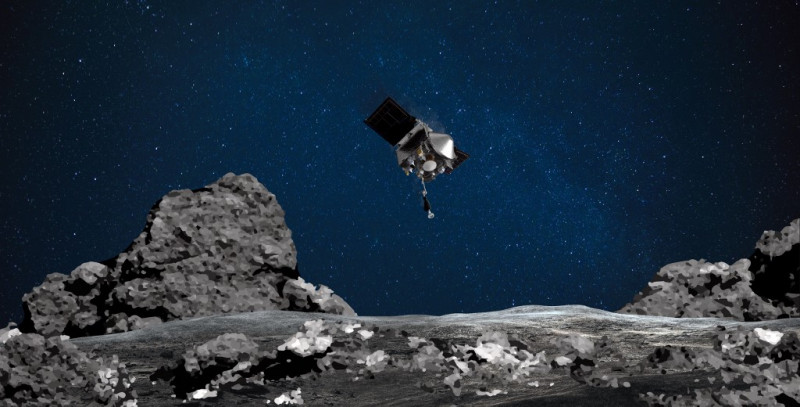
WASHINGTON – After a four-year journey, NASA's robotic spacecraft Osiris-Rex briefly touched down on asteroid Bennu's boulder-strewn surface on Tuesday to collect rock and dust samples in a precision operation 330 million kilometres from Earth.
The so-called "Touch-And-Go" or TAG maneuver was managed by Lockheed Martin Space in Denver, Colorado, where at 6.12pm (2212 GMT) an announcer said: "Touchdown declared. Sampling is in progress," and scientists erupted in celebration.
The historic mission was 12 years in the making and rested on a critical 16-second period where the spacecraft performed a delicate autonomous maneuver to grab its precious payload: at least 60 grams, or a candy-bar sized amount of regolith that scientists hope will help unravel the origins of our solar system.
If Osiris-Rex successfully comes home in September 2023, it will have collected the largest sample returned from space since the Apollo era.
"We think we actually might be coming back with a baby picture of what the solar system was like, of what our chemistry was like, billions of years ago," NASA scientist Michelle Thaller said.
"We're looking for our own origins out there, and that's why we've gone so far to bring a bit of Bennu back."
The spacecraft, about the size of a large van, slowed down to a crawl of just 10 centimetres per second on the final phase of its descent into the Nightingale crater on the north pole of the asteroid, which is 490 metres in diameter.
For size comparison, that is just a bit bigger than the Empire State building.
Osiris-Rex eased its robotic arm down to a target zone just eight metres in diameter, then fired pressurised nitrogen to agitate the surface material and catch its sample.
Then the spacecraft fired its thrusters to back away from Bennu's surface to complete what scientists playfully described as a "boop."
Mission control and the public learned of all this about 18.5 minutes later than it actually happened because of the time it takes for the signals to return from the space rock, which for the most part orbits between Venus and Mars.
The first images will only be available on Wednesday once the probe is further away and has a higher data transmission rate.
We will have to wait until Saturday to find out if Osiris-Rex has succeeded in collecting the desired amount of dust.
Scientists want at least 60 grams but the spacecraft is capable of picking up as much as two kilograms, or five pounds.
If it turns out the spacecraft didn't collect enough, it will have another go on January 12, 2021, at a backup site which is another relatively boulder-free area near the rock's equator.
'Rosetta stone'
Scientists are interested in analysing the composition of the asteroids in the solar system because they are made of the same materials that formed the planets.
It's "almost a Rosetta stone, something that's out there and tells the history of our entire Earth, of the solar system during the last billions of years," said NASA's chief scientist, Thomas Zurbuchen.
Laboratories on Earth will be able to carry out much more high powered analysis of their physical and chemical characteristics, said NASA's planetary science division director Lori Glaze.
Not all samples will be analysed immediately, like those brought back from the Moon by the Apollo astronauts, which NASA is still opening up 50 years later.
NASA chose this particular asteroid because it is conveniently close and also ancient: scientists calculated that it formed in the first 10 million years of our solar system's history, 4.5 billion years ago.
After Osiris-Rex reached the rock at the end of 2018, the project's team was surprised to receive photographs showing that it was covered with pebbles and boulders sometimes 30m high.
Last year, Japan became the first nation to touch an asteroid after its Hayabusa2 probe collected some dust from Ryugu, and is now on its way home. – AFP, October 21, 2020