Business

China’s April exports lowest in two years as virus bites: customs data

Recent lockdowns cause factory shutdowns, transport curbs, congestion at ports

Updated 4 years ago · Published on 09 May 2022 12:42PM

China’s April exports lowest in two years as virus bites: customs data
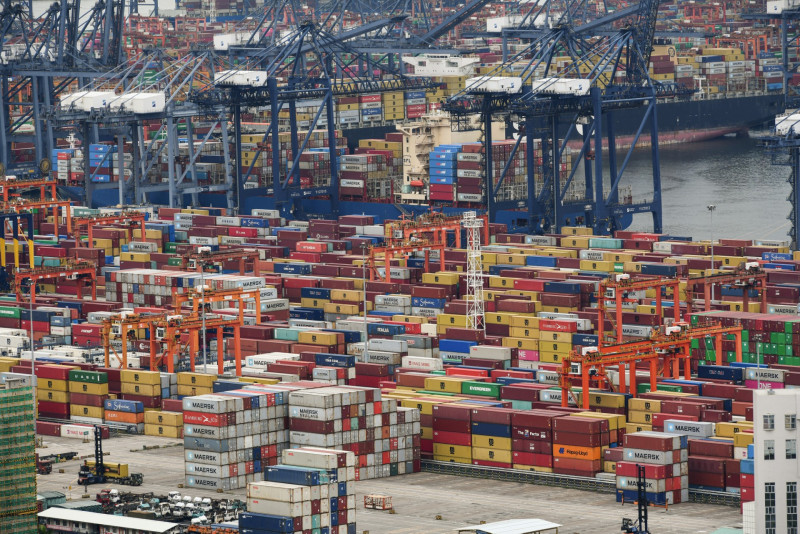
China’s Customs Administration data shows the growing economic damage caused by the country’s recent strict Covid-19 restrictions, with export growth plunging to 3.9% on-year in April. – AFP pic, May 9, 2022

BEIJING – China’s export growth slumped in April to its lowest level in almost two years, customs data showed today, as a Covid-19 resurgence shuttered factories, sparked transport curbs and caused congestion at key ports.

The data shows the extent of growing damage as the world’s second largest economy confines millions to their homes – particularly in key business hub Shanghai – to stamp out its worst Covid-19 resurgence since the early days of the pandemic.

Beijing has persisted with a strict zero-Covid-19 policy involving lockdowns and mass testing, but the economic costs are mounting as manufacturing hubs and supply chains atrophy under gruelling restrictions.

Export growth plunged to 3.9% on-year last month, the Customs Administration said today.

While this was above analysts’ expectations of 2.7% growth according to a Bloomberg poll, it marked the lowest rate since June 2020.

Import growth was flat in April, an improvement from a 0.1% contraction in March, as Chinese consumers remain hesitant under a welter of restrictions across the country.

Customs spokesman Li Kuiwen tried to strike an upbeat note today saying the economy still has room to make a turnaround and that its “positive fundamentals” remain unchanged.

In April, China’s biggest city Shanghai was almost entirely sealed off as it became the epicentre of the country’s worst coronavirus resurgence, with many factories halting production and trucker shortages causing goods to pile up at its port.

Restrictions are also creeping in other cities, including the capital Beijing.

While top leaders have offered words of reassurance for tech, infrastructure and jobs, analysts have warned that the zero-Covid-19 strategy remains a dominant challenge to growth and stability. – AFP, May 9, 2022


Related News

Tech / 1d

Penang’s Tech Dome celebrates 10th anniversary with opening of new space gallery

Education / 2w

Malaysia must embrace AI in education to avoid falling behind

Opinion / 2w

Why Bersama is not Malaysia’s best hope

Malaysia / 4w

Recent Rain Rave Water Music Festival generated over RM320m - Tiong

Malaysia / 4w

Police investigate personnel accused of insulting local community while travelling in China

Malaysia / 1mth

Controversy in China, woman comes forward to apologise (video)

Spotlight

Malaysia

After Johor, the uncomfortable question for Anwar’s critics: Were we too impatient?

By The Vibes Says

Malaysia

Network School's business licences revoked, to cease operations tomorrow

Opinion

Orang Asli in Pahang: Token gestures or genuine recognition?

Malaysia

Tuition teacher sentenced to 105 years in prison and 70 lashes for raping daughter

Malaysia

Azam Baki denies involvement in RM178.29 million contract linked to brother’s company

Malaysia

Aminuddin urges NS voters to weigh manifesto promising benefits for M40 and B40 groups

Malaysia

No need to resign, PM has absolute power if there is doubt – Ahmad Zahid

World

Gaza’s water crisis deepens as families face thirst, disease and collapsing sanitation systems

You may be interested

Business

Plastics industry faces tough year as raw material volatility add to cost pressures

Business

Oil prices near five-week high as US-Iran conflict fuels supply concerns

Business

Oil prices rally above US$84 per barrel as US-Iran conflict deepens

Business

Central bank policies remain crucial in shaping currency market movements

By Alfian Z.M. Tahir

Business

Malaysia posts record RM340.9 billion trade in June as exports jump 45.4%

Business

Govt boosts SME digitalisation support with new smart manufacturing co-investment scheme