KUALA LUMPUR – As Indonesia goes full steam ahead to enforce its ban on palm oil exports, Malaysia is seeing this as a window of opportunity and is eyeing more migrant workers to help harvest palm fruits to bank on the situation.
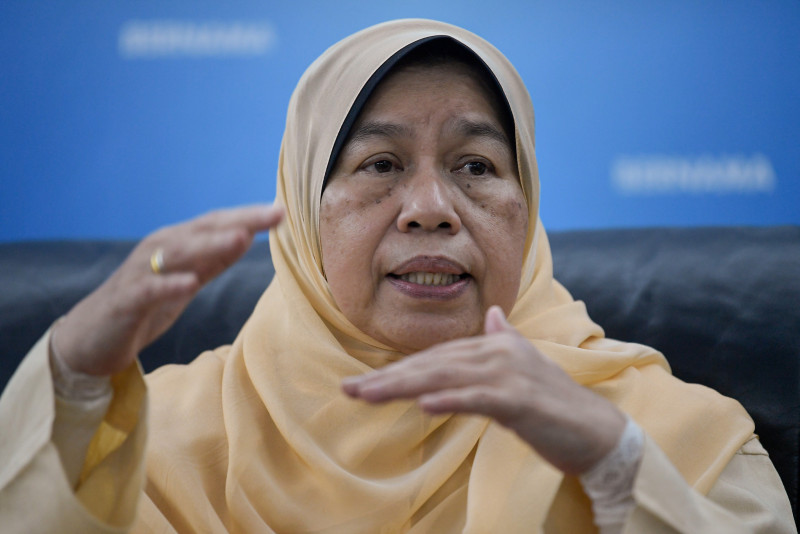
Plantation Industries and Commodities Minister Datuk Zuraida Kamaruddin said Malaysia remains optimistic that the nation has what it takes to fill the gap in global palm oil supply based on its market trend analytics and projection.
“While Malaysia sympathises with Indonesian palm oil players who will be impacted by significant shift in the demand-supply mechanics in the country, this is nonetheless the best time for Malaysian palm oil players to enhance their innovation capability while exploring the best possible strategies to meet a spike in demand by palm oil importing countries,” she said in a statement.
She said the industry will enter its seasonal peak output period soon.
Malaysia is expected to go head-to-head with South Korea, one of the fastest-growing palm oil markets releasing its stockpiles, which could trigger a sharp price correction.
With the prospect of both Russia and Ukraine releasing their rapeseed and sunflower oil stockpiles, if any, once their conflict passes or subsides, Zuraida said it was “only logical” that both Malaysian palm oil planters and downstream industry players go all out to take advantage of the current situation rather than let such a opportunity slip away.
She said that her ministry wants to assure industry players that it is doing its utmost to meet the demand for migrant workforce, especially from upstream players.
“Recall that in September last year, the authorities approved the recruitment of 32,000 migrant workers for palm oil plantations, which culminated in the entry of the foreign workforce into the plantation sector in mid-February this year.
“Malaysia is now anticipating a new batch of foreign workers to arrive in May and June, hence overcoming the further manpower crunch to harvest palm fruits, which otherwise would cap production,” she said.
“Rest assured that the process to hire foreign workers has already begun under a special quota.”
The Plantation Industries and Commodities Ministry projects palm oil production and export to rise by 30% by end-2022, which comes against the backdrop of Malaysia having reopened its international borders on April 1.
Zuraida assured that production levels will rise again, with the incoming migrant workers to get Malaysia on track to meet global demand soon.
“As palm oil prices will stay elevated supported by low inventory levels at both origins and destinations amid heightened price volatility, it is our hope that both the Malaysian upstream and downstream players seize the opportunity from Indonesia’s absence to maximise their revenue stream, hence earnings.
“After all, such an opportunity only presents itself for a short term, given Indonesia will certainly relook into its ban policy.”
Market analysts expect the export ban to be lifted around July 2022 and there is a probability that Indonesia will flood the global market again with its inventory stockpiled during the ban. Major importers of Indonesian palm oil include China, India, and the United States.
On May 6, Zuraida had said that Russia’s invasion of Ukraine beginning February 24 has significantly affected global vegetable oil supplies as the uncertainty over Black Sea exports have resulted in higher vegetable and edible oil prices.
She said that this could further tighten the global oilseed and vegetable oil supplies, thus prolonging the upcycle in vegetable oil prices.
The Eastern European tension has led to shortages of sunflower oil and rapeseed oil with both countries accounting for 80% of global exports, she added.
She also said that she had instructed relevant agencies under the ministry, such as the Malaysian Palm Oil Council and the Malaysian Palm Oil Board, to undertake aggressive efforts and campaigns for the commodity to fill global market gaps in the interim. – The Vibes, May 10, 2022.