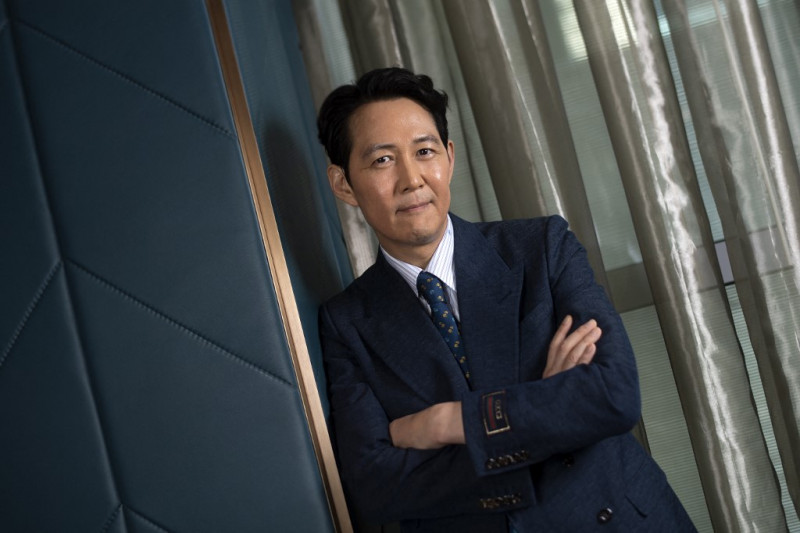
TORONTO – Smash hits like ‘Squid Game’ and ‘Parasite’ may make it look easy, but Emmy-winner Lee Jung-jae says South Korean cinema spent years learning how to reach unprecedented global audiences through stories about the competitiveness and violence of modern life.
Lee spoke to AFP just days after making history as the first foreign-language performer to win the Emmy for best actor in a drama with ‘Squid Game’ – the most-watched Netflix show of all time.
“As a piece of work that is not in English that we're able to bring to the global audience, we're very happy about that,” said Lee.
“Even from Korea everybody was so happy and they were sending me congratulating messages,” he said during an interview at the Toronto film festival.
“When I go back there's a lot of interviews and things waiting for me!”
The brutal social satire about misfits and criminals competing for cash in twisted versions of schoolyard games followed in the footsteps of South Korea's ‘Parasite’, which two years earlier became the first foreign-language movie to win best picture at the Oscars.
“For a long time, Korean cinema has been trying to figure out how to connect better with global audiences,” said Lee.
“Now, as a result of these years-long efforts, we see a lot of high-quality content, that has resonated around the world and won critical acclaim.”
It has also been a huge commercial success: ‘Squid Game’ director Hwang Dong-hyuk is writing an eagerly-awaited second season, with Lee teasing that his character Seong Gi-hun “will be completely different” this time around.
‘Overly competitive’
But before then comes ‘Hunt’, Lee's directorial movie debut, which earned a prestigious “gala presentation” premiere this week at the Toronto International Film Festival – relatively rare for an Asian-language film.
The twisty Cold-War era spy thriller in which Lee also stars is loosely based on real 1980s political events, including an attempted assassination of South Korea's president and the defection of a North Korean pilot.
Lee said the film shares some themes with ‘Squid Game’ – including its unflinching depiction of violence, as rival South Korean spies turn against and even torture one another.
For instance, it too looks at how an “overly competitive society could actually lead to people hurting each other”.
‘Hunt’ has already topped the box office in its home country, and will be released in North American theatres and on-demand streaming on December 2 by Magnolia Pictures.
But in a further sign of how Korean movie-making is adapting to the needs of its new-found audience, the final version reflects a more global film.
Following its initial screening at the Cannes film festival in May, some critics complained the plot was difficult to follow for Western audiences not familiar with Korean politics, so Lee re-cut it to simplify some elements, and revised the subtitles.
But, he emphasised, the film is less about Korean history and more about “how this violence is happening all around the world globally,” hurting ordinary people.
“This movie is about these two protagonists and whether their principles are righteous.
“What's most important is, because it's an espionage action-drama, that I just want you to really enjoy the film,” he said.
‘Growing closer’
When ‘Parasite’ director Bong Joon-ho stunned Hollywood by winning best picture at the Oscars in 2020, he spoke about the importance of overcoming “the one-inch-tall barrier of subtitles”.
Lee said he has not discussed South Korea's newfound global clout with Bong, but agreed that the country's culture “has become widely understood globally” as the world becomes more inter-connected via technology such as global streaming and social media.
“In Korea actually we watch a lot of content from different countries and all around the world, so it's very natural for us,” he said.
He added: “The world is a lot closer now... Korea’s distinctive story is not something that is difficult for foreign audiences to understand.”
“It's natural. With everyone growing closer to each other, it's not difficult to understand the emotions – whether it's pain or grief – of others, because we live in a world where feelings are shared instantly.” – AFP, September 17, 2022