


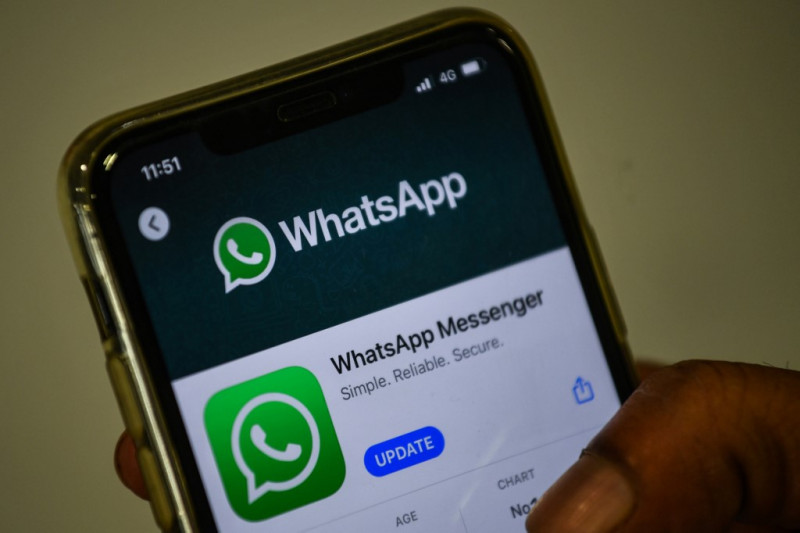

KUALA LUMPUR – The recent changes to WhatsApp's privacy policy has ignited a discussion over data sharing and user privacy, with some users considering a switch to other messaging platforms.
WhatsApp currently has over 2 billion users, which is simply a staggering number, so this change has many worried.
However, if you are worried that WhatsApp will read your private messages, know that they are not planning to do so anytime soon.
"We offer end-to-end encryption for our Services. End-to-end encryption means that your messages are encrypted to protect against third parties and us from reading them," WhatsApp's privacy policy reads.
WhatsApp will share other types of information from their users, and they will share it with their sister and parent companies.
As you may or may not know, Facebook owns WhatsApp and other social media applications.
They claim that they will only use user information to provide better services.
"The types of information we receive and collect depend on how you use our services. We require certain information to deliver our services and without this we will not be able to provide our Services to you.
“For example, you must provide your mobile phone number to create an account to use our services," WhatsApp's privacy policy says.
So, what will WhatsApp be collecting and sharing with others?
We want to address some rumors and be 100% clear we continue to protect your private messages with end-to-end encryption. pic.twitter.com/6qDnzQ98MP
— WhatsApp (@WhatsApp) January 12, 2021
Phone-related and personal information
When users sign up for WhatsApp, they have to provide a phone number, profile name, and sometimes a picture, though the latter is optional.
Additionally, WhatsApp will also collect information related to your phone. For example, if WhatsApp works slowly on a user's phone - that information would be collected.
"This includes information such as hardware model, operating system information, battery level, signal strength, app version, browser information, mobile network, connection information (including phone number, mobile operator or ISP), language and time zone, IP address, device operations information, and identifiers," WhatsApp privacy policy states.
Identifiers should include information like the user's International Mobile Equipment Identity (IMEI), which is a unique number that identifies your phone.
Location and contacts
Instead of giving friends your address in writing, it is easier to just share your location through WhatsApp.
However, WhatsApp will collect these "precise location information".
Plus, even if users turn off the location sharing settings, WhatsApp will try to estimate your general location through IP addresses and phone area codes.
Also, WhatsApp will access the user's contacts and chat groups.
But WhatsApp promises that if users in the contact list do not subscribe to WhatsApp, they "will manage this information in a way that ensures those contacts could not be identified by them".

Third-party info
The same way WhatsApp can access your contact list, Whatsapp can access information about you through the contact lists of other users.
Additionally, WhatsApp will also have access to interactions between users and businesses.
"When you message with a business on WhatsApp, keep in mind that the content you share may be visible to several people in that business.
“In addition, some businesses might be working with third-party service providers (which may include Facebook) to help manage their communications with their customers," WhatsApp's policy states.
Take into account the fact that WhatsApp will share information with third parties, which may include other Facebook companies like Instagram.
Why third-parties?
Well, these would be information related to troubleshooting, downloading the app, advertising, cybersecurity, among many other reasons.
For example, WhatsApp can be downloaded on Apple’s App Store or Google’s Play Store, and information could be shared with these service providers.
Or if a user shares an article from Facebook to their WhatsApp contacts, the information may be shared between these two entities.
Why does WhatsApp want all this info?
If a user is concerned about giving this information to WhatsApp, third parties or other Facebook companies, they should be concerned with WhatsApp’s reasoning for collecting these details.
To go-to response from WhatsApp – and other apps that share user information – is that information would be used to provide better services.
This is not limited to providing better WhatsApp services, but for other Facebook-related applications too.
Additionally, a user's details could be used to provide better advertisement targeting, which is a commonplace practise.
Alternatives messaging apps
For users who are concerned with this new privacy policy, an obvious solution provided by the messaging app is to delete one’s account.
Of course for many that is a step too far. After all, many use WhatsApp because it has become a necessity in how we communicate.
Given the current controversy two major rival messaging apps have risen in popularity, namely Telegram and Signal.
Telegram, with 400 million users, has always been a popular alternative, though the relatively new Signal has drawn much media attention.
Earlier this month, Tesla CEO Elon Musk recommended that WhatsApp users switch over.
Use Signal
— Elon Musk (@elonmusk) January 7, 2021
Signal is something like WhatsApp, in which it provides safe end-to-end encryption communication.
The takeaway is that Signal does not have as many users as WhatsApp and their backup and restore mechanisms are not the best.
Basically, if a user changes phones, the user may find difficulties backing up his chat history.
Should you switch?
It depends on how much a user prioritises privacy.
Because as of right now, WhatsApp will not be able to access the contents of a chat, only the metadata.
In other words, WhatsApp won't know what a user says in his message – but they will know which user received the message and at what time.
In general, the new mistrust of WhatsApp comes from Facebook’s ownership of the messaging app. Facebook has a spotty track record – at best – when it comes to sharing user data with third parties. The lack of privacy on the platform despite repeated pledges by the social media giant is another concern.
And the more centralised user data becomes, the more susceptible it will be to hacking or theft by nefarious elements. – The Vibes, January 13, 2021
















.jpeg)
