
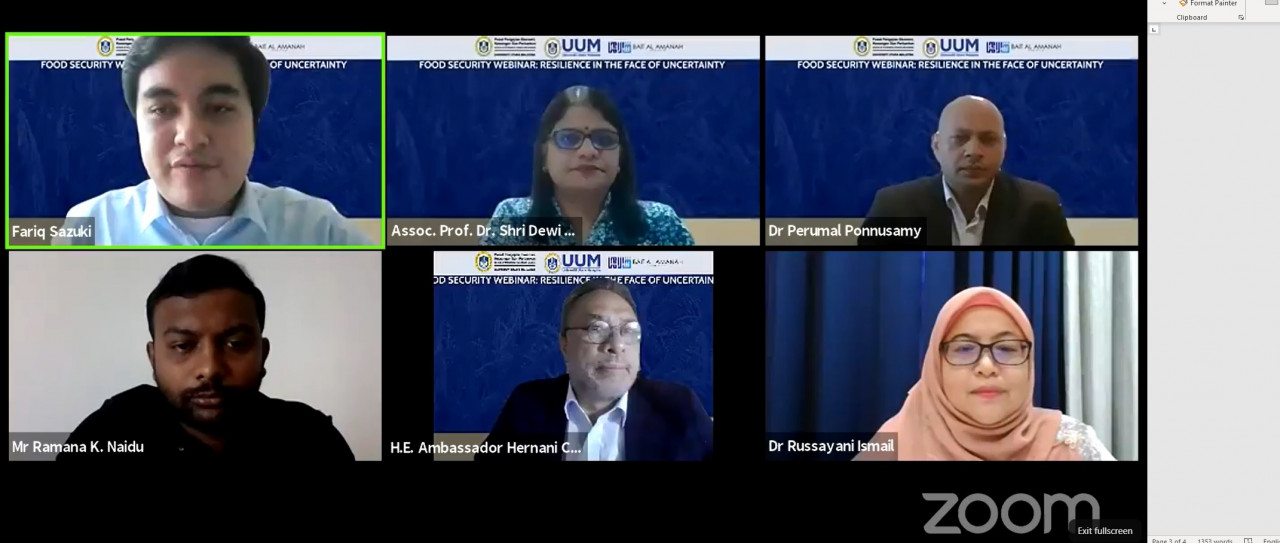
PROVIDING an insight on Malaysia’s current food security and self-sufficiency levels in light of the pandemic, School of Economics, Finance and Banking (SEFB) Universiti Utara Malaysia (UUM) jointly organised a webinar with Bait Al-Amanah (House of Trust) earlier this week.
The two-hour long online discussion presented an overview of the situation and was joined by a handful of speakers on the panel.
Among them, SEFB dean, professor Dr. Russayani Ismail, Food and Agriculture Organization (FAO) representative in Mozambique and former Minister of Foreign Affairs & Cooperation of East Timor H.E. Hernani Coelho da Silva, UUM Head of Sustainable Agriculture and Food Research Unit (Safru) assoc. professor Dr Shri Dewi Applanaidu, and Ministry of Agriculture and Food Industry (Mafi) Policy and Strategic Planning Division senior principal assistant secretary Dr Perumal Ponnusamy.
What defines food security?
Russayani opened the discussion by highlighting the role of higher education institutions to enhance food security and how the matter is a global concern that touches the basic factors of human survival.
“One responsibility includes putting forth a sustainable capacity building for research extension in agriculture, food and related discipline.
“These can be encouraged through researches that are adaptive to problem solving issues and turning the outputs into practice among farming communities which will eventually reduce the gaps that exist in current practices as well as ensuring the community crops to be environmentally friendly,” she said.
According to the professor, insecurity occurs when people are not able to access enough nutrition to meet requirements for a healthy life.
“Global Security UK reported that around 795 million people face hunger daily. However, more than two billion lack vital micro-nutrients affecting health and life expectancy.
“Nearly a quarter of children today below the age of five face stunted growth – in physical and mental capacities.
“Less than a third of all young infants in 60 low- and middle-income countries meet the minimum dietary diversity standards needed for growth,” added Russayani, sharing that climate change, population spikes, and increasing competition due to urbanisation – which decreases the land mass for agriculture –allows for such instances to occur.
In relation to the above, she noted that food production depends on the ecosystem, and that the relationship is symbiotic where growing demands inevitably affects the supporting environment.
“The current pandemic has led to substantial concern about the threats, especially on food pricing since the MCO has affected the supply chain,” shared the professor, noting that the insecurity can double if there is no concerted action.
“The use of technology and best farming practices should be the way forward if the goal is ensuring sustainable food production – consumption and waste”.
Local scenario and challenges
Highlighting on the scenario and challenges on food security in Malaysia, Shri Dewi shared, “A micro-outlook of food security comprises four critical dimensions –availability, affordability, quality and safety as well as natural resources and resilience”.
“In terms of global ranking, Malaysia is placed 43rd in 2020 on the global country performance of the Global Food Security Index (GFSI) 2020 with a score of 67.9, which is categorised as a ‘good’ score.
“On the Asia Pacific front, the GFSI position for the country is 8th, which places us after China and before Thailand as of last year,” she said.
“A deeper look by taking the critical dimensions in consideration, Malaysia fares well on the first three but falls short with a moderate score on natural resources and resilience.
“I believe it is widely understood that if we have a 100% (or more) self-sufficiency, we do not need to rely on imports,” added the assoc. professor.
Among the food items that we rely on imports based on the 2019 Self Sufficiency Ratio (SSR) include rice, most livestock meats (i.e. mutton, beef, poultry, and pork), fresh milk, fisheries (Ie. mackerel, tilapia and crab), and popular fruits/vegetables (Ie. chilli, round cabbage, mango, banana, coconut).
On the challenge(s) of the supply and demand side of our food equation: “Local food production is increasing but the rate of progression is slow”.
“There is also a declining growth in agricultural land and research. While we place emphasis on industrial crops such as palm oil that contribute significantly to our economy, our food production rate is still lagging,” noted Shri Dewi.
Other challenges include ageing farmers and lack of interest among the younger generation, shortage of domestic skilled labour and reliance on foreign workers, low adoption technology by small farmers/agropreneurs as well as climate change.
Getting the younger generation interested
Famox Plantation M. Sdn. Bhd CEO Ramana K. Naidu who also joined the discussion during the later part of the webinar to present the reality of a young agropreneur.
“In agriculture, management and planning are keys to success.
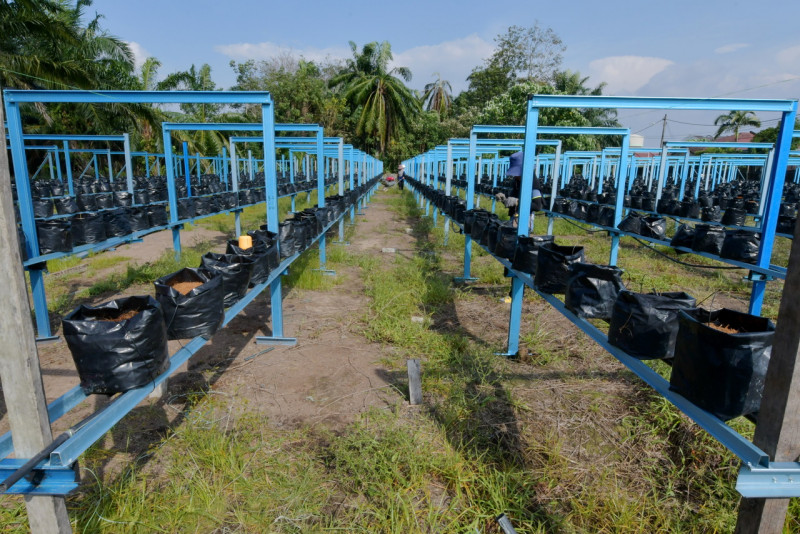
“For the company, we don’t rely on just one type of crop and follow an umbrella that commits to multiple business ventures from pineapple and corn to poultry and cattle breeding.
“It is considered as integrated farming that diversifies the profits and revenue sources if any shortage in demand were to occur in one. It is a better way of monitoring our cashflow and success rate,” said the 31-year-old.
On raising awareness among youngsters, Ramana notes that efforts rely on how we can shape the industry to be more appealing among the youth. This includes the upgrade of the tools and instruments of the trade – adapting it to present times.
“Another thing is by ensuring that the income is attractive enough for the young to partake”.
“The image of agriculture is still reduced to only being known for getting your hands dirty, which means the work is laborious.
Ramana, who is a commercial pilot license holder, shares, “... pandemic has taught us a lot, and that is in the form of the demand of the public – local food supply”.
“What most are not exposed to are the availability of the incentives that youngsters are able to benefit from.
“For instance, there is the Program Agropreneur Muda where they are offering around RM15,000 to RM20,000 worth of support for start-ups that are not necessarily money, but in terms of the input to help kickstart their agro journey”.
Demand and supply during the pandemic
The pandemic specifically has disrupted the food system through delayed port activities and trade, blocked raw material transportation, the inability for migrant labour or seasonal workers to travel, interrupted smallholders market access and food accumulation which has led to dumping.
Specifically, only 17% of food industry players were operating at normal operating capacity, 48% had distribution constraints and 64% were not able to sell their produce, as a result of the MCO.
That said, the agrofood sector recorded a positive growth of 1.0% in 2020 and remained resilient throughout the year, buoyed by the benefits of the timely fiscal policies.
The economic stimulus packages were provided including a special funding of RM1 billion for food security programmes to increase capacity of food production, besides other programmes to improve employability, for logistic storage and distribution capacity and micro-credit financing schemes.
Whether the reliance on foreign workers is truly a bad thing, Dr. Perumal notes, “it is not detrimental per se if we directly relate it to food security.
“In fact, if we look at previous experiences with the global food price – some of the countries that immediately took action in reducing their migrant workers had an adverse impact on their economy.
“A lot of companies still refuse to shift their operations to technology where the intention to move towards it has been left behind due to a more labour-intensive preference to cap costs.
He further explained MAFI’s action towards enhancing production capacity in the 12th Malaysian Plan. Among the strategies include adoption of modern technology, farm optimization and new farming models for productivity and the revival and upgrading of food parks. – The Vibes, June 25, 2021