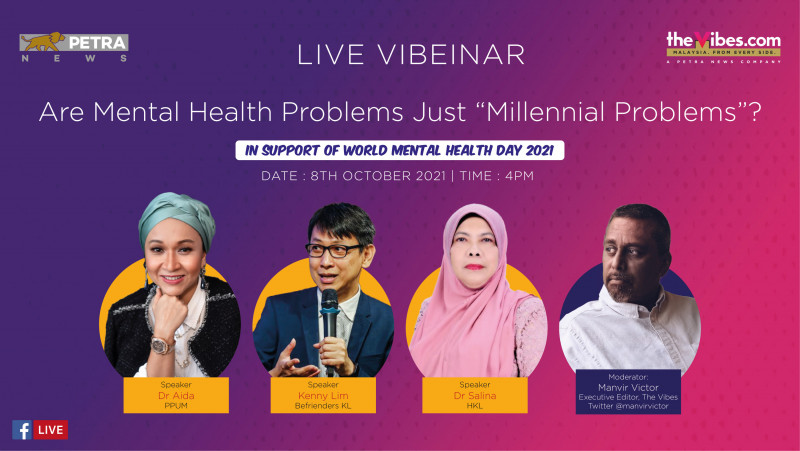

KUALA LUMPUR – Ahead of World Mental Health Day, The Vibes hosted a Live webinar to raise further awareness on building mental resilience and address psychological stigma among the public through its second Vibeinar titled, ‘Are Mental Health Problems Just ‘Millennial Problems’?
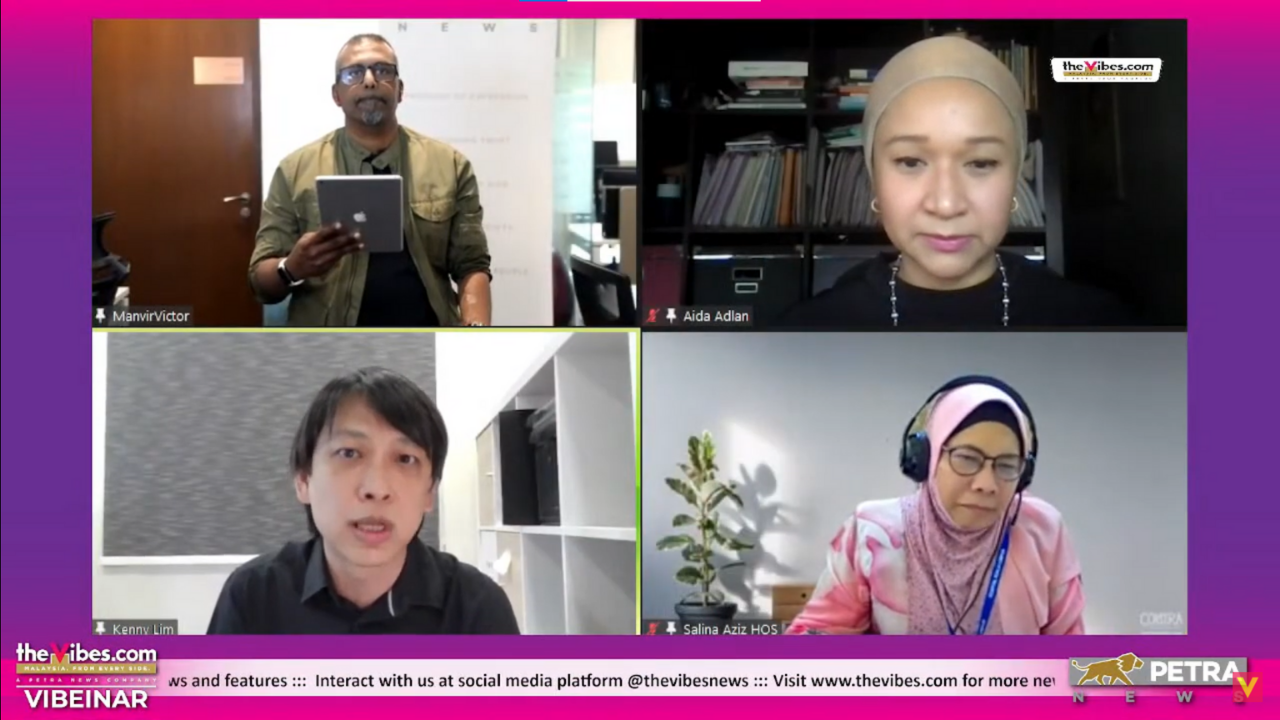
The one-and-a-half-hour-long discussion included panellists such as MoH head of psychiatry services Dr Salina Abdul Aziz, UMMC medical lecturer and psychiatrist Dr Aida Syarinaz Ahmad Adlan, and Befrienders Kuala Lumpur executive director Kenny Lim. It was moderated by The Vibes executive editor Manvir Victor.
Setting the stage for the engagement, statistics were presented to kick off talking points. It was shared that over 140,000 distress calls were received by government agencies from March 2020 up to May this year. Of this, 85% were related to mental health issues such as acute stress, anxiety, depression, abuse, and suicidal tendencies/behaviour.
Besides, there were 2,426 reported suicide cases between 2018 up to July of this year, where men make up for over 2,000 of the noted cases.
During the lockdown period specifically, calls to the Women’s Aid Organisation (WAO) and the Talian Kasih increased by 44% and 57% respectively, of which many are linked to domestic violence.
How reflective are the statistics when in practice and to what extent?
While the pandemic allowed for the masses to experience the silence of isolation, it was hard to appropriately confirm the influx in demand for psychiatric services during this period.
“Yes, we do receive a lot of outpatients and calls among those that seek help, but the increase is with regards to anxiety, restlessness, and sadness because of the situational change experienced. However, these are not the sort of mental disorder that you see tertiary centres treat,” noted Salina, who is also a member of staff at HKL.
“For instance, the Mentari initiative (a community of practice to improve outreach and re-integration of people struggling with mental health) including clinics saw an increase between 5-10% in cases.
"But it is due to patients struggling to adapt to the pandemic, rather than an increase in the severity of people suffering from actual mental health disorders (such as schizophrenia, OCD etc).
“What is certain is that the coping style and resilience is affected because of the new normal,” she added.
“From the private side, one would think the turnout to be lower during the MCO with SOPs in place. It’s not – people do come to seek help, and the landscape here at UMMC echoes similarly with what Dr Salina shared. Where it is more of emotional dysregulation, where they feel one intense emotion and is not able to balance it well anymore,” said Aida.
Explaining further on how feeling emotions are very normal, she noted that the common presentation of one reacting to a particular event and coming to terms with it is for a few days where life would go on as usual, provided there are good coping skills.
“Just to be clear, some may confuse themselves between mental health issues and mental health illness. Everyone has mental health and sometimes it gets affected occasionally. But if it gets too bad and disruptive that you are not functioning then it becomes a disorder,” added the UMMC doctor.
“If we compare to 2019 before the pandemic hit with the first eight months of this year alone, there is an increase of 25% in the number of calls received,” shared Kenny.
“During the pandemic stretch alone (between 2020-2021), there is an increase of more than 50% in calls. So, more and more people are being affected emotionally.
“Most of the reasons are related to loss of income and other financial issues, isolation due to travel restrictions, struggling with the transition of working from home, and online studies among them,” he added.
Ending mental health discrimination
“We can look at the trend of the increase in numbers (even in the past decades), it can be due to many factors. One, people are more educated with ensuring their mental health and they are not afraid to come forward for treatment,” shared Salina in response to the hike in the statistics, noting, “this is mainly because it (mental health) is seen more as a medical entity, so they seek help more.”
“Secondly, as time increases, we have more facilities to provide the aid needed which has their mental health services. You don’t need to only go to Hospital Bahagia/Permai, and instead can head on to general hospitals and health centres where services are made readily available,” she said.
“Seeking help for mental illness is not so stigmatising anymore, and this is what contributes to the increasing statistics. I see it as a good thing because people are not afraid to seek help,” she added.
Replying to the idea (and concept) of a ‘snowflake generation’, the consultant psychiatrist noted that the focus should be on, “talking about the resilience of the community/people/population, being able to adapt to misfortunes and setbacks”
“The snowflake generation in question face harsh accusations. Some of the terms that I managed to garner are 'entitled, self-absorbed, narcissistic, and oversensitive',” said Aida.
“I agree that it is about resilience. But with that, I must stress that these millennials are at risk of developing mental health issues if they can’t regulate or cope with emotions well."
She acknowledged that most of us are at times guilty of comparing how today’s generation should cope. We may have gone through somewhat similar struggles before, but this may not work well “because they are already in a different era.”
“I do agree with the awareness level mentioned by Dr Salina where it is higher now than before. There are more discussions and courage to come forward in sharing stories,” said Kenny.
“I would also like to add that maybe challenges at this time or life in this modern world is more stressful than before. Expectations are heightened and different as compared to decades ago.
“That is why there is such focus on the existing practices of today’s generation in how they cope and solve problems,” he noted.
“It’s not nice to label them ‘snowflakes’ but rather [we must] look at things from a different perspective. Maybe the current generation is not adequately equipped with the needed skills to deal with stress and challenges in life.
“This also boils down to parenting, how they are brought up – all of this plays a role,” he added. – The Vibes, October 9, 2021
*Watch ‘Are mental health problems just ‘millennial problems’ webinar in the video below:




.jpeg)