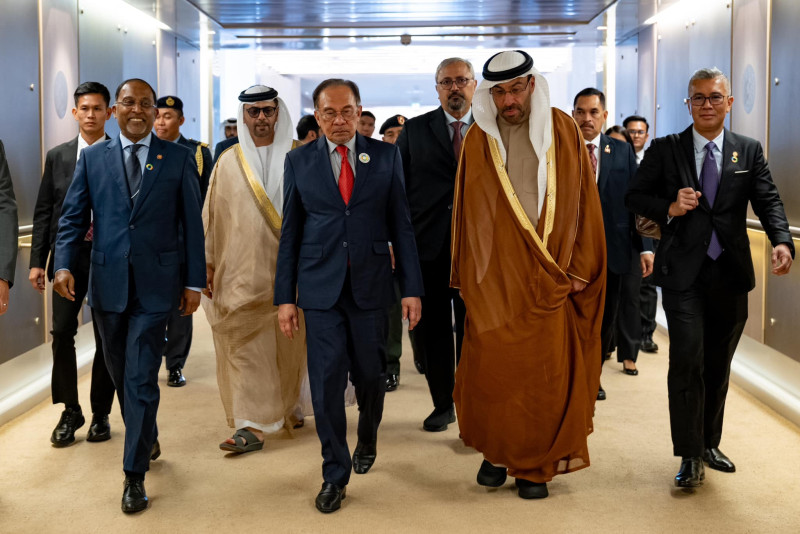
PRIME Minister Datuk Seri Anwar Ibrahim’s working visit to the United Arab Emirates (UAE), his first overseas visit for 2025, has yielded encouraging results. The Prime Minister and Malaysia have gained the trust of the UAE government and leading companies from the Gulf nation to foster economic cooperation, reported Bernama.
The most significant achievement was the signing of the Malaysia-UAE Comprehensive Economic Partnership Agreement (MY-UAE CEPA), expected to boost bilateral trade by at least 60 per cent within the next five years.
The successful signing of the free trade agreement also opens up opportunities for similar agreements with other Gulf Cooperation Council (GCC) member states, namely Bahrain, Kuwait, Oman, Qatar, and Saudi Arabia, and potentially with the GCC itself.
The three-day working visit, which kicked off on Sunday, marked the Prime Minister’s second visit to the UAE since October 2023, and his first overseas trip since Malaysia assumed the ASEAN chairmanship for 2025.
While Anwar was in the Emirates to attend the Abu Dhabi Sustainability Week (ADSW) 2025 at the invitation of UAE Vice President and Prime Minister Sheikh Mohammed bin Rashid Al Maktoum, who is also the Ruler of Dubai, he also took the opportunity to meet with the senior management of the UAE’s three major companies and sovereign wealth funds, including the Abu Dhabi Investment Authority (ADIA), Mubadala, and Masdar.
This resulted, among others in Masdar’s plans to invest in Malaysia through joint ventures with local companies involving green energy, infrastructure and battery energy storage as well as for strengthening the energy grid.
Meanwhile, ADIA’s investment commitments are related to the New Industrial Master Plan (NIMP) 2030 and the MADANI Economy framework, as well as projects in the Johor-Singapore Special Economic Zone (JS-SEZ) focusing on advanced manufacturing. This includes infrastructure development, green technology, renewable energy, logistics, healthcare, digital economy, and education.
The sovereign wealth fund also plans to participate in the restructuring or potential privatisation of Malaysia Airports Holdings Bhd (MAHB), involving Khazanah Nasional’s control, given ADIA’s experience with major airports like those in Dubai, Abu Dhabi, Heathrow (London), and Paris.
ADIA intends to collaborate with Global Infrastructure Partners (GIP) and MAHB on the restructuring and seeks a more positive role to complement GIP and MAHB.
“ADIA’s expertise will be transferred to MAHB,” said the Prime Minister, affirming the government’s support for ADIA’s participation.
Mubadala, on the other hand, discussed the production of liquefied natural gas (LNG) and gas-related infrastructure development, as well as the development of value chains such as blue hydrogen and carbon capture, utilisation, and storage (CCUS) projects, along with projects in the JS-SEZ.
“This happens to be the first visit of 2025. (The positive impact of the visit) will benefit the entire country,” Anwar said.
The Prime Minister also held meetings with UAE President Sheikh Mohamed bin Zayed Al Nahyan, who is also the Ruler of Abu Dhabi, and Sheikh Mohammed bin Rashid Al Maktoum in Dubai, both of whom played pivotal roles in making this vist a success.
As for his participation at ADSW 2025, Anwar attended a plenary session and joined a dialogue on “ASEAN’s Interconnected Future: Linking Energy, Trade and Prosperity,” which served as a platform for him to promote Malaysia’s ASEAN chairmanship to a wider audience.
The Prime Minister’s participation, along with other government leaders, in ADSW on Jan 14, was seen as aligning with the theme of ASEAN-Malaysia Chairmanship 2025, “Inclusivity and Sustainability.”
Anwar also attended the Youth 4 Sustainability (Y4S) dialogue session, which was part of the ADSW 2025 programme for youth. - January 15, 2025







.jpeg)