THE re-election of US President Donald Trump could present a significant opportunity for ASEAN to assume a 'middle power' role, positioning itself as a stabilizing force amid rising geopolitical tensions, according to Datuk Seri Dr. Zambry Abd Kadir, Secretary-General of Barisan Nasional (BN).
Zambry highlighted that this role would not be centered on conflict but rather on guiding major global powers, allowing ASEAN to assert its influence and address regional challenges effectively.
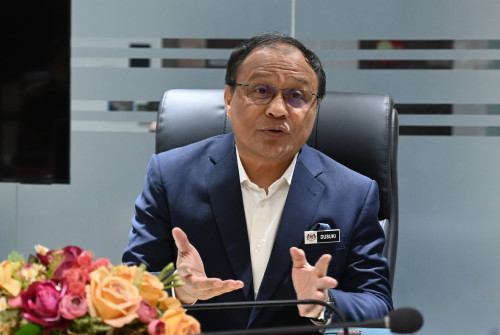
Speaking at a forum titled "The Impact of Trump’s Election and His Policies on the World"* held at the World Trade Centre Kuala Lumpur (WTCKL), Zambry explained that recent developments in the United States open up new avenues for political engagement on the world stage.
“We’ve long discussed a unipolar world, where one nation holds all the power. But now, we are moving into a multipolar world. In this new global order, ASEAN has the opportunity to step up as a middle power, balancing the influence of major nations,” Buletin TV3 reported Zambry saying, adding, “As ASEAN’s chair, Malaysia is uniquely positioned to play this critical role in global diplomacy.”
Zambry, who is also Minister of Higher Education, was speaking as the moderator of the forum, which featured distinguished panelists including Professor Emeritus Dr. Johan Saravanamuttu from Universiti Sains Malaysia, Dr. Azmi Hassan, Senior Fellow at the Nusantara Strategic Research Academy, and Dr. Khoo Ying Hooi, Associate Professor at Universiti Malaya’s Department of International and Strategic Studies.
The event was also joined virtually by Elina Noor, Senior Fellow at the Carnegie Endowment for International Peace’s Asia Program.
In his remarks, Zambry emphasised that Malaysia, in collaboration with ASEAN, could play a pivotal role in addressing international disputes, particularly in regions of conflict such as Myanmar. This highlights ASEAN’s potential as both a mediator and a peacekeeper, facilitating dialogue and fostering stability in the region.
“With Trump leading the United States, we can anticipate how his leadership might influence global politics, and how this will impact Malaysia in various spheres including politics, economics, and international relations,” Zambry added.
Furthermore, Zambry noted that BN has launched a series of forums aimed at fostering greater understanding of global developments and current affairs. These forums, he said, are not solely focused on Malaysian issues but also explore global topics, reflecting the rapidly changing dynamics of the international landscape.
“These discussions are vital for Malaysia's younger generation, as well as the wider public, to remain informed about global trends and how they may affect our country. The world is evolving quickly, and it’s crucial that we stay ahead of these changes,” Zambry concluded.
The forum, which included a lively Q&A session, provided insightful commentary on current global affairs, highlighting the growing public interest in international issues and their potential consequences for Malaysia.
_.png)
The discussions underscored ASEAN's potential to become a central player in global politics, particularly as the world shifts toward a more multipolar geopolitical framework.
Separately, Free Malaysia Today (FMT) reported, as geopolitical tensions continue to rise, several leaders and analysts have stressed the importance of ASEAN enhancing its influence to ensure peace and stability in the region.
According to Thailand’s Foreign Ministry spokesperson Nikorndej Balankura, the Southeast Asian bloc has the potential to play a significant role in global politics and international affairs.
In an exclusive interview with FMT, Balankura emphasised that ASEAN must be dynamic and adaptable in response to the rapidly changing global landscape. He noted that ASEAN’s ability to evolve and address contemporary challenges is key to maintaining its relevance and influence on the world stage.
“We are living in a time of fast-paced, ever-changing geopolitical dynamics. ASEAN must be flexible and quick to adjust to these shifts,” Balankura said during the ASEAN foreign ministers' retreat in Langkawi.
He pointed to ASEAN’s success in areas like the development of the ASEAN Outlook on the Indo-Pacific (AOIP), which has received praise from the international community. Introduced in 2019, the AOIP adapts the Indo-Pacific concept, initially promoted by the United States, to better align with regional needs.
This initiative places ASEAN at the center of regional affairs while maintaining inclusivity and promoting cooperation with global powers without directly challenging them.
“The ASEAN Outlook on the Indo-Pacific is an excellent example of our proactive role. ASEAN has devised initiatives that complement the actions of superpowers while fostering cooperation,” Balankura added.
"Looking ahead, ASEAN must continue to assert itself in the global arena, making its presence more pronounced to international superpowers."
Philippine Foreign Secretary Enrique Manalo echoed this sentiment, stressing the importance of unity and regional adaptability within ASEAN.
Manalo noted that the organization’s ability to remain dynamic is crucial to promoting and sustaining peace and stability in the region. He also highlighted areas such as artificial intelligence where ASEAN could play a leading role, both regionally and globally.
“As the world continues to evolve, ASEAN has the potential to be a powerful force not only in our region but on the global stage as well,” Manalo remarked.
Despite these opportunities, ASEAN has faced criticism for its slow progress in addressing challenges and capitalizing on emerging opportunities. Senior Fellow Tang Siew Mun from the ISEAS Yusof Ishak Institute argued that ASEAN is long overdue for a "makeover" to remain effective in the 21st century.
“The foundational principles that guide ASEAN were established in 1967 with the Bangkok Declaration. Given the increasingly complex nature of global and regional challenges today, we must ask: is ASEAN still fit for purpose?” Tang said.
He emphasized that while ASEAN remains highly relevant, particularly in the face of evolving regional and global issues, it must modernize its approach. “ASEAN needs to equip itself with the necessary tools to drive community-building in the 21st century,” he added. – February 13, 2025


.JPG)




.jpeg)