DORIS Au, a seller of door locks and hardware in Hong Kong for 25 years, received a letter from her bank, DBS Group, last June stating that her business account would be closed. The bank gave little explanation but subsequently froze the account, killing her business with international suppliers, she said.
Reuters reported today that Au discovered after searching online that another firm with a similar name was added to the U.S. trade blacklist in October 2023, for "providing support to Russia's military and/or defense industrial base." The entry identified two addresses, one of which was Au's warehouse.
"We are not that company. It's totally a mistake," Au told Reuters in her warehouse stacked with locks, hinges and sliding-door kits from well-known brands.
Au's predicament captures the challenge facing the administration of U.S. President Donald Trump as it ramps up limits on China's access to American technology by adding dozens of Chinese firms to its blacklist.
A Reuters review of almost 100 Chinese and Hong Kong companies added to the U.S. entity list in 2023 and 2024 found more than a quarter, or 26 entries, contained erroneous details, such as incorrect names and addresses and outdated information.
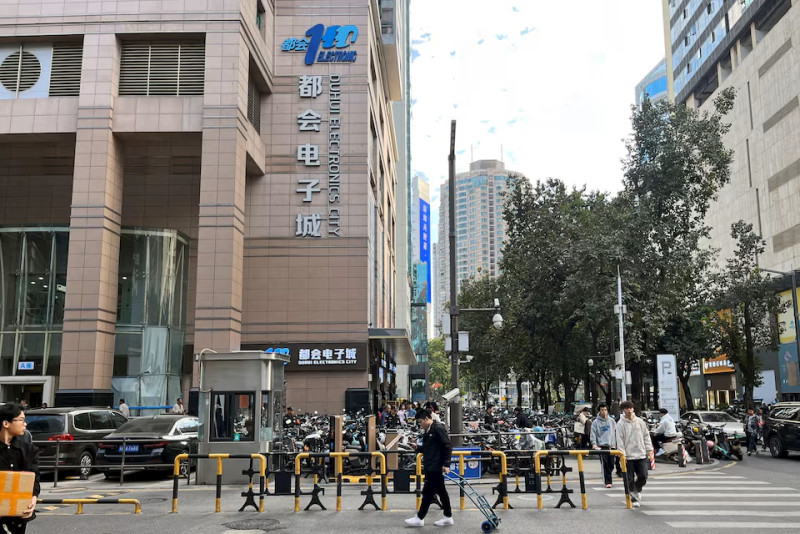
For each listed entity, Reuters visited at least one address identified by the U.S. to determine whether the blacklisted firms were still there. Businesses at those locations included a beauty salon, a tutoring firm, a massage parlour and a counselling center.
At one site in Shenzhen, Reuters found weed-covered remnants of a factory locals said was demolished years earlier.
Yet Reuters also found evidence of trade in restricted items by some entities, aided by loopholes, paper companies and networks of freight forwarders and shipping agents, illustrating the challenge of containing access to sensitive technology.
Ho King Commercial Building in Hong Kong
People walk outside Ho King Commercial Building, which hosts a cluster of U.S. entity-listed addresses, in Mong Kong district of Hong Kong, China, December 11, 2024. REUTERS/James Pomfret Purchase Licensing Rights, opens new tab
The entity list, established in 1997, has become an increasingly important tool for the U.S. to limit technology transfers to Russia and China, including semiconductors, that might undermine U.S. security. It is managed by the Bureau of Industry and Security (BIS), a Commerce Department agency.
In the Kenyan village of Kamathatha, farmer-turned-seed advocate Martha Njenga is teaching fellow villagers traditional seed preservation methods – empowering them to save and replant seeds season after season.
Five former U.S. officials acknowledged difficulties in evaluating possible cases of mistaken identity and updating information on the entity list, due in part to limited staffing. BIS is "woefully under-resourced," one said.
Many listed entities are front companies, said Matthew Borman, who until March was a senior BIS official overseeing U.S. export controls, including those targeting China and Russia.
"The challenge is that they can move to a different address with a different name," he said.
BIS and the Commerce Department didn't respond to detailed questions about errors on the trade blacklist and any actions to rectify them.
Singapore-based DBS (DBSM.SI), opens new tab declined to comment on Au's case. In its letter to Au, DBS didn't mention the entity list but said it had reviewed her business account and found "activity/information that is not consistent with your account profile."
Trade Flows
Under the Biden administration, the U.S. sought to limit transfers of technology that Russia needed for its war in Ukraine. The U.S. added hundreds of entities to contain Moscow's access to such components, many made in China. It also used the list to limit China's access to advanced capabilities in AI, military modernisation and quantum technology.
That trend is continuing under Trump.
U.S. Commerce Secretary Howard Lutnick said in March that China must be prevented from getting U.S. chips, noting the success of Chinese AI startup DeepSeek. He said the U.S. would bring export controls into future trade deals.
The Commerce Department has claimed some success from its export controls in stemming chip flows to Russia via Hong Kong and China. But they don't catch everything.
Ukraine's KSE Institute think tank found 76% of all common high priority items likely to be procured by Russia for its weapons programs, including semiconductors, radar and communications gear, were routed through China and Hong Kong in 2023.
Russian customs records show 20 of the 92 entity-listed companies visited by Reuters were exporting restricted items to Russia in December 2023, the most recent month for which a complete dataset was available. Those items, including semiconductors, were valued at US$7.5 million.
A Hong Kong government spokesperson said the region had robust controls of strategic trade in line with international standards, but it would not implement unilateral sanctions imposed by other countries.
China's Commerce Ministry didn't respond to questions about trade in U.S.-restricted items with Russia. Moscow's embassy in Washington also didn't respond to questions.
Blacklisted companies and addresses are barred from receiving restricted U.S. goods. Transactions with listed entities aren't necessarily prohibited but should be treated with a "red flag," and parties involved should conduct due diligence, BIS says on its website.
Borman said entities are listed based on BIS analysts' review of open-source and classified information, and the process involves the Commerce, State, Defense, and Energy departments.
Denis Makkaveev, the Hong Kong-based director of Global Broker Solutions Limited, a freight-forwarding company that was entity-listed in 2023, told Reuters he was visited by two BIS agents in October.
In an email seen by Reuters, BIS told Makkaveev it wanted to conduct a "post shipment verification" on a 2024 shipment "to discuss the end use and the end user of the item".
The item wasn't specified and Makkaveev told Reuters he had no idea what it was.
"I'm the forwarder, the logistics guy. I don't trade military goods," Makkaveev said in his office in an industrial building, showing some of the semiconductors he was shipping.
Makkaveev said he got around his company's blacklisting by setting up two new firms on Hong Kong's Companies Registry, which took less than a week. He said he used e-commerce platforms to process payments after banks shunned him. - May 2, 2025