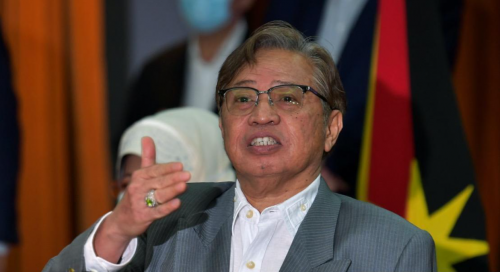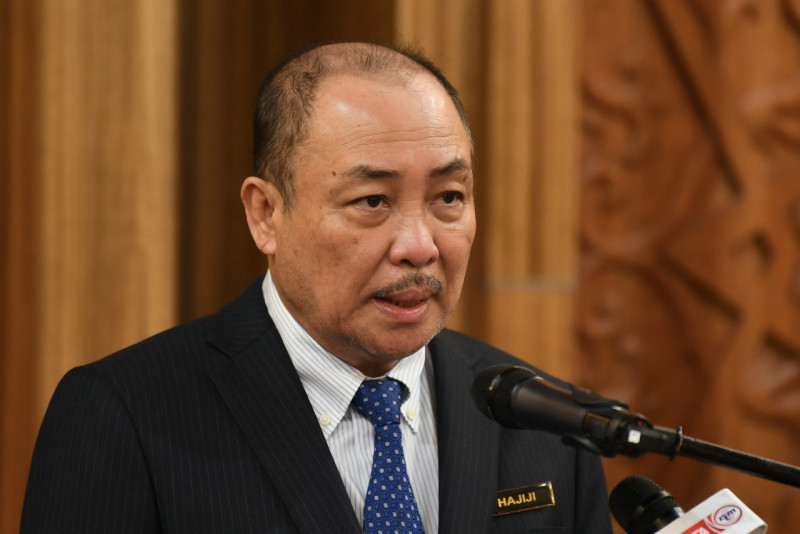

KOTA KINABALU – Sabah Chief Minister Datuk Seri Hajiji Mohd Noor took a swipe at Warisan, which led the previous state government from May 2018 to September this year, for claiming credit over the imposition of the sales tax on petroleum products.
He said that if Warisan wants the present Gabungan Rakyat Sabah (GRS) government to thank them for the tax, the administration should also thank those who worked on the process to get it imposed since 2014.
“We should also thank Prime Minister Tan Sri Muhyiddin Yassin for ensuring Petronas pays its tax to Sabah,” said Hajiji, who is also state finance minister.
He said although the tax was gazetted in 2018 and came into effect earlier this year on April 1, the efforts to realise it had started before then.
The state Finance Ministry had, since 2014, appointed Ernst & Young as a consultant to study issues on the tax in terms of administration and future prospects.
“The study was presented in the state cabinet meeting the same year and was agreed to in principle,” Hajiji said.
“Petronas was registered and licenced under the state’s sales tax regime on December 15, 2020, which was eight months after the tax was effective, and when it was under the governance of GRS and Perikatan Nasional,” he said.
Hajiji said this during his winding-up speech as finance minister in the Sabah state assembly here yesterday.
He also said that the state will consider changing its pursuit of 20% petroleum royalty from Petronas to shares in the national oil company, and will conduct a study to see if this will benefit it in the long run.
“We will consider the total net worth of Petronas to determine how many shares will be owned, as well as returns that the state government will get, and whether the dividend received will be able to meet with our development needs.
“Petronas’ financial status must also be considered because the share of dividends is subject to its financial capability. These are the risks that we must look into before the government makes any decision on the matter,” he said.
Hajiji also touched on the state’s RM1 billion bond that was settled with the federal government in October last year under Warisan.
The then-chief minister Datuk Seri Mohd Shafie Apdal had reportedly described the “bullet payment” as a feat of his governance.
However, Hajiji said when the bond started in 2014, the state had already set up a sinking fund to repay the bond following a recommendation from Bank Negara Malaysia.
The state contributed to the sinking fund each year so that it would not be burdened upon the bond’s maturity date in 2019.
He said Sarifuddin Hata (Warisan-Merotai) and Ben Chong Chen Bin (Warisan-Tanjong Kapor) caused confusion about the bond given by Shafie, who is Warisan president and Senallang assemblyman, with the former two trying to suggest that the bond was a repaid lump sum with an allocation last year.
“In fact, they paid the bond with a sinking fund that had been collected since the bond started,” Hajiji said.
He said the RM1 billion was also provided with a low coupon rate at 4.275%, while the state invested in fixed savings at Sabah Development Bank Bhd with returns of 4.325%.
“With this, the state government had actually earned from its investment, and (the bond) is not a bad debt (“hutang lapuk”) of the government, as claimed by some,” he said.
On another matter, Hajiji said that the Warisan Plus government was just lucky to have the Auditor-General’s Report (AG’s Report) 2019 describe the Sabah government’s financial status as stable in 2019.
“The state government has been receiving a clean audit certificate for financial statements for 19 years straight since 2000. The state government also achieved the highest recognition – triple A from RAM Ratings – since 2009.
“It has also maintained a surplus account since 2000. Hence, Warisan Plus was just lucky to be able to continue the excellent legacy from the financial management of the previous state government. GRS will continue this excellence in the state’s financial management,” he said. – The Vibes, December 24, 2020