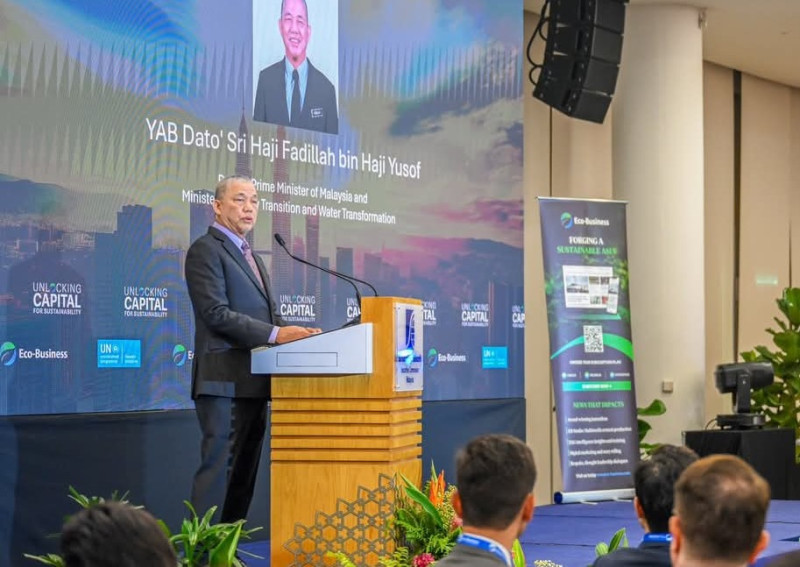
MALAYSIA has called on ASEAN member states to strengthen collaboration in unlocking climate finance and accelerating the region’s energy transformation, as the country prepares to steer the bloc under the 2025 ASEAN Chairmanship.
Delivering the keynote address at the Unlocking Capital for Sustainability (UCFS) 2025 forum in Kuala Lumpur, Deputy Prime Minister and Minister of Energy Transition and Water Transformation Datuk Sri Fadillah Yusof urged ASEAN to pursue collective action in reforming its energy landscape and investment strategies.
“Malaysia is committed to a development model that ensures economic progress while safeguarding the environment—where no community is left behind,” said Fadillah. “The UCFS summit is a timely platform to convert regional ambitions into concrete action, particularly in financing the energy transition, which is central to our ASEAN leadership agenda.”
Fadillah described the region’s energy trilemma—balancing sustainability, affordability and energy security—as an era-defining challenge. With energy demand in ASEAN expected to rise by 60 per cent by 2040, he said how these goals are balanced will shape the region’s long-term economic trajectory.
He warned that geopolitical volatility and unstable global capital flows risk diverting investment away from emerging economies at a critical time. He called on ASEAN nations to deepen regional energy integration, align clean energy policies, and mobilise sustainable capital.
“The trilemma is not a zero-sum game. It is a call for integrated and innovative solutions,” he said.
On Malaysia’s domestic efforts, Fadillah highlighted the National Energy Transition Roadmap (NETR), which outlines the country’s goal of reaching 70 per cent renewable energy in installed capacity by 2050. He said the NETR sends a strong market signal to attract private capital, reduce investor uncertainty and foster a more investable environment for clean energy.
To realise these ambitions, he noted, Malaysia must invest in modern energy infrastructure, including smart grids, energy storage systems and robust transmission networks to support decentralised and cross-border power exchange.
He emphasised that the shift must be a just transition, with protections for workers in carbon-intensive sectors such as oil and gas, aviation and heavy industry. This includes workforce reskilling, upskilling and strong social safety nets.
Fadillah reaffirmed Malaysia’s commitment to leading the ASEAN Power Grid (APG) initiative, aimed at enabling cross-border electricity trade and strengthening energy security. The APG, he said, provides an opportunity to harmonise regulatory frameworks, modernise transmission infrastructure and foster public-private partnerships that unlock regional investment.
He said Malaysia expects to table progressive outcomes for the APG in October 2025, underlining its role as a vital platform for long-term climate-aligned investments.
Addressing the US$1.5 trillion annual financing gap in the Asia-Pacific region identified by ESCAP, he said Malaysia is actively contributing to regional financial innovation.
This includes the ASEAN Taxonomy for Sustainable Finance, co-led by Bank Negara Malaysia and the Securities Commission; the development of green and sustainability bond standards; and collaboration with multilateral bodies to de-risk investments.
Fadillah also outlined initiatives spearheaded by the Ministry of Energy Transition and Water Transformation (PETRA) to expand access to green electricity.
These include the Green Electricity Tariff, which enables direct purchase of certified renewable energy; the Corporate Renewable Energy Supply Scheme, which allows businesses to procure green power from independent producers; and the Community Renewable Energy Aggregation Mechanism, which supports solar rooftop adoption at community level.
He said these programmes are not only critical to meeting Malaysia’s net-zero ambitions but are also enablers of high-value investment and inclusive growth.
Fadillah then urged ASEAN countries to act decisively and in unison, stating that the choices made today will determine the region’s legacy.
“Let us be guided by balance and inclusion, cross-sector collaboration, and agile leadership,” he said.
“With Malaysia’s leadership and ASEAN’s collective spirit, we can demonstrate that sustainability and growth are not competing priorities, but complementary pathways towards a stronger, more resilient region.” - July 28, 2025







.jpg)