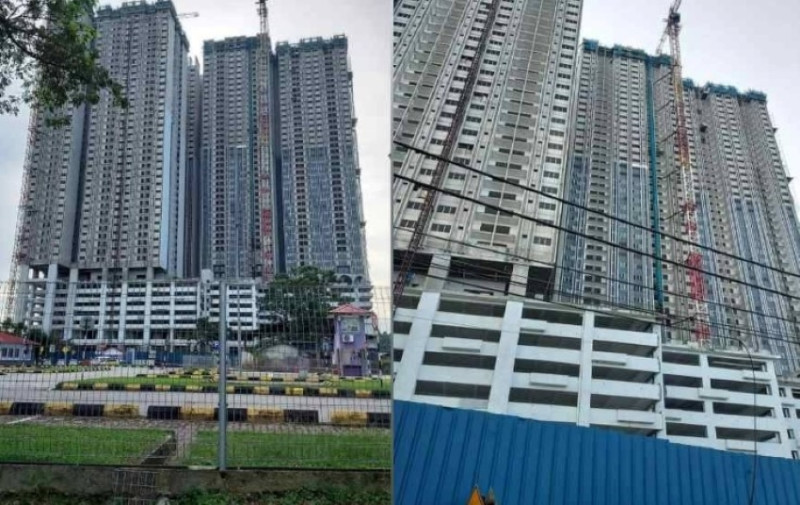
FOR Mohd Sharrel Fahmi Baharum, reading reports that the government would revive the abandoned Residensi Hektar Gombak housing project triggered a wave of mixed emotions — hope, relief, and lingering doubt.
“Imagine paying RM1,600 every month for almost five years now… and I have yet to even hold my house keys,” Bernama cited the 43-year-old father of two, one of whom is a special-needs child saying.
A government employee, Mohd Sharrel purchased his unit in 2018, but the project was declared "sick" by the National Housing Department in April 2023. A housing project is categorised as “sick” when its construction lags by over 30 percent or when the sale and purchase agreement (SPA) has expired.
The Residensi Hektar Gombak project was launched under the Federal Territory Affordable Housing (RUMAWIP) scheme with 2,400 units priced between RM266,000 and RM299,900. Since 2020, Sharrel has continued making loan repayments despite not having received possession of his home.
“My hope is that this time the promise will be fulfilled and the project completed as scheduled,” he said. “We buyers are exhausted and disappointed… previously, there was an announcement that work would resume in February 2025, but nothing happened.”
Another buyer, Mohd Adnan Othman, 34, postponed his marriage plans while renting a house with friends.
“My late mother always told me to secure a home first. She died in May without seeing me move in. It’s painful to bear this financial burden that shouldn’t even exist,” he said.
Work Resumes, Relief Grows
On 30 July, Housing and Local Government Minister Nga Kor Ming confirmed that construction on Residensi Hektar Gombak had officially resumed. The project is expected to be completed by 2027.
Located on 7.85 hectares of Malay Reserve land, the development has a gross development value of RM700 million. All units have been sold.
Buyers have since reported visible signs of progress, including the arrival of lorries and construction materials at the site.
Property analyst Professor Dr Noor Rosly Hanif of Universiti Malaya-Wales and the University of Technology Sarawak welcomed the revival but stressed that completion now depends on strict oversight.
“Past records show that the developer failed due to poor cash flow management, weak risk mitigation and inexperience,” he said. “The government has injected RM125 million, or RM52,000 per unit, to rescue the project. This must be carefully monitored.”
He urged the Ministry of Housing and Local Government to conduct quarterly audits and ensure that suppliers and contractors meet strict quality and credibility criteria. On-site monitoring should continue until the project is complete.
Given that the buildings have remained idle for several years, Noor Rosly cautioned that safety assessments are crucial.
“There is a risk of foundational shifts due to underground water movement, or deterioration caused by weather and vandalism. Structural integrity must be confirmed before construction resumes,” he said.
In rare cases where severe damage is found, he added, demolition and reconstruction may be necessary.
For abandoned projects that resume within a short period, market value typically remains intact, especially if new materials and designs are incorporated.
“However, for projects over 50 percent complete but abandoned for more than a decade, public reception is more cautious due to outdated design and potential quality issues,” Noor Rosly explained.
He advocated for stronger legal enforcement, including bankruptcy proceedings and asset liquidation against developers who fail to complete projects.
“Blacklisting is not enough. Buyers should not suffer financially and mentally because of developers’ failures,” he said.
He called for a shift from the current “sell-then-build” model to a “build-then-sell” approach, where only completed units with certificates of fitness can be sold.
“This ensures development risks are borne by the developer — not the buyer, who is usually the end-user, not an investor,” he said.
Noor Rosly proposed that major affordable housing projects be managed solely by government-linked companies such as Syarikat Perumahan Negara Bhd, UDA Holdings, TH Properties or Sime Darby Property.
“These firms have the financial strength and experience. Unknown developers should not be entrusted with building affordable homes,” he said.
Under Section 8A of the Housing Development (Control and Licensing) Act 1966, buyers can terminate their SPA and claim a full refund if construction has been suspended for six months, provided they obtain bank approval and the housing controller certifies the developer’s inaction.
Buyers can also file claims of up to RM50,000 through the Consumer Claims Tribunal under the Consumer Protection Act 1999, provided the claim is made within three years.
To date, the Ministry of Housing has successfully revived 1,127 abandoned housing projects involving over 135,000 buyers and a combined development value exceeding RM106 billion.
Notable revivals include the Rumah Ladang Estet in Selangor (abandoned for 27 years), the Bestari Jaya project (20 years) and the Putera Kiansom People’s Housing Project in Sabah, dating back to the Eighth Malaysia Plan.
Prime Minister Datuk Seri Anwar Ibrahim recently announced that one million affordable homes would be built from 2026 to 2035 under initiatives such as the Madani Residensi Programme, Rumah Bakat Madani, and the Public Employees Housing Scheme.
To date, 180,000 homes have been completed and another 235,000 are under construction.
“This shows the Madani government’s commitment to ensuring safe, affordable and comfortable homes for all Malaysians,” Nga said. - August 24, 2025