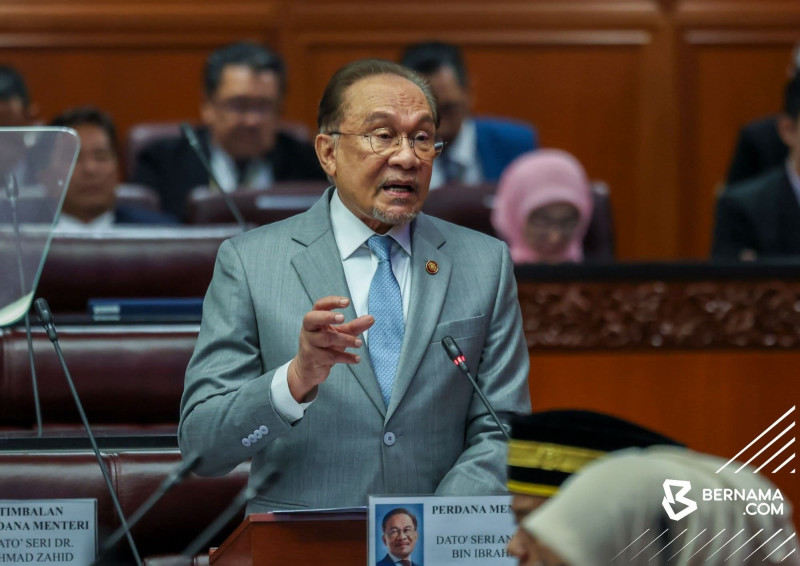
PRIME MINISTER Datuk Seri Anwar Ibrahim tabled the 13th Malaysia Plan (RMK13) in the Dewan Negara on Monday, seeking approval for a sweeping national blueprint aimed at recalibrating development strategies for the 2026–2030 period, in line with the Malaysia MADANI vision.
Addressing the Upper House, Anwar urged lawmakers to endorse the plan’s mission to strengthen socioeconomic development, enhance national resilience, and embrace values-driven governance in the face of intensifying global challenges.
“This Plan marks a departure from the previous models,” said Anwar. “It embraces a holistic reform of our economic and social structures, with clear strategies to lift living standards, promote equity, and build a respected, sovereign Nation-State.”
Under the theme ‘Redesigning Development’, RMK13 charts a shift toward a value-creation economy, greater income equity, spiritual and human development, and renewed leadership in regional and global affairs through digital and green transformations.
The Government has committed RM611 billion over five years to realise the Plan.
Some RM430 billion will come from public sector development expenditure, RM120 billion from domestic investments via government-linked companies and investment institutions, and RM61 billion through public-private partnerships.
Investments will focus on education, healthcare, housing, public safety, and core infrastructure, including school and hospital construction, housing for low-income groups, and flood mitigation measures.
The Plan outlines targets including annual GDP growth between 4.5 and 5.5 percent, a 5.8 percent increase in gross exports, a reduced fiscal deficit below 3 percent of GDP, and national debt capped at 60 percent of GDP.
By 2030, per capita gross national income is expected to exceed RM77,200, placing Malaysia in the high-income bracket. Inflation is projected to remain between 2 and 3 percent annually, unemployment will fall to full employment levels, and labour compensation will rise to 40 percent of GDP.
RMK13 is structured around nine strategic ‘Prakarsa’ or initiatives.
To address the cost of living, the Government will combine income enhancement with cost-reduction policies.
Key initiatives such as STR, SARA, and Rahmah programmes for food, internet, and insurance will continue. Price controls on food and public utilities will be strengthened. Wage policy reforms, including a review of the minimum wage and introduction of a progressive wage model, will be prioritised to ensure fair earnings.
The second initiative focuses on reforming the social system through the MADANI lens. This includes revamping the education system from pre-school to secondary level, enhancing STEM and digital skills, and bolstering national unity through programmes such as National Service and Kembara Perpaduan Malaysia.
The third initiative seeks to improve quality of life by building one million affordable homes, enacting climate legislation, upgrading flood mitigation infrastructure, and reforming the national healthcare system, particularly for underserved rural communities.
The fourth pillar targets equitable economic distribution by empowering underrepresented groups including Bumiputera, Orang Asli, Sabah and Sarawak communities, as well as the Chinese and Indian communities. Women, the elderly, and persons with disabilities will also be supported through wider economic participation.
In a bid to future-proof the economy, the fifth initiative will see Artificial Intelligence embedded as a core economic driver. The National AI Action Plan 2030 will guide talent development and research, bolstered by wider 5G coverage and a strong national data protection strategy.
The sixth pillar aims to strengthen industrial resilience and growth in key sectors including semiconductors, green energy, halal industries, Islamic finance, the creative economy, and micro, small and medium enterprises.
The seventh initiative addresses regional disparities through infrastructure projects such as the ECRL, Penang LRT and Pan-Borneo Highway. These will be complemented by improved rural roads, utilities, and basic amenities to ensure inclusive regional development.
Expanding Malaysia’s role in the global economy forms the eighth pillar. This includes implementing the Johor–Singapore Special Economic Zone (JS-SEZ), advancing initiatives like the ASEAN Power Grid and the Asia Zero Emission Community (AZEC), and broadening export markets to BRICS, Africa, and the OIC.
The final initiative seeks to ensure that public services are transparent, agile, and responsive. Public sector digitalisation through GovTech and MyDigital ID, improved institutional integrity, and prudent fiscal governance will underpin this effort.
Anwar emphasised the Government’s intent to “lift the floor” for all citizens, ensuring access to fair wages, quality education and healthcare, and economic mobility.
“This is not mere rhetoric,” he said. “We must curb inflation, create decent-paying jobs, and expand skill-building through strengthened TVET pathways and higher-level certification aligned with the Malaysian Qualifications Framework.”
Private employers will be encouraged to implement living wage standards, and a Multi-Tiered Levy Mechanism will be introduced to reduce dependency on foreign labour, with a target to lower the foreign workforce share to 10 percent by 2030.
Education reform will serve as the foundation of these efforts. The Government aims to raise pre-school and secondary school enrolment to 98 percent by 2030, exceeding global benchmarks. Teacher competency, infrastructure upgrades, and learning outcomes will be central to this reform.
“The 13th Malaysia Plan is more than a document — it is a collective mission,” Anwar concluded. “Let us rise above political divides and commit ourselves to building a dignified, resilient, and prosperous Malaysia for all.”
Parliament will now begin debate on the proposed plan. - August 25, 2025