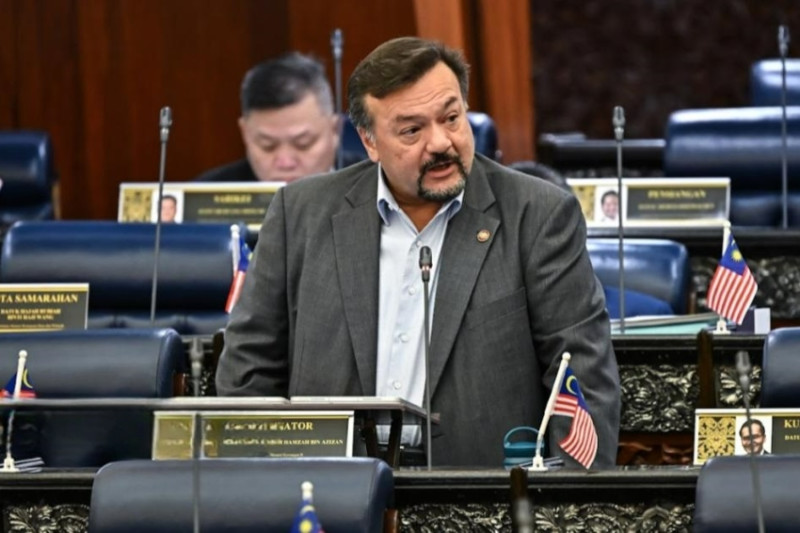
FINANCE Minister II Datuk Seri Amir Hamzah Azizan has rejected claims that the Government Procurement Bill 2025 (RUU Perolehan Kerajaan) would grant excessive powers to his office, arguing instead that the proposed law would curtail ministerial discretion while introducing stringent accountability and oversight mechanisms.
Winding up the policy stage debate on the Procurement Bill 2025 in the Dewan Rakyat on Thursday, Amir thanked the 21 Members of Parliament who contributed to the debate and reaffirmed the bill's alignment with the government’s MADANI economic framework, particularly its pillar of enhancing public financial management.
He said the legislation complements the Public Finance and Fiscal Responsibility Act 2023 and recent amendments to the Audit Act 1957, adding that it builds on the principle of “follow the public money”. The new bill, he noted, would further tighten the provisions found in the Financial Procedure Act 1957.
“This bill reinforces five core procurement principles: public accountability, transparency, value for money, open competition, and fairness,” said Amir, adding, the Ministry of Finance would incorporate the suggestions made by MPs into the detailed regulations and guidelines to follow.
Responding to concerns raised by ten MPs regarding the concentration of power in the hands of the Finance Minister, Amir clarified that the current law already grants such powers under Section 6(1) of the Financial Procedure Act 1957.
He stressed that the new legislation, far from expanding these powers, introduces legal limits and oversight.
“In reality, this bill does not expand the Minister’s powers—it limits them,” he said, highlighting the creation of a Procurement Review Panel and an independent Procurement Appeals Tribunal under Parts 9 and 10 of the bill.
“No one is above the law. Under this bill, the Finance Minister may also be prosecuted and punished—by fine or imprisonment—for failing to declare a conflict of interest or for interfering with the procurement process,” he added.
Amir explained that ministerial approval is only required for procurements exceeding RM50 million for goods and services, or RM100 million for works contracts.
He underlined that all such decisions must be accompanied by a formal declaration of interest, as stipulated under Clause 37(1), with non-compliance constituting a criminal offence under Clause 82.
“The perception that the Finance Ministry acts as both player and referee is inaccurate,” he said, assuring the House that the bill establishes a fully independent investigation unit, to be staffed by officers from external enforcement agencies, with oversight from the Treasury Secretary-General under Clause 39.
On the matter of direct negotiations, Amir reaffirmed that open tender would remain the primary procurement method under Clause 28.
He noted that any alternative methods could only be employed under clearly defined conditions—such as public urgency, security concerns, or when there is only one viable supplier—and that such decisions would be subject to appeal and possible penalties.
Clause 28(2) mandates that alternative procurement procedures must be regulated and accompanied by qualifying criteria, conditions, and limitations. “Clear discipline will be imposed even for non-open methods,” he said.
In response to queries raised by the Bachok MP, Amir confirmed that national procurement policies favouring Bumiputera participation will continue to apply, and that these will be enforced through subsidiary guidelines and circulars issued under the framework of the new law.
He also addressed Clause 17, which requires that only registered contractors and suppliers may participate in government procurement exercises.
“The aim is to ensure that only qualified, credible, and competent vendors are allowed to bid,” he said, noting that registration criteria—including criminal records, bankruptcy, or insolvency—are transparently set out in Clause 19.
All procurement exercises will be conducted through the eProcurement system, as mandated under Clause 36, which Amir said would ensure fairness, competitiveness, and full digital traceability of offers and decisions.
Responding to calls from Rasah and Puchong for enhanced transparency, Amir pointed to several clauses intended to reinforce integrity in procurement processes.
These include mandatory conflict-of-interest disclosures (Clause 37), the establishment of internal Procurement Review Panels at all implementing agencies (Clauses 61 and 62), and the creation of an independent Procurement Appeals Tribunal (Clause 63).
He added procurement decisions will be made based on technical and financial evaluations via eProcurement, and not subject to arbitrary interference.
“The bill reflects our commitment to manage every sen of public funds with transparency, efficiency and integrity,” Amir said in closing.
“With a more robust framework and stronger enforcement mechanisms, we will curb leakages, close avenues for abuse of power, and restore public trust in governance.”
He described the bill as a pivotal step towards a better-governed and more accountable Malaysia. - August 26, 2025