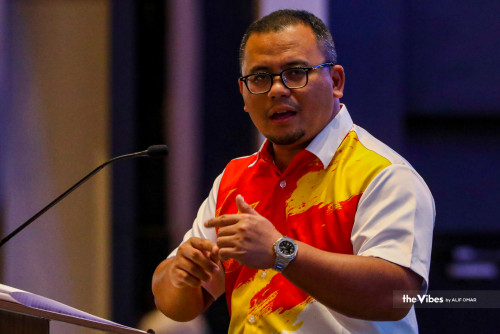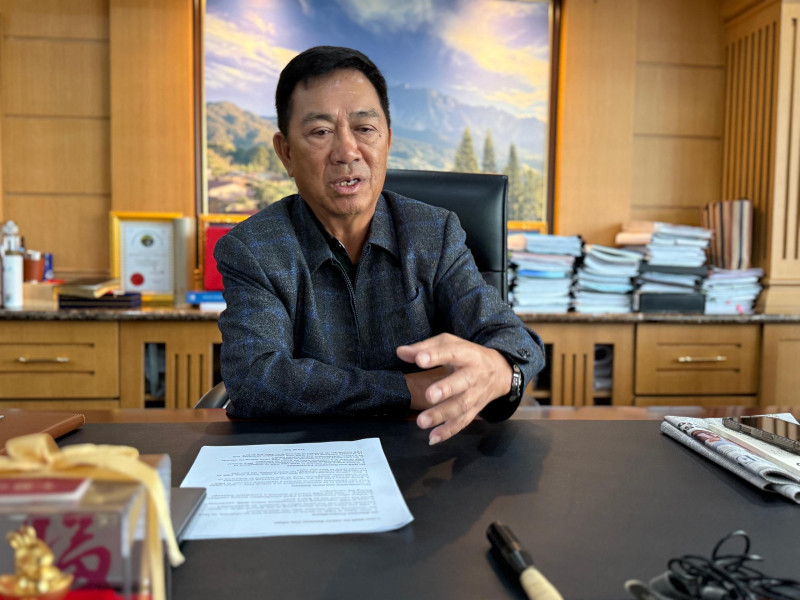
DR Joachim Gunsalam, a medical doctor turned politician, faces his toughest test yet as he leads Parti Bersatu Sabah (PBS) into the state election for the first time as acting president. A five-term Kundasang assemblyman since 2004, his performance will not only decide PBS’s future but also weigh heavily on the ruling Gabungan Rakyat Sabah (GRS) coalition.
The Kadazandusun Murut (KDM) vote, once PBS’s anchor, is now split across rival parties, especially Star. Both claims to champion KDM interests, but their division has blunted the bloc’s influence. How PBS fares will determine if the KDM voice regains weight in government or remains fractured.
For Gunsalam, the contest is also personal as well as political. A strong showing could seal him as PBS president. Failure maybe could deepen the party’s leadership uncertainty and raise questions over his softer, consensus-driven approach.
Since replacing Maximus Ongkili in 2022, Gunsalam has emphasised diplomacy and consultation, in contrast to Jeffrey Kitingan’s combative style at Star.
Supporters see pragmatism while critics see weakness. He insists it is steadiness, not indecision, that PBS needs to survive its toughest election in years.
PBS itself, which was founded in 1985, is not the kind of party that switches sides for convenience. It has chosen to sit with the opposition camp when necessary — from 1994 to 2002 and again from 2013 to 2018 — rather than abandon its principles. That history, Gunsalam argues, shows discipline and resilience where others bent to political expediency.
Met in his ministerial office in the final days before switching fully into campaign mode, Gunsalam outlines PBS’s preparations, defends its place in GRS despite corruption scandals, and explains why he believes the party’s history and disciplined machinery remain decisive assets.
Q: How ready is PBS to face the election?
A: “We are very ready. I have all my candidates ready. Even the seats that we are asking for, we have candidates there — no problem with that.
“In terms of machinery, the senior YBs know what they are doing. The new YBs might have some problems, but they already told me they are prepared on the ground. All the PDMs have people ready.
All they need is the extra push — meaning finances, the allocation (peruntukan). That’s all.”
[Joachim acknowledged that newer assemblymen and candidates may face challenges, particularly in terms of funding for local machinery, but stressed PBS is ready.]
Q: When you say ‘new YBs’, do you mean first-term ones?
A: “First term, second term. They might have some issues, but they are ready. And new calon [candidates] because we expect to have new ones as well.”
Q: In 2020, PBS contested 22 seats but only won seven. How do you see it this time?
A: “This election, we see how it is. I really think we should talk with GRS and get winnable candidates. It’s not just about PBS, because all of us are fighting the same battle — for the future of Sabah.
“Yes, we want more seats, but we should not demand too much. If we have the people, yes, we can ask. But if another party has a better candidate, then there has to be compromise somewhere.”
[Context: In 2020, PBS contested 22 seats and won 7, while Star contested 23 and won 6. Together the two KDM parties fielded 45 candidates but only captured 13 seats.]
Q: With Star no longer in GRS, how many seats is PBS targeting?
A: “Now that Star is not in the picture, those four or five seats that were supposed to go to PBS, we are looking at them. Earlier, we estimated between 18 and 20 seats for both Star and PBS. Now it’s PBS.
“But it doesn’t mean we can simply clash (langgar) with Star. The pact is still relevant. To me, the pact is still on. If possible, we are not going to contest against each other, because the pact is binding. It can only be broken through mutual agreement.”
[Context: “Langgar” is colloquial Malay for crashing or colliding; in political terms, Joachim meant clashing in contests.]
(PBS and Star signed an MOU to work together in April 2024, but with Star out of GRS, situations believed to have changed)
Q: The Star–PBS merger talks are not dead following Star departure?
A: “Of course it is going to affect the merger. But the understanding is still there. We have not given up on it.”
Q: What message does PBS want to deliver in this election?
A: “PBS has been consistent. Even after the collision, we said we are doing it under GRS.
“We have been consistent in fighting for Sabah rights through MA63.
For example, I am co-chairing health matters for Sabah with the federal health minister, Datuk Seri Haji Dr. Dzulkefly Ahmad. We are pushing for revision of the public health ordinance so Sabah can decide on vaccinations.
“At the moment, foreigners cannot be vaccinated. But if we don’t vaccinate foreigners or street children, then we cannot reach herd immunity. So, we are asking for devolution on health matters. That is what we want.”
[MA63 refers to the Malaysia Agreement 1963, which guarantees Sabah and Sarawak special rights. PBS often highlights its role in pursuing gradual devolution of powers from the federal government.]
Q: This is your first time leading PBS into an election. How do you avoid a leadership vacuum?
A: “2020 was still under Max (Ongkili). This is the first time I am leading.
“I am not leading alone. I have a team of dedicated leaders, with the political bureau and senior figures. We consult each other every now and then. I don’t decide alone. That’s my principle.
“To me, I am not here to give orders. I am here to say, come, let us discuss what is best for the party.
“I might be a poster boy to outsiders, but inside the party we talk to each other. So, there is no vacuum there.”
[PBS has not formally elected a new president since Maximus Ongkili stepped aside due to health reasons. Joachim has served as acting president for over a year, which critics describe as a leadership vacuum.]
Q: Critics say a consultative style makes a leader look weak.
A: “No. It is not a sign of weakness. It is adapting to the current situation. Every crisis is different.
“The party is not just me. It is all the members. Of course, when a decision is made, they will know in advance. That is why I insist there is no (leadership) vacuum.”
Q: Some PBS members are said to be looking at leaving for Star. Is that true?
A: “Yes, some PBS members may join Star because they want to lead, or they want to be a candidate. But if that is the case, then what was the main aim of joining the party?
“If you want to be a leader just to be a candidate, that is different. If you want to be a leader because you believe in the struggle, then it doesn’t matter whether you are a candidate or not.
“I have also heard rumours that some have been approached by other parties to become candidates. But others have told me clearly: ‘No, I am still with PBS. My struggle is with PBS.’ That is what matters.”
Q: Let’s turn to GRS. Critics argue staying in GRS ties PBS to corruption scandals.
A: “It depends on what you mean by tainted. It is a grey area. This issue came from one man trying to get mining licenses. He approached different YBs separately. Each one thought he was the only one asked. None of us knew he had asked the others.
“He had about 19 companies under his belt. When the Chief Minister saw everything went through one person, he said: no, this cannot be. This is cartelisation. He rejected it. That was the right decision. So, it’s not a case of corruption by PBS.”
[“Cartelisation” refers to Albert Tei’s alleged tactic of splitting applications across multiple companies he controlled, to build a monopoly-like hold over mining rights.]
Q: But the perception of corruption is still strong.
A: “Yes, perception. But perception is created by others, perhaps the opposition, or maybe individuals not knowing the full story.
“The truth will prevail. PBS has given full cooperation to the authorities. Let the investigation continue. We are open.”
Q: A video of you with Albert Tei was circulated. What’s your response?
A: “I am aware of the video. He asked, and I told him: if you want to donate money to the party, I will use it for the election. I did not ask him (for the money).
“All my statements and WhatsApp with him have been handed to the authorities. I volunteered to give them.
“This happened in 2022, before Langkah Kinabalu [the failed coup attempts to topple the Chief Minister]. The video itself was in 2024, when he was already trying to bring down the Chief Minister.
“To me, the truth will prevail. I believe in that. We wait for the relevant authorities.”
Q: Finally, how do you see PBS’s role compared to Jeffrey’s push for full autonomy?
A: “Jeffrey is more vocal, but his idea of full autonomy is impractical. Sabah’s revenue is about RM7 billion, maybe RM10 billion. But education spending is already RM5 billion, health is RM6 billion. We cannot sustain that on our own.
“Our approach is being pragmatic — we fight for Sabah rights within Malaysia, not in isolation. That is a better way forward.”
[Under MA63, Sabah has a constitutional entitlement to 40% of federal revenue collected in the state, a demand opposition critics argue PBS has not pushed hard enough.]
Q: There are rumours you may not be able to defend Kundasang. How do you respond?
A: “I leave it to the people. I am there to serve. If they don’t want me, then I under direct [I accept it directly]. Simple as that.
“I have been there for the last five terms. I am not saying that I have done everything, but we have done something. We have done a lot of things. So, with that, it’s okay with me. Let them decide.
“I have some supporters, yes, I mind that, but let them decide. I am quite okay with that.”
[Joachim has been assemblyman for Kundasang since 2004, winning five consecutive terms. His incumbency now stretches 21 years, making him one of PBS’s longest-serving representatives.]






.jpeg)