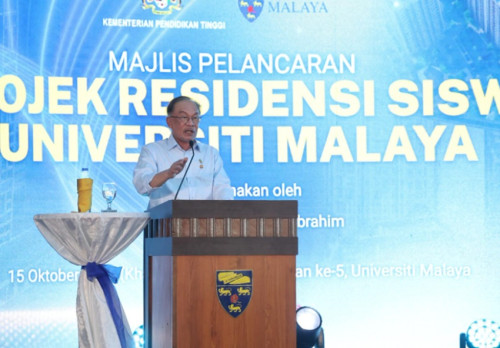
DEPUTY Prime Minister II Datuk Seri Fadillah Yusof formally opened the International Halal Economic Conference 2026 and launched the World Islamic Economic Development initiative,
The twin events brought together policymakers, industry leaders, Islamic finance institutions, academics and strategic partners from Malaysia and abroad.
In his keynote address, the Deputy Prime Minister II invoked the Quranic reminder that Muslims are entrusted with the responsibility to act as a just and balanced community.
“This position is not a privilege but a responsibility to exemplify good conduct and justice to all humanity through our actions,” he said.
Highlighting the significance of the conference, Fadillah described halal as a global economic agenda extending beyond food and beverages to sectors including Islamic finance, pharmaceuticals, cosmetics, logistics, tourism, technology, energy, engineering, governance and international standards.
The global halal economy is now estimated at USD40 trillion across more than 90 key sectors.
“Halal is not merely a market opportunity — it is a values-based economy built on trust, integrity and responsibility. When halal is upheld sincerely, the economy grows, and society is safeguarded,” he added.
Fadillah outlined Malaysia’s strategic advantages, such as internationally recognised halal certification, strong institutional governance, and policy stability, stressing the need to strengthen these through clear leadership, continuous innovation, strategic investment and structured cross-border collaboration.
He highlighted JAKIM’s ISO/IEC 17065 accreditation, ongoing efforts to extend halal certification to state religious authorities, and adoption of OIC/SMIIC standards to facilitate trade and global recognition.
Malaysia’s National Halal Policy (DHN), expected by May 2026, will guide an inclusive, sustainable halal ecosystem, he said, citing international awards such as the Institutional Excellence in Halal Governance at the World Islamic Tourism & Trade Award 2025 and the World Muslim Leadership Excellence Award 2025. Malaysia also recognises 92 foreign halal certification bodies across 48 countries in line with international standards.
“Halal is not merely product certification; it is a legacy and a trust to be preserved for future generations. Malaysia has built a comprehensive halal ecosystem encompassing certification, research, innovation, industry development and governance,” he said.
He described priority initiatives to advance the industry, including streamlined SME certification pathways, enhanced certification systems with mutual recognition, and strengthened halal clusters in cold-chain logistics, pharmaceuticals, cosmetics, and ready-to-eat foods.
He also emphasised the enforcement of halal standards under the Trade Descriptions Act 2011, noting that from 2023 to 2025, authorities recorded 182 enforcement cases with seizures valued at RM4.46 million and investigated 552 halal-related complaints.
The halal industry’s contribution to Malaysia’s economy reached 7.94 per cent of GDP, or RM118.2 billion, by the third quarter of 2025, supported by 1,525 registered halal exporters.
Through the Halal Industry Master Plan 2030, Malaysia aims to raise the sector’s value to RM231.1 billion, boost halal exports to RM70 billion, and increase its GDP contribution to 10.8 per cent by 2030.
On the historic launch of WIED, Datuk Amar Haji Fadillah described the initiative as a coordinated global platform to unify the fragmented Islamic and halal economy, enhance strategic cooperation among governments, industries and financial institutions, and drive ethical, structured and sustainable economic growth.
The Deputy Prime Minister II reminded attendees of the Prophet Muhammad SAW’s teaching: “Seeking what is halal is obligatory for every Muslim,” emphasising that halal commerce is both a spiritual and economic responsibility.
“Halal is not merely a market standard — it is a civilisational trust. When safeguarded with knowledge, integrity and perseverance, it not only builds the economy but shapes the future of communities and the world,” he said. - February 3, 2026