KUALA LUMPUR – A fictitious agreement was used to cover up the payment of bribes from former Jepak Holdings Sdn Bhd managing director Saidi Abang Samsudin to Datin Seri Rosmah Mansor, said the prosecution.
The team, led by senior deputy public prosecutor Datuk Seri Gopal Sri Ram, said the purpose of the said deal was to “regularise” the bribe that Rosmah would receive.
“The object was to prepare an agreement to conceal the true nature of the payment by Saidi, who is the 17th prosecution witness, to the accused. The euphemism ‘consultancy’ was used to mask the payment of the bribes,” said the prosecution in its written submission filed at the high court here on Tuesday.
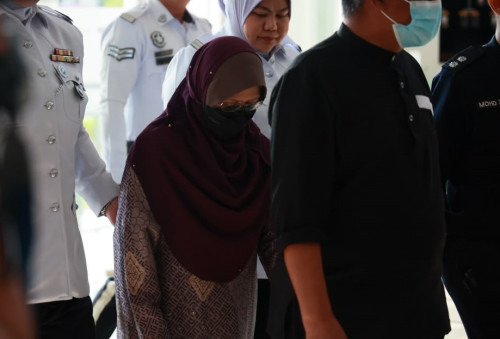
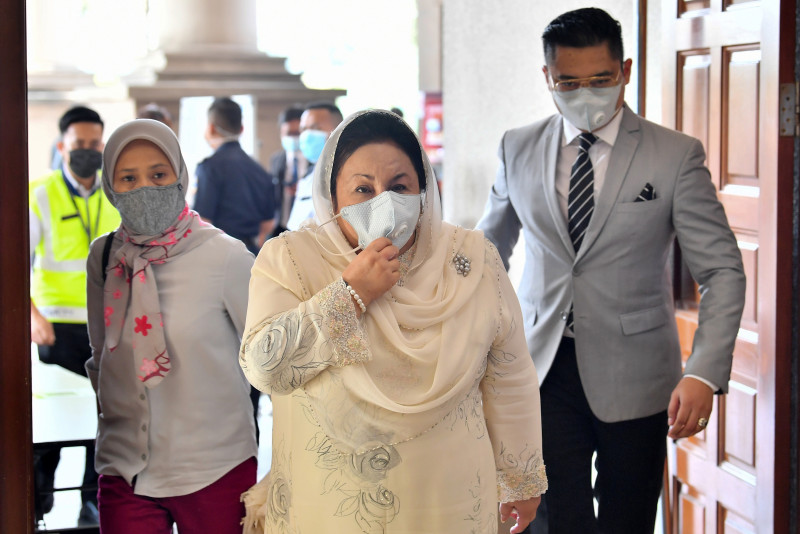
Rosmah, the wife of former prime minister Datuk Seri Najib Razak, is on trial for allegedly soliciting RM187.5 million and receiving bribes totalling RM6.5 million from Saidi as a reward for helping Jepak Holdings secure a solar project, as well as the maintenance and operation of diesel generator sets, for 369 rural schools in Sarawak, in a contract worth RM1.25 billion from the Education Ministry through direct negotiations.
Presiding judge Mohamed Zaini Mazlan fixed February 10 for the parties to appear before him for oral clarification, before deciding whether to acquit Rosmah of the corruption charges or order her to enter her defence.
The prosecution, which closed its case on December 11, said if the payment in question was truly a genuine political donation to Najib, then it was unnecessary to mask it under a “consultancy agreement”.
In the submission at the end of its case, the prosecution said the agreement for the solar project, which has since gone missing, was prepared by the 20th prosecution witness, businessman Lawrence Tee Kien Moon.
“Tee is a truthful witness, and despite the accusations of unethical conduct hurled at him, his credibility remains unshaken. He is a disinterested witness, and his evidence is purely of corroborative value.”
Based on evidence, it said, the money was delivered to Rosmah on two occasions – a first payment of RM5 million was delivered to her official residence, and a second payment of RM1.5 million to her private residence.
The prosecution said there is evidence that Rosmah spoke to former education minister Datuk Seri Mahdzir Khalid, the ministry’s then secretary-general, Tan Sri Madinah Mohamed, and Madinah’s successor, Datuk Seri Alias Ahmad, to facilitate or accelerate the award of the contract to Jepak Holdings, and later, expedite payment to the company.
“This evidence fairly supports the prosecution’s case that the accused solicited a bribe as a reward for assisting Jepak Holdings obtain the solar contract.”
It said the decision of the public prosecutor to prosecute Rosmah and adduce such evidence that is lawfully admissible to prove her guilt is not selective or discriminatory.
It said the accused’s contention of selective or discriminatory prosecution, which it denies, is not a defence to the charges against her.
“Based on the foregoing, this honourable court is respectfully moved to make a finding that the prosecution has established a prima facie case, and for an order that the accused’s defence be called upon all three charges.”
Meanwhile, the defence, in its written submissions filed on Monday, countered that the prosecution failed to establish a prima facie case because it is clear that Saidi was the one who intended and offered a political donation to Rosmah.
The defence, led by lawyer Datuk Jagjit Singh, said the political donation was meant for Najib as a “gesture of gratitude” for supporting the application by Jepak Holdings, and to ensure Barisan Nasional’s victory in the 14th general election.
On the alleged consultancy agreement, the defence said Rosmah had no knowledge whatsoever about the document purportedly drafted by Tee, and that Saidi, in his witness statement, testified that the idea to draft such a deal was Tee’s.
“There is no independent evidence before the court that the accused has knowledge about the alleged consultancy agreement, or the accused has sighted the same. After the alleged consultancy agreement was drafted and finalised, the parties were Jepak Holdings and a company named Lucky from Taiwan (the name was given by Tee), and the name of the accused was not mentioned at all.
“Since the accused never instructed, and her name was not mentioned at all in the alleged consultancy agreement, a nexus could not be made to the accused.”
The defence said there is also no credible evidence produced by the prosecution to corroborate the evidence provided by Rosmah’s former aide, Datuk Rizal Mansor, to prove that he was indeed instructed by the accused to ask for the gratification from Saidi.
Further, it submitted that the fact that the gratification was allegedly demanded through Rizal showed that Saidi had no first-hand knowledge in proving that Rosmah was the one who demanded the said gratification.
“The prosecution has failed to show credible and independent evidence that the accused solicited and received any of the corrupt monies. The truth completely unfolded through the evidence of the three main prosecution witnesses – Saidi, Rayyan Radzwill Abdullah (Saidi’s former business partner) and Rizal – where their evidence contradicted each other’s.
“The prosecution’s case does not lead to an irresistible inference that the accused committed all the offences as charged. Hence, the defence should not be called merely to clear or clarify the prosecution’s case.” – Bernama, December 31, 2020