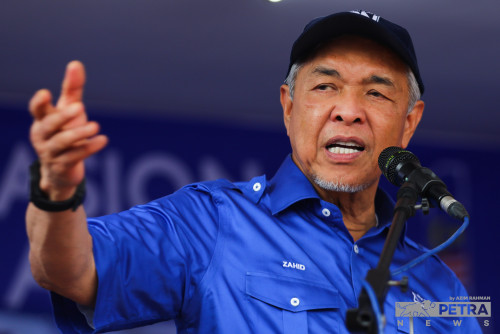
AS questions continue to grow over Perikatan Nasional’s (PN) future direction, political analyst Dr Azmi Hassan believes the party facing the biggest dilemma is not PAS, but Bersatu, which he said should be the one considering an exit from the opposition coalition.
Azmi said Bersatu’s internal struggles and declining influence had become a major weakness for PN, raising questions over whether the party could continue to play a meaningful role within the coalition.
He pointed to Bersatu’s decision to contest the Negeri Sembilan state election under its own logo as a possible indication that the party was already taking steps away from PN, despite remaining a member of the coalition.
“Logically, Bersatu is the party that should leave PN. If we look at Negeri Sembilan, Bersatu has almost moved away from PN by using its own logo,” he said.
According to Azmi, the move reflected deeper problems within Bersatu, which he said had struggled with internal conflicts that have weakened both the party and PN’s overall standing.
“The reality is that Bersatu’s internal issues have weakened PN. To make matters worse, Bersatu should officially leave PN,” he added.
It has been reported that Bersatu president Tan Sri Muhyiddin Yassin had pushed back against calls for his party to leave PN, arguing that PAS should be the one to step away from the coalition after choosing to end political cooperation between the two parties.
Muhyiddin likened the situation to disagreements within a shared “house”, saying it was illogical to demand that Bersatu vacate the coalition when PAS was the party that initiated the split.
PAS ended its cooperation with Bersatu early last month, though both remain PN components.
The coalition, now chaired by PAS vice‑president Datuk Seri Ahmad Samsuri Mokhtar, has since admitted two new members — Pejuang and Parti Wawasan Negara, led by former Bersatu deputy president Datuk Seri Hamzah Zainudin.
However, Azmi said leaving PN would not mean Bersatu could operate independently, as the party would need to align itself with a larger political platform to remain competitive.
He suggested that Pakatan Harapan (PH) could potentially become an alternative for Bersatu, particularly if the party can convince PH that it can expand the coalition’s appeal among Malay voters.
“Bersatu cannot go solo. It has to join a bigger coalition, and the bigger coalition would be PH,” he said.
Azmi said Bersatu could position itself as a bridge to attract Malay voters who may not currently support PH, but acknowledged that PH leadership would likely remain cautious about accepting the party as an ally.
The hesitation, he said, stemmed from Bersatu’s past political history, including its role in the collapse of the previous PH government following the Sheraton Move in 2020.
“Bersatu can say it can bring more Malay voters to support PH, but at this stage, PH is still very hesitant to accept Bersatu as an ally,” Azmi said.
He added that Bersatu would first need to prove its ability to win over Malay voters, with the Negeri Sembilan election potentially serving as a key test of the party’s remaining influence on the ground.
“Whether Bersatu can actually attract Malay voters in Negeri Sembilan needs to be seen after the state election,” he said.
Azmi’s remarks come amid growing speculation over the future dynamics within PN, where Bersatu and PAS have increasingly appeared to have different priorities despite remaining partners in the coalition.
While PAS continues to strengthen its position as PN’s dominant force, Bersatu has faced challenges in maintaining its political identity and voter support, particularly after losing its position as the coalition’s main Malay political vehicle. – July 27, 2026