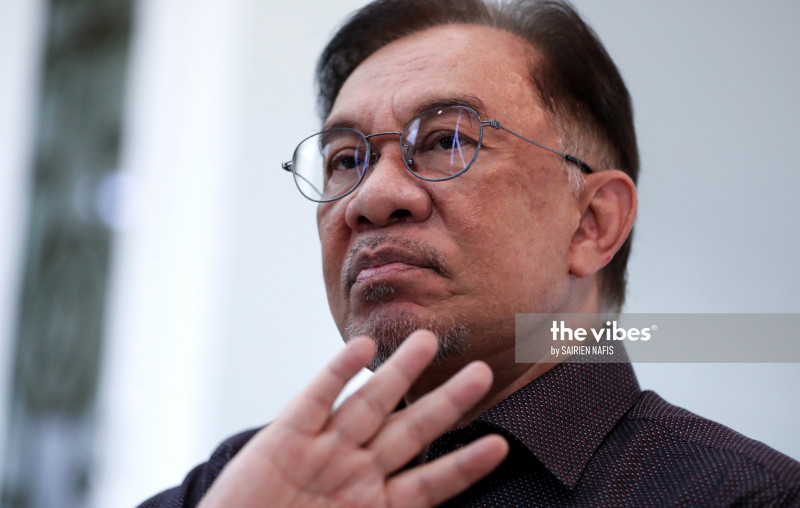
PUTRAJAYA – The Federal Court today reserved its decision in Datuk Seri Anwar Ibrahim's legal questions on the constitutionality of the National Security Council Act (NSCA) 2016.
A seven-man bench led by Federal Court judge Datuk Vernon Ong Lam Kiat said the court would take time to consider the matter and would inform parties once they were ready with the decision date.
The other judges presiding on the bench were Federal Court judges Puan Sri Zaleha Yusof, Datuk Zabariah Mohd Yusof, Datuk Seri Hasnah Mohammed Hashim, Datuk Mary Lim Thiam Suan, Datuk Harmindar Singh Dhaliwal, and Datuk Rhodzariah Bujang.
Today’s proceeding was conducted online, with the seven judges and several court officers in an open court, while counsel Datuk Seri Gopal Sri Ram who represented Anwar and senior federal counsels Suzana Atan and S. Narkunavathy representing NSC and the Malaysian government appeared virtually before the panel.
The court reheard the PKR president’s legal questions as it had on September 10 last year, allowing Anwar’s review application to set aside a majority ruling on February 11 that had declined to answer constitutional questions on the validity of the NSCA.
Earlier, Sri Ram submitted that the NSCA, which came into force on August 1, 2016, was unconstitutional as it has taken away a number of basic fundamental rights guaranteed under the federal constitution.
“Several aspects of the NSCA had removed the rights to life and personal liberty, freedom of movement, right to property, free speech, assembly, and association," he said.
The lawyer further said that the NSCA was also unconstitutional because it did not receive the royal assent of the Yang di-Pertuan Agong.
“The act was null and void as the king did not give his royal assent. The king’s function of assenting to bills is an executive authority and he must act on the advice of the cabinet or a minister,” he said adding that nowhere was it stated in the act that it was enacted by Parliament under Article 149 of the federal constitution, where fundamental rights could be taken away.
Suzana argued that the king did not have discretion in assenting bills as he is a constitutional monarch and must act on the advice of the cabinet and minister.
On February 11 last year, the Federal Court in a 5-2 majority verdict declined to answer the constitutional questions raised by Anwar on the NSCA and held that it had not been shown that the existence of the NSCA had interfered with Anwar’s personal life.
Anwar subsequently filed an application to review the February 11 decision to which the court had on September 10 allowed his request to set aside the majority ruling and ordered the case to be reheard at the Federal Court.
Anwar had filed the originating summons in 2016 to challenge the constitutionality of the NSCA, claiming that its implementation was unconstitutional. He had named the National Security Council and government as defendants.
On March 14, 2019, the Kuala Lumpur High Court allowed Anwar’s application under Section 84 of the Courts of Judicature Act 1964 to refer the matter to the Federal Court for determination of four constitutional questions. – Bernama, January 7, 2021