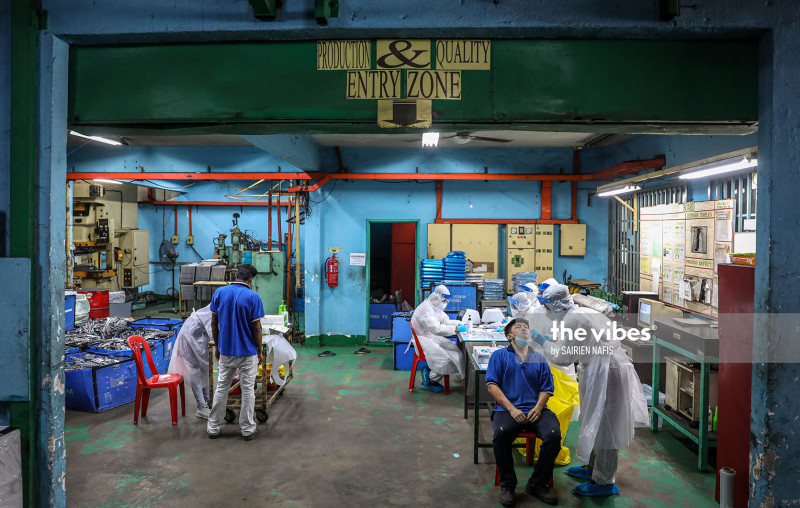
KUALA LUMPUR – Former ministers in the Pakatan Harapan administration have urged Putrajaya to heed medical experts’ call and begin mass Covid-19 testing, especially for those living in high-risk areas.
“We strongly believe that the government must heed the call of many medical experts to embark on a mass testing exercise, starting with screening in all high-risk areas, such as foreign workers’ living quarters, prisons and the community living near them,” said a joint statement.
“According to the parliamentary reply, government facilities can do PCR tests of close to 19,489 per day (16,670 tests under the Health Ministry and 2,819 under the Defence Ministry), while the private sector can do 59,485 tests per day. That is a national total testing capacity of close to 80,000 PCR tests a day.
“But if we dispute over the exorbitant cost of doing this screening, please resort to the inexpensive and faster turnaround time of the RTK Antigen test, which is arguably more appropriate for the purpose of mass screening. Be that as it may, we are undoubtedly capable and have the capacity to do mass testing for targeted areas.”
The statement is signed by former health minister Datuk Seri Dr Dzulkefly Ahmad, his former deputy, Dr Lee Boon Chye, former energy, science, technology, environment and climate change minister Yeo Bee Yin, and her deputy, Isnaraissah Munirah Majilis.
They pointed out that the majority of Covid-19 cases, or about 80%, are asymptomatic, and given this, mass testing is critical to enable the early isolation of patients and prevent the disease’s spread in the community.
They said the government should combine epidemiological data and artificial intelligence to come up with a risk-ranking algorithm capable of predicting big clusters.
The Selangor-owned Selcare has been running a series of community testing programmes in areas close to factories in Klang where outbreaks have been recorded, they said.
“For example, in Taman Bayu Perdana, two community testing (programmes) have been organised, the first one on December 23, 2020 – out of the 915 tested, 63 were positive (60 locals and three foreigners) – and the second one on January 3 – from the 75% samples analysed so far, out of 1,021, 45 are positive (33 locals and 12 foreigners).
“This represents a 4.4% positivity rate. Remember, WHO (World Health Organisation) recommends a positivity rate of less than 5% as a threshold of controlled community spread. Admittedly, of the eight mass community screenings done, there were others ranging from about 7% to 25%.”
Acknowledging that mass screenings may be costly and result in a spike in infections detected, the former ministers said Malaysia has to face the facts head-on and isolate individuals found to be infected.
They panned the government’s MySejahtera tracing app, which has reportedly detected only up to 4% of total infections nationwide, and Putrajaya’s reliance on manual contact tracing.
“It also shows that the government has not fully (or at all) leverage big data analytics using the data collected through MySejahtera and combine it with other data available in the government system, as well as public data that can be mined, such as posts with metadata and tags used on social media, etc, and develop a more sophisticated way of tracing cases in the community.
“We must keep on innovating and not sit complacently on our early successes and laurels.” – The Vibes, January 8, 2021




.jpeg)