KEPALA BATAS – The cost of cultivating padi is expected to go up after rice farmers were directed to only purchase seeds from their respective area’s Farmers’ Association (PPK) by the federal government, instead of from the open market.
About 1,000 rice farmers in Seberang Prai Utara are protesting the decision by the Agriculture and Agro-Based Industries Ministry to grant monopoly power to PPK to sell seeds of essential crops this year, especially in the midst of a pandemic.
PPK is a management agency under the National Farmers’ Organisation (Nafas).
The decision will likely have an impact on padi production in the coming season, as the seeds will be sold at a higher price to farmers than in stores and distributors.
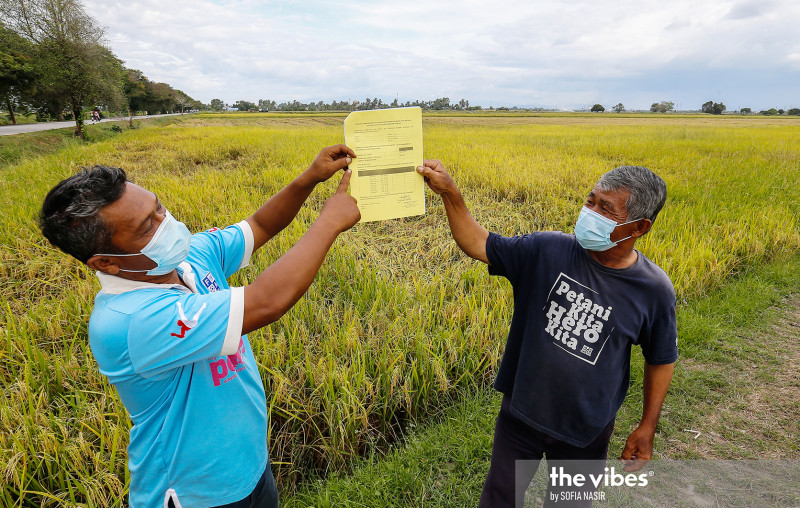
Farmer Lee Seng Wye, 64, said he is disappointed about having to buy padi seeds from PPK at RM35 for 20kg, compared with RM31 from his usual distributor.
“Actually, what worries us more is if we are given low-quality rice seeds. If that happens, we will find it difficult to get help because PPK is only open during office hours, while our work is full time.
“The process of planting rice should not be delayed because the release of water at dams only occurs for 10 days. If we do not have time to plant, we will lose,” he told The Vibes recently.
In November last year, Nafas was appointed the sole wholesaler in the federal government’s Legit Rice Seeds Incentive programme.
The programme is aimed at solving long-running distribution and pricing problems afflicting rice farmers nationwide.
Agriculture and Agro-Based Industries Minister Datuk Seri Ronald Kiandee had reportedly said the move will prevent manipulation of the price of rice seeds by various parties.
Meanwhile, another farmer, Mohd Yusri Mustafa, 40, said that his colleagues had to sign a pledge form as a condition to obtain their supply of padi seeds from PPK.
Yusri said he was told the PPK can provide any type of seed if the supply needed by farmers is not sufficient.
It is understood that the form needs to be signed and submitted before Thursday.
“Our padi has eight types of seeds, and each one has its own function. For example, during the rainy season, we need to plant wind-resistant seeds.
“If you want to plant padi, you also need to follow the season – you can’t simply plant anything,” said Yusri, who has been cultivating padi for 23 years.
He hoped that the government will give licences to other distributor companies, apart from PPK, to distribute seeds.
The issue has also received the attention of state Agrotechnology, Food Safety, Rural Development and Health Committee chairman Dr Norlela Ariffin, who held a meeting with farmers on January 24 and pledged to look into their grievances.
Seberang Prai Utara is home to the largest area of padi fields in Penang, with a total of 1,546ha, followed by Seberang Prai Selatan (1,365ha), Seberang Prai Tengah (305ha) and in the southwest (112ha). – The Vibes, February 2, 2021
1,000 Penang padi farmers protest against PPK seeds monopoly
Move likely to impact price as the cost of the seeds is higher than usual distributors
Updated 5 years ago · Published on 02 Feb 2021 3:20PM

.jpeg)