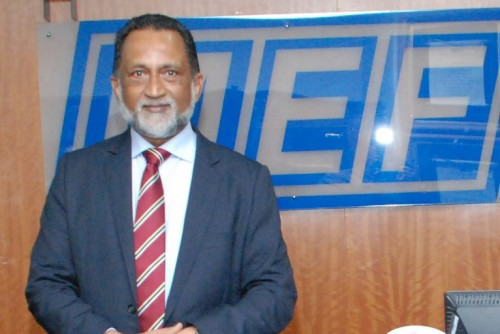

KUALA LUMPUR – Malaysia could graduate into a high-income country within a decade, but the government needs to improve the quality, inclusivity and sustainability of its economic growth, said Economic Action Council (EAC) secretariat executive director Prof Tan Sri Noor Azlan Ghazali.
Rather than the government focusing its efforts only on hitting the golden threshold, any progress should go hand in hand with reducing inequality in terms of income and opportunities, as well as promoting sustainability.
Noor Azlan also noted the number of countries globally that have failed to advance their economies despite being classified as high-income.
“We shouldn’t be focusing too much on the numbers, because beyond the numbers, what do they even mean?” said the senior economist in a virtual press conference yesterday on the secretariat’s unpublished research document Resetting Malaysia: Aligning to the New Economic Landscape.
“We must also focus on wealth distribution, who benefits from us being high-income, whether our industries are adopting the necessary technology to move forward, and whether our exports are of high value.
“What’s important is, we must also look inside our own box (country), make sure that what we do is beyond dollars and cents.
Are we achieving high-income status by compromising the future of our environment and the happiness of our people?”
Malaysia was initially on course to achieve high-income status by 2025, according to the World Bank’s projection in March based on 2019’s income per capita, but its progress has taken a beating due to the Covid-19 pandemic.
Noor Azlan, who is also an economics professor at Universiti Kebangsaan Malaysia, said according to the International Monetary Fund, Malaysia’s per capita gross domestic product in 2019 was US$11,213 (RM46,422) – just US$1,322 (10.5%) short of the World Bank’s high-income threshold of US$12,535.
He added that in 2020, Malaysia’s per capita income dropped by 8.4% to US$10,270.
The latest lockdown, which took effect on June 1, is expected to further hamper the nation’s efforts to become a high-income economy by 2025.

In its report Aiming High – Navigating the Next Stage of Malaysia’s Development published on March 16, the World Bank said the country is expected to cross the high-income threshold in four years’ time, in a baseline scenario.
In a high-case scenario, this could be realised earlier, in 2024, whereas a low-case scenario sees the achievement later, in 2028.
Good policies hindered by dissatisfied quarters
Noor Azlan said the challenge for Malaysia now is to move its economy forward and sustain its previous positive growth.
However, he acknowledged that there have been occasions where the government’s positive efforts are hampered by criticisms and protests by certain affected quarters.
These efforts include reducing the number of foreign labourers in the country, especially unskilled workers, in order to promote employment for locals.
“Are we ready to reduce the number of the unskilled foreign workforce, or are they a permanent expectation now? If they are not here, a lot of items and services will be more expensive,” said the senior economist.
Citing the United Kingdom as an example, he noted how only registered and licensed professionals are allowed to offer services such as plumbing, construction and electrical-related jobs.
“This is the kind of living in some of the more advanced economies. Imagine if this (policy) is enforced here. Of course, the quality of work is good, but it comes at a higher price.”
He added that as long as locals’ income is not increased to a satisfactory level, it will be a challenge to reduce foreign labourers in Malaysia. – The Vibes, June 18, 2021















_-_ABDUL_RAZAK_LATIF_07.JPG)