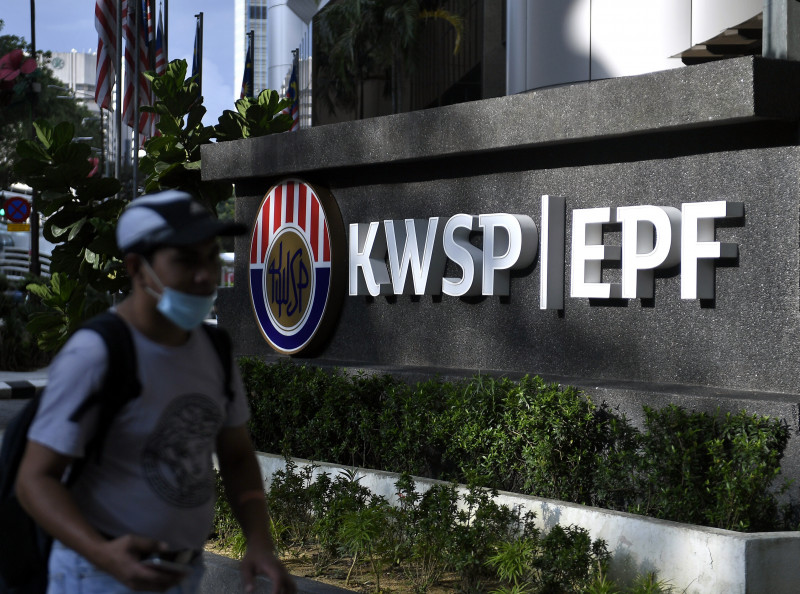
KUALA LUMPUR – Allowing the RM10,000 Employees Provident Fund (EPF) i-Citra withdrawal is not the best solution for contributors adversely affected by the recent floods, a financial expert said.
Movement for Monetary Justice Malaysia vice-chairman Assoc Prof Ahmed Razman Abdul Latiff said this withdrawal would only reduce their EPF savings for their old age.
“The average lifespan in this country is 75 years and if they retire at 55, they have 20 years more to live as retirees.
“During those 20 years, they need at least RM1,000 monthly to survive, hence they should have RM240,000 in savings. But what is happening now is that, on average, the EPF contributors only have RM42 to spend on each month, based on their average savings now,” he said when contacted.
Razman said not all EPF contributors could benefit from the RM10,000 i-Citra withdrawal as about 6.1 million of them currently had savings of less than RM10,000.
The issue of a one-time special i-Citra RM10,000 withdrawal has become a hot topic again when some quarters urged the government to consider the measure to lighten the burden of the flood victims.
Prime Minister Datuk Seri Ismail Sabri Yaakob reportedly said that the government did not intend to approve such a withdrawal for the second time due to the various allocations already provided, including financial assistance for the flood victims.
Besides Bantuan Wang Ihsan (compassionate cash aid), the government is also giving cash vouchers of RM500 each to the flood victims to purchase electrical appliances, providing discounts and cash vouchers of RM1,000 each to repair or buy a vehicle damaged in the floods as well as offering cash aid of up to RM5,000 to repair their homes.
For houses seriously damaged in the floods, the government will provide up to RM15,000 to repair these and an allocation of up to RM56,000 for the rebuilding of each destroyed house.
The government is also providing a special cash aid of RM2,500 for the purchase of necessities.
The EPF, in its recent statements, described the i-Lestari and i-Sinar withdrawal schemes introduced in 2020, which were followed by i-Citra in July 2021, as extraordinary measures aimed at meeting the pressing need for cash flow during the Movement Control Order period and the economic slowdown.
It said that although these withdrawal schemes provided some financial relief to contributors during the Covid-19 pandemic and MCO, it had resulted in 6.1 million contributors having less than RM10,000 in their EPF savings account, with 3.6 million of them having less than RM1,000.
Concurring with Razman’s views, senior lecturer at the Finance Department, School of Economics, Finance and Banking, Universiti Utara Malaysia, Adilah Azhari, said the withdrawal of savings meant for old age must not be made a normal thing each time a disaster like floods occurred.
“The people see this as an opportunity to withdraw their EPF savings and if this becomes a normal thing, the withdrawal will continue, resulting in less savings for the future.
“When they’re used to using their EPF savings in emergency cases, what financial assistance can they turn to, if not from their EPF savings, when they reach the age of 60?
“We understand that those hit by floods need money to recover and survive, but making their EPF savings a source for their survival will not help in the long run.
“If one can only withdraw RM500 from the EPF savings, perhaps one can buy food that is sufficient for a month. But what about the following months? You still need money for it,” she said. – Bernama, January 9, 2022