![[UPDATED] Deputy minister blames water column phenomenon for Dec floods, not logging](https://media.thevibes.com/images/uploads/covers/_large/02112020-KUL-videographer_at_parliament_gate-SYEDA.jpg)

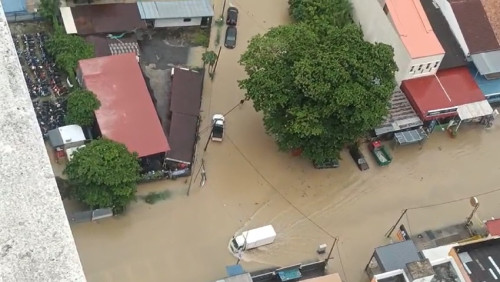
KUALA LUMPUR – Claims that logging activities in Pahang contributed to last December’s deadly floods are untrue, but it was caused by a water column phenomenon, said Deputy Energy and Natural Resources Minister Datuk Ali Biju (Saratok-Bersatu).
He added that Pahang has been adhering to the government’s annual cut ration (CTT) on logging activities, which are set by the National Land Council (NLC).
Speaking in Parliament, Ali said following the deadly floods, the Pahang Forestry Department had conducted ground and aerial assessments in several locations that allegedly had logging activities.
Specifically, he said the assessments were done near Jalan Bentong-Karak and the Sri Telemong Bridge in Bentong.
“Checks found that the flood was not caused by illegal logging, but due to the phenomenon of water column near the two locations,” he said, adding that no approved forest activities were conducted in these areas.
“The gushing of the water column started in the Lentang forest reserve, following continuous downpour for three days beginning December 16 until the day of the big flood in Bentong on December 18.
“The heavy rain has also led to a concentration of water in highlands, subsequently causing their structure to weaken and leading to landslides.”
Ali was responding to questions from Datuk Mohd Anuar Mohd Tahir (Temerloh-PH) on the implication of logging activities in Pahang, and the efforts taken by the government to control such activities to avoid a repeat of the disaster in December.
According to the deputy minister, the NLC had approved 68,435ha of permanent forest reserves in Pahang as CTT for logging activities under the 11th Malaysia Plan (11MP), from 2016 to 2020.
However, during this period, only 58,075ha of forests were cultivated, he added.
“This shows that the forest being logged is less than the CTT set – 10,360ha less. Additionally, for the 12th Malaysia Plan, the NLC has only approved 58,000ha of permanent forest reserves for activities. That is a reduction of over 10,000ha compared to the 11MP.”
Ali said the CTT is set based on sustainable forest management, and meant to balance the total amount of wood production with the forest’s capacity and land area. – The Vibes, March 9, 2022