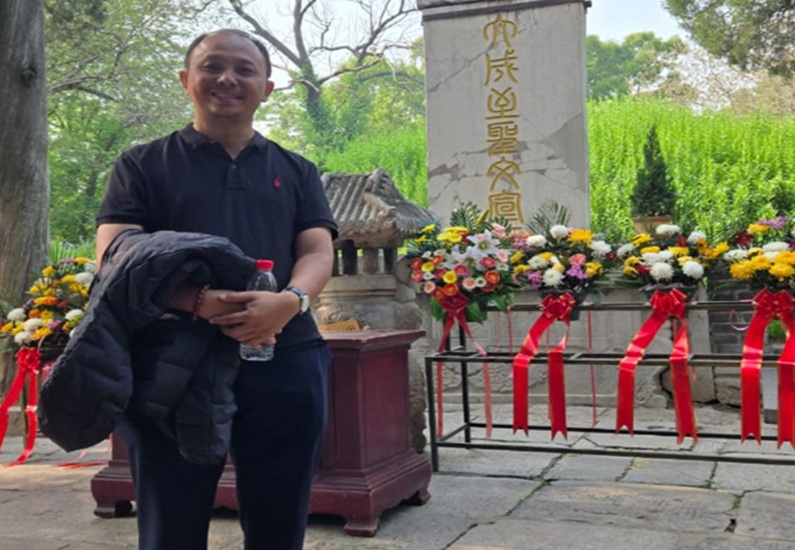
THIS reflection was inspired by my historical trips (first time) to Beijing accompanying Professor Osman Bakar, Rector of International Islamic University Malaysia (IIUM), a prominent and leading Muslim Philosopher to Department of Philosophy and Institute of Advanced Humanistic Studies, Peking University, Chinese Academy of Social Sciences (CASS) and participation in “The Idea of Global Civilisation: Islam–Confucianism Dialogue 2026” held in Beijing on April 16 2026, jointly organised by the International Islamic University Malaysia (IIUM) and the International Confucian Association (ICA).
In that gathering of civilisational thought, one question became increasingly clear: in a world marked by fragmentation, how should we rethink the very foundations of global civilisation?
We are witnessing unprecedented advances in artificial intelligence, cyber capabilities, and global connectivity.
Yet, paradoxically, we are also confronting deepening fragmentation—between nations, between disciplines, and perhaps most critically, between knowledge and ethics.
The challenge of our time is not the absence of knowledge.
It is the disintegration and parochialism of knowledge.
Science advances at a remarkable speed, but often detached from ethical reflection. Policy is shaped by urgency and competition, rather than wisdom.
Power—whether technological, political, or economic—is exercised with increasing reach, yet not always with corresponding responsibility.
In such a world, the risk is clear: that humanity progresses in capability, but regresses in judgment.
It is within this context that global conversations on civilisation have re-emerged. Initiatives such as the call for a Global Civilizational Initiative by Xi Jinping reflect an important recognition that dialogue among civilisations is essential in an increasingly multipolar world.
But dialogue alone is not sufficient
We must move beyond dialogue to integration.
Historically, the world’s great civilisations did not separate knowledge into isolated silos. Philosophers, jurists, scientists, and leaders operated within integrated intellectual traditions.
Thinkers such as Ibn Khaldun understood that civilisation itself is sustained by the interplay of knowledge, ethics, and social cohesion.
Similarly, the intellectual traditions of Asia—from Confucian humanism to Islamic philosophy—placed moral responsibility at the centre of governance and leadership.
Modernity, however, has fractured this unity.
Today, we speak of “technology policy,” “economic policy,” and “security strategy” as though they exist independently of ethical frameworks. The result is a world in which decisions of immense consequence are made without a sufficiently integrated understanding of their moral implications.
This is the crisis that ETIKA101°—the Enlightened and Integrated Knowledge Agenda—seeks to address.
At its core, ETIKA101° is grounded in a simple but profound proposition:
that the future of global civilisation depends on reuniting ethics, knowledge, and power.
The “101” represents a return to foundational principles—a recognition that in times of complexity, we must revisit the basics of what knowledge is for, and whom it serves. The “°” symbolises a holistic, 360-degree perspective, transcending disciplinary, cultural, and geopolitical boundaries.
But ETIKA101° carries a deeper, strategic meaning.
The “101°” also refers to the East meridian—a symbolic centre of gravity running through Southeast Asia. It reflects a subtle but significant shift in how we understand the world: from a historically West-centric intellectual orientation toward a more balanced, multipolar civilisational perspective. Along this axis lies a region where cultures, religions, and traditions have long interacted—not in isolation, but in co-existence.
It is here, at this civilisational crossroads, that a new synthesis can emerge.
ETIKA101° advances three interconnected dimensions.
First, Enlightened Knowledge—the recovery of philosophical and ethical traditions that shape moral consciousness. This is not a call to romanticise the past, but to draw from enduring civilisational wisdom to guide contemporary challenges.
Second, Integrated Knowledge—the bridging of disciplines that modern systems have separated. In an age defined by artificial intelligence and cyber warfare, law, technology, ethics, and policy must be understood as parts of a single ecosystem.
Third, Applied Knowledge—the translation of ideas into leadership, institutions, and governance. Without application, knowledge remains abstract; without ethics, application becomes dangerous.
In this sense, ETIKA101° is not merely an intellectual framework.
It is an ethical operating system for a multipolar world
Its relevance is particularly evident in regions such as ASEAN, where diversity is not theoretical but lived. The philosophy of muafakat—consensus-building grounded in mutual respect—offers a practical model for managing pluralism without fragmentation. It suggests that coexistence is not achieved through uniformity, but through dialogue anchored in shared values.
Malaysia, located along this symbolic 101° meridian, is uniquely positioned to contribute to this emerging global discourse. The vision of an Asian Renaissance, championed by Anwar Ibrahim, emphasises the importance of reconnecting development with culture, ethics, and identity. Today, that vision must evolve to address the complexities of the digital and geopolitical age.
The urgency of ETIKA101° lies in its recognition that the next phase of global leadership will not be defined solely by economic growth or technological superiority. It will be defined by the ability to integrate knowledge with wisdom, and power with responsibility.
We are entering an era in which decisions made in one domain—cybersecurity, artificial intelligence, or global governance—will have profound implications across all others.
Without an integrated framework, we risk managing these challenges in isolation, with unintended and potentially irreversible consequences.
The question before us, therefore, is not whether we will continue to innovate. We will.
The question is whether our ethical frameworks will evolve in tandem with our capabilities.
If they do not, we risk a future where knowledge advances without purpose, and power operates without restraint.
If they do, we may yet shape a global civilisation defined not by fragmentation, but by coherence—where dialogue leads to understanding, and understanding to responsible action.
ETIKA101° is, ultimately, an invitation to rethink the foundations of knowledge,
to reconnect ethics with power, and to reimagine the future of civilisation from a shared centre of gravity. - April 23, 2026.
Yusmadi Yusoff is a former Member of Parliament and Senator