WE have been told time and again that the Covid-19 vaccine is not a silver bullet but it looks like it is our best bet to get ahead of this pandemic or, at the very least, get a hold of the situation. Countries that have successfully inoculated a large portion of their populations have reported improved conditions, such as lower daily new cases, lower hospitalisations and lower deaths.
With daily new cases in Malaysia reaching new highs in recent days and the peak for the current wave still a week or two away (at best), it is not surprising to see a mad scramble for the AstraZeneca vaccine, despite it being linked to unusual and severe blood clotting events associated with low platelet counts. It offered the Malaysian public a golden opportunity to legally jump the vaccination queue and, as the saying goes, the best vaccine is the vaccine in your arm.
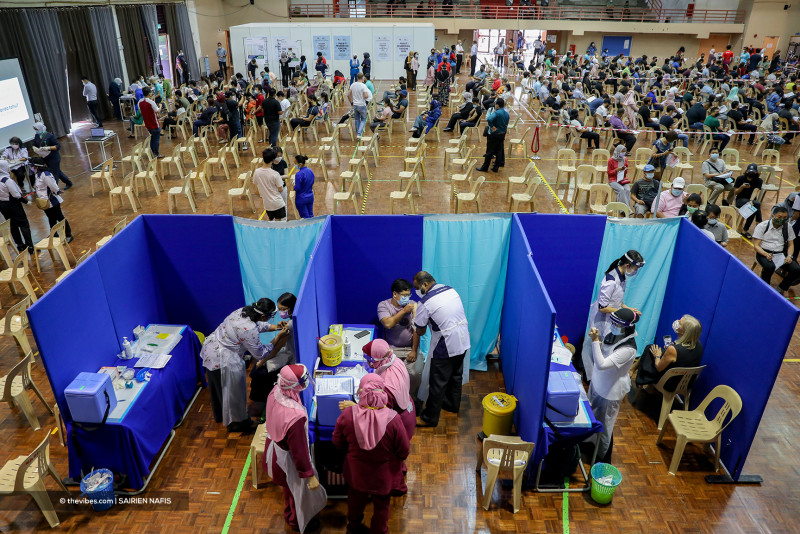
Demand for vaccines is real, so it comes as no surprise that Malaysians are frustrated to hear that about 10,000 people in Kelantan and Kedah each did not turn up for their vaccination appointments. There have been strong calls for the vaccines to be reallocated to where there is demand for the vaccines. So, that got me thinking: how are vaccines allocated to the states and territories in Malaysia?
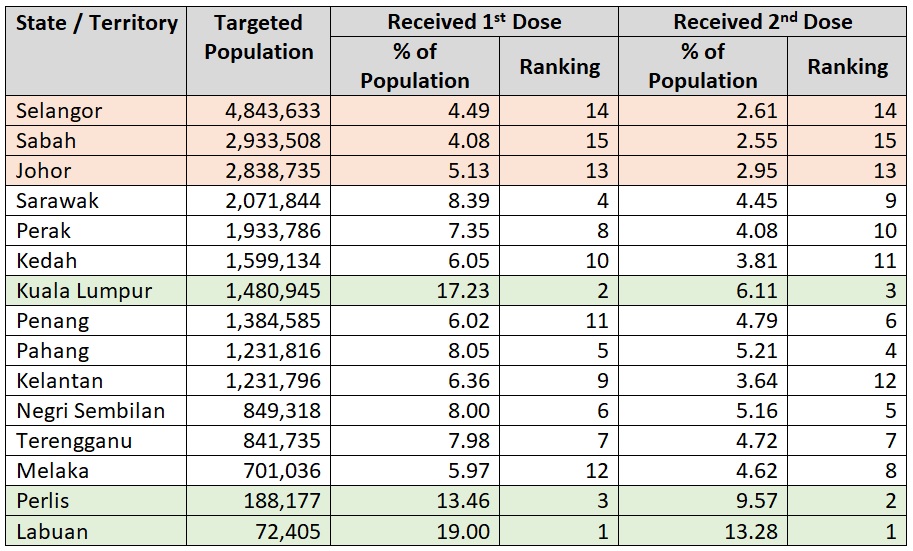
One would rationally assume that the states/territories with a higher population or, in this case, the targeted population eligible for vaccination, would get a proportionately higher amount of the vaccines. If this is the case, the three states with the highest populations would be Selangor, Sabah and Johor. Unfortunately, these are the three states that happen to see the lowest percentage of their eligible populations receiving either their first dose or both doses.
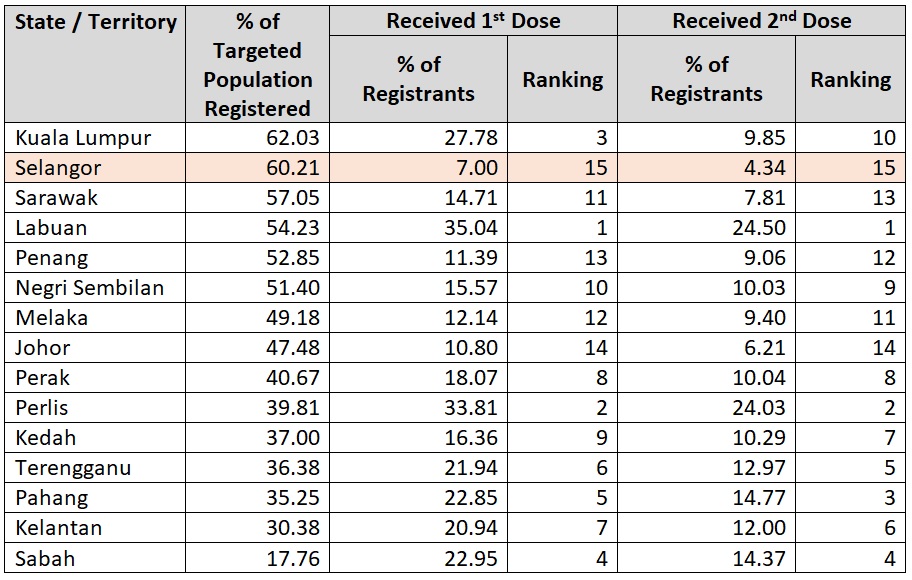
One may then challenge that the states/territories that have the highest demand in the form of registrations should have proportionately higher supplies of the vaccines. In this scenario, Selangor is ranked second (60.21%) behind Kuala Lumpur (62.03%) but Selangor comes in dead last with regard to the percentage of those registered having received either their first dose or both doses.
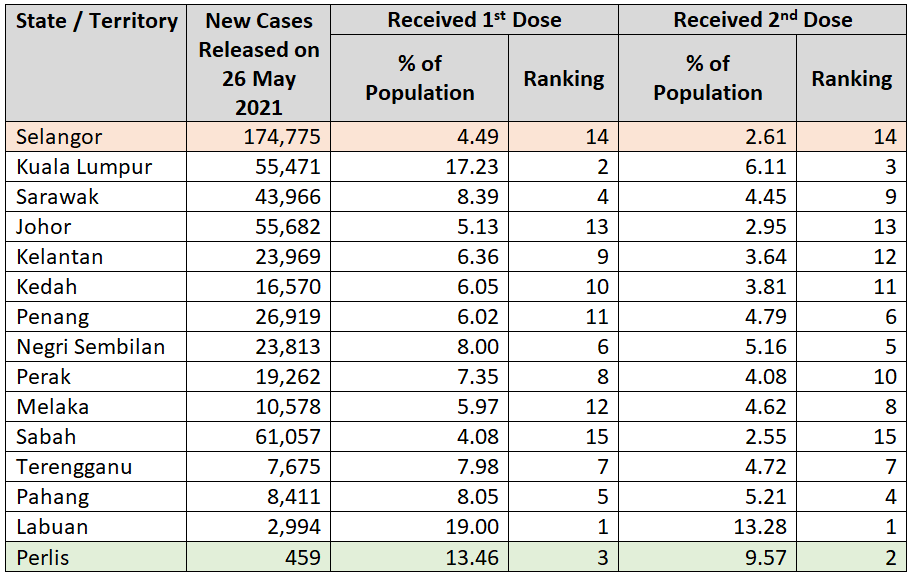
One could possibly hypothesise that vaccines are channelled to where there is great need for them, as in, where daily positive cases are higher. This would seem to be most plausible considering it has been frequently mentioned by government officials as a criterion for how vaccines are allocated. Selangor has repeatedly taken the top spot be it daily new cases or cumulative cases but finds itself at the bottom quartile of vaccination rate. Perlis, on the other hand, is the antithesis of Selangor yet Perlis finds itself at the top quartile of the vaccination rate.
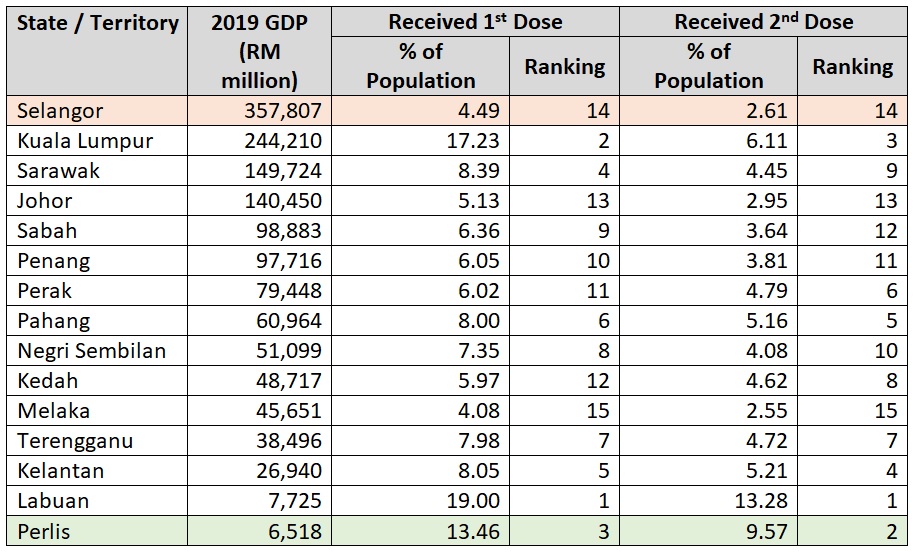
We have often heard the need to balance lives and livelihood, and the need to keep the Malaysian economy open, hence the impossibility of another lockdown like the one we had in March last year. If this is truly the case, then we should see a higher proportion of the vaccines channelled to states/territories that contribute higher gross domestic product (GDP) so that we can protect the Malaysian economy and keep it running. Selangor again tops this chart with Perlis finding itself on the other end but the vaccination rates do not match economic productivity and output.
So, if it’s not based on demand (population size or registration rate) or need (number of cases or economic importance), how are vaccines allocated in Malaysia? What are the criteria used to determine how many vaccines each state/territory receives? Shouldn’t we rethink our country’s overall vaccination strategy and allocation to better tackle this pandemic?
We have been told to trust science, follow the data and let evidence drive our decisions. It is hoped that the analyses of the data that is retrieved from official government sources made publicly available online and evidence produced in this article will help the government of the day make more informed decisions that will usher us closer to taming Covid-19. – The Vibes, May 27, 2021
Lee Kuan Shern is a Master of Science graduate from Universiti Sains Malaysia and strongly believes that a scientifically literate society is important to address societal issues as a science-literate citizen will better understand how the world works, and thus can better deal with problems through intelligent and informed decisions
Notes:
⦁ Putrajaya has been omitted from this exercise as GDP figures were not available.
⦁ 2019 GDP was used as barometer before Covid-19 affected the Malaysian economy in 2020.
⦁ Covid-19 Vaccination, Vaccine Registration, Daily Cases and Cumulative Cases are as released on May 26, 2021.