
MIRI – I have covered five state elections in Sarawak, and in every election, the pledge by politicians to build houses for the poor has been repeatedly used to win the hearts and minds of the people.
There are always grand announcements, followed by ground-breaking events and symbolic signing ceremonies.
In urban constituencies, the topic of affordable housing has always cropped up during election speeches.
It is a matter that is close to the heart of urban voters, and politicians know that.
Unfortunately, these election promises of affordable housing often take many years to translate into reality and some don’t materialise at all.
I still remember a so-called low-cost housing project involving 800 units that was symbolically launched almost two state elections ago along the Kuala Baram highway some 25km north of Miri city. There was a colourful and grand ground-breaking event, attended by many top state politicians.
Until today, that site is empty. There are no low-cost units as promised, only empty land overgrown by tall bushes.
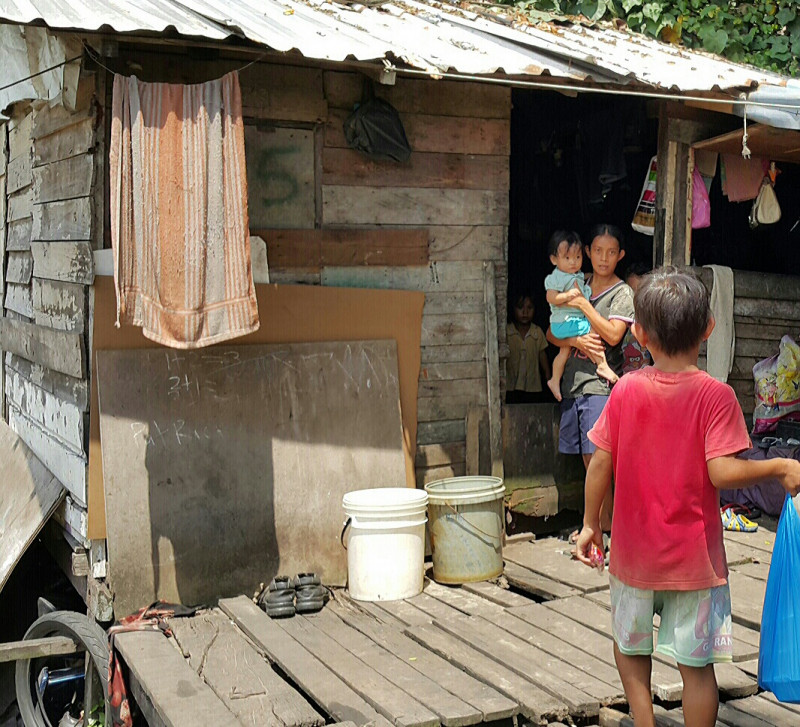
If you are streetwise and know where to go in Miri city, there are many urban poor living in shacks.
Many of these are rural migrants who had moved to Miri in search of jobs but ended up living in makeshift wooden and zinc structures they constructed on vacant plots of land.
Over time, these became squatter colonies, where there are no water supplies, electricity, sanitisation, or sewerage systems.
These areas often become sites for social ills like alcoholism, glue-sniffing, gambling, and so on.
Due to the high cost of houses, the population of urban poor mushroomed in numbers as their families grew and expanded.
That is why in Miri city, the number of urban poor is increasing every year. The same is happening in other big urban localities in Kuching, Bintulu and Sibu.
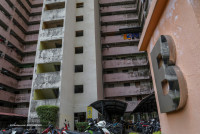
In the Miri city centre alone, there are about 8,000 squatter families at one time, which roughly translates into a population of about 40,000 people if each family has five people.
To house them will require 8,000 units of really low-cost houses readily available, but in Miri, the cheapest house costs a minimum of RM300,000 each unit.
How many poor families can afford that sum?
The state government must resume the role of building low-cost houses. They cannot continue their policy of leaving it to the private sector or joint ventures with private companies that are profit-driven.
Last week on November 24, caretaker chief minister Tan Sri Abang Johari Openg came to Miri and launched a big project to build nearly 700 houses in Taman Vista Perdana, 20km from Miri city. He described it as an “affordable housing project for B40 families” to be constructed by the National Housing Commission.
The exercise is a joint venture with a private property developer here, and each unit will cost RM300,000, he had said.
It is good for more houses to be built, but the houses announced by Johari are not really affordable for the masses.
Opposition party Parti Bersatu Sarawak said it is wrong for the ruling Gabungan Parti Sarawak leaders to go around the state saying that they are building “affordable homes” for the rakyat when such houses cost a minimum of RM300,000 per unit.
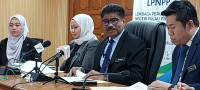
Pujut PSB branch chief Bruce Chai had said very few B40 income-earners can buy a house that costs RM300,000.
He told The Vibes that random surveys conducted by his PSB office in the Miri city centre showed that most B40 families earn less than RM2,000 combined per household per month.
“Many B40 workers earn minimum wage and their take-home pay after various deductions amounts to just about RM1,000.
“Even if the family has a husband and wife working, and both of them earn around RM1,000 each, their combined salaries per month will not be able to secure them a house costing RM300,000.
“Families with many children will be in even worse situations. Bills for household expenditures, food, utility bills, transportation, handphones, schooling needs, and the like are already hefty enough to bear for these low-income earners.
“In Miri, as is the case in the rest of urban Sarawak, houses cost at least RM300,000 per unit, and they are beyond the reach of not just people in the B40 group but also many in the M40 category.
“It is therefore misleading to label houses costing RM300,000 per unit as ‘affordable homes’,” said Chai.
He suggested that the GPS state government construct houses costing about RM150,000 per unit specifically for B40 earners.
“Those can then be called affordable homes,” he said, adding that the payment system must be less burdensome on lower-income earners.
Indeed, Chai has valid arguments. I think housing should be categorised as a basic human rights need for every family in society. It should not just be used as a subject for election sweet talk. – The Vibes, November 28, 2021

.JPG)