WHEN Pakatan Harapan (PH) signed a historic memorandum of understanding (MoU) with the government led by then prime minister Datuk Seri Ismail Sabri Yaakob, it was with the intention of providing political stability just after Tan Sri Muhyiddin Yassin was forced to resign as the 8th prime minister of Malaysia.
At the same time, important institutional reforms, most notably the anti-hopping bill, were also included in the MoU. These concessions were only made possible because Ismail Sabri knew that he was in a politically vulnerable position.
This was not the first time PH had worked with Umno leaders on issues of political stability and institutional reforms.
In December 2020, PH state representatives in Perak voted with the majority of Umno state representatives to reject a motion of confidence in the then Menteri Besar (MB), Bersatu’s Datuk Seri Ahmad Faizal Azumu.
In exchange, Perak Umno MB, Datuk Seri Saarani Mohamad, agreed to provide equal constituency allocations to all state representatives and allowed opposition representatives to participate in local and district-level government meetings where important local-level decisions were made.
Johor Umno MB, Datuk Seri Hasni Mohammad, who was installed shortly after the Sheraton move in February 2020, also made certain political concessions to PH state representatives, including increasing their constituency allocations – because of the razor-thin one-seat majority of his then governing coalition.
The possibility of working with Umno to form a government post-15th general election (GE15) had already been raised by DAP secretary-general, Anthony Loke, back in May 2021 and repeated in August 2022. Although he was heavily criticised for his statement then, including by many PH supporters, many of the same critics would later welcome the support of Umno’s 26 MPs for Datuk Seri Anwar Ibrahim as prime minister post-GE15 when it was clear what the alternative would be.
In the context of a hung Parliament, and to dampen criticism among the Malay electorate that a PH-led government would be controlled by DAP and non-Malays, the inclusion of Umno in a unity government makes logical and political sense.
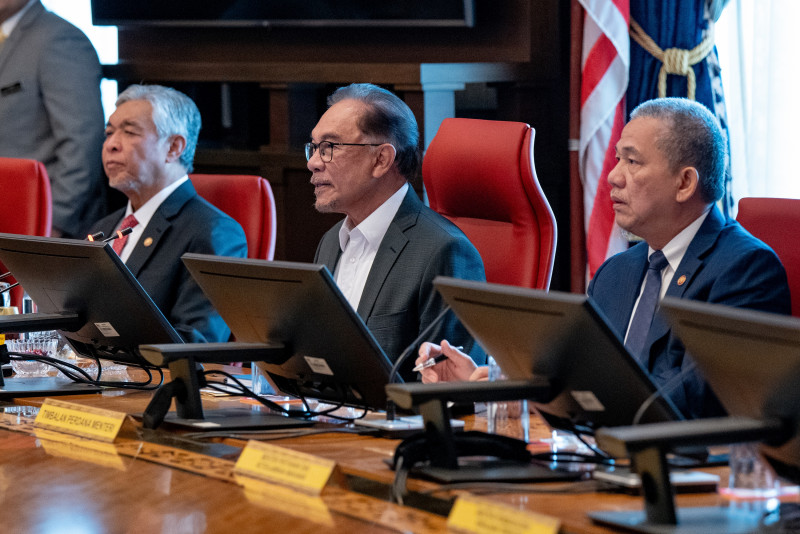
The appointment of Datuk Seri Ahmad Zahid Hamidi as the deputy prime minister (DPM) and a cabinet member should be seen in a similar light – to provide much-needed political stability and to deliver institutional reforms.
As explained by the Umno secretary-general, Datuk Seri Ahmad Maslan, the appointment is based on Zahid Hamidi’s position as Umno president.
This means that whoever wins the Umno party elections slated for the 1st quarter of 2023, will have the assurance of being appointed as DPM – if a new president is elected.
In addition, the fact that there are six Umno ministers (compared to only four from DAP, despite DAP having 40 MPs to Umno’s 26) will also help the Umno leadership explain to its members that they are not in an inferior position in government compared to DAP.
Anwar’s own appointment as finance minister may also have been a compromise solution so that Umno leaders can explain to their supporters why they did not get this much sought-after ministerial position.
The appointment of the first DPM from Sarawak, Fadillah Yusof, and five ministers from Gabungan Parti Sarawak (GPS) was also needed to cement GPS’ commitment to the new unity government. The concession to GPS that no DAP Sarawak MPs would be included in the cabinet was also granted.
With the inclusion of Barisan Nasional (BN), GPS, GRS, Warisan, and a number of independent MPs, Anwar’s government should easily obtain sufficient votes to pass the motion of confidence during the upcoming parliamentary session later this month.
But what are the reforms which we can look forward to under this unity government?
For this, we need to refer to the election manifestos of respective coalitions. Although the manifestoes were not significant points of discussions and debates during the GE15 campaign, there are many points of agreement between the PH and the BN election promises.
The BN manifesto explicitly mentions the move to a more “needs-based policy” approach (peralihan daripada dasar berasaskan kaum kepada berasakan keperluan), highlights the need for greater decentralisation to states, and promises to amend the federal constitution to explicitly allow citizenship rights to children of Malaysian mothers who are born overseas. These election promises can form the basis of the institutional reform agenda of the unity government.
Controversy surrounding Zahid Hamidi’s appointment as DPM should not detract from other positive takeaway points from the cabinet appointments.
The economic team comprising Anwar as finance minister, Rafizi Ramli as economic minister, and Datuk Seri Tengku Zafrul Abdul Aziz as international trade and industry minister should give investors and the business community confidence that the economy will be well-managed, pro-FDI policies will continue, and new sources of economic growth can be generated and enhanced.
Experienced former ministers from different coalitions – Khaled Nordin and Azalina Othman from Umno, Saifuddin Nasution from PKR, Mat Sabu and Salahuddin Ayob from Amanah, Alexander Linggi and Nancy Shukri from GPS – will give sufficient weight and heft to the new cabinet.
Experienced MPs who are also familiar public faces such as Nga Kor Ming (DAP), Chang Lih Kang (PKR), Nik Nazmi Nik Ahmad (PKR), Fahmi Fadzil (PKR) and Hannah Yeoh (DAP), will bring new ideas and energies to their respective ministries.
What may be more concerning would be the appointment of two first-time MPs to two heavyweight portfolios – Fadlina Binti Sidek (Nibong Tebal) as education minister and Zaliha Binti Mustafa (Sekijang) as health minister. They will have their work cut out for them in managing these two huge and complicated ministries which also invite plenty of public scrutinies.
If PH’s 22 months in government post-GE14 has taught us anything, it should be that we should not expect results to be delivered overnight.
We should give some room for the policy agenda of the unity government to be set by the prime minister and his team.
We should anticipate the appointment of many capable deputy ministers among the ranks of the MPs who are not yet part of the front bench.
We should expect some level of political intrigue and uncertainty in 2023 due to the Umno party elections and the state elections in Kedah, Kelantan, Terengganu, Penang, Selangor and Negri Sembilan.
We should hope for a stable government that can last the full five-year term and show slow and steady progress in the delivery of political and economic reform during this time. – The Vibes, December 5, 2022
Ong Kian Ming is former Bangi MP and DAP’s assistant political education director


.jpg)