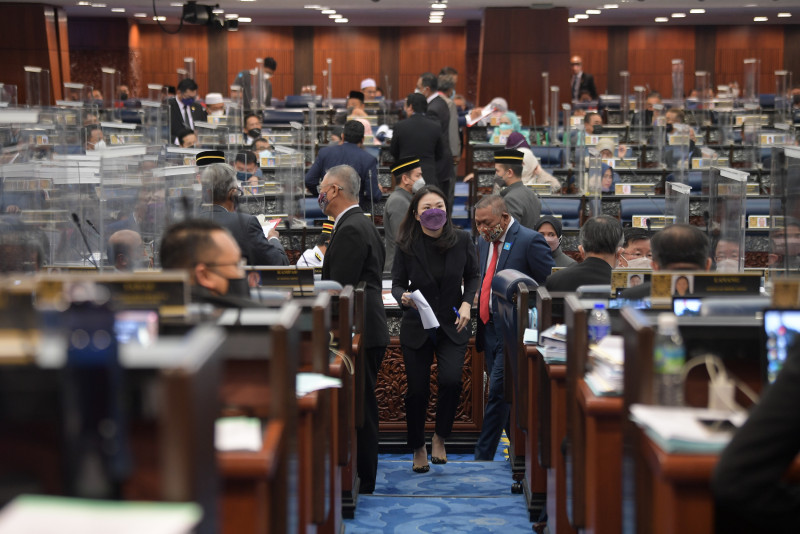
AN unnecessary uproar erupted in the Malaysian Parliament over this issue, namely should the 2021 Auditor-General’s Report be debated in Parliament?
In other countries, the opposition bloc may be highly eager to debate an audit report as MPs generally think that it is part of their sacrosanct duties to put the government to task as to how public money was defrayed by the government.
In Malaysia, it is a totally new ball game, however. To their discredit, the opposition’s MPs vehemently rejected the decision of the speaker to have the audit report debated in the august House.
The opposition MPs have advanced several lame excuses in dismissing the idea of having the audit report in the lower House.
The Kota Baru MP from PAS, Datuk Seri Takiyuddin Hassan, contended that by virtue of Article 107 of the federal constitution, the audit report shall be laid before the Dewan Rakyat.
He submitted that there is no requirement for such a report to be debated. A simple reply would be there is equally no legal hindrance for it to be debated as well.
Anyway, he was of the view that the decision of the speaker in allowing a motion for such a report to be debated is against the law and convention. He further argued that the audit report has never been debated in Parliament so far. Thus, in his view, this practice ought to continue!
With due respect, his argument is devoid of any merit. Using his own logic, perhaps, the decision of the ex-speaker in the former Pakatan Harapan government in allowing the Suhakam Report to be debated in Parliament was also contrary to the law.
Yes, Article 107(1) of our apex law merely provides that “the auditor-general shall submit his reports to the Yang di-Pertuan Agong, who shall cause them to be laid before the House of Representatives”. Does it mean any move to have the audit report debated in the House would be unconstitutional and illegal?
Being the supreme law of the land, the constitution should never be narrowly interpreted so much so that it would be seen to be against the doctrine of constitutionalism. A constitution which is bereft of constitutionalism is akin to a body without spirit!
After all, a cornucopia of legal judgments by our Malaysian courts have duly called for the apex law to be broadly construed as it should be taken as a vibrant document.
A pedantic and restrictive interpretation of our supreme law would be doing a grave injustice against the constitution. The federal constitution should never be treated as a dogmatic piece of paper!
As one constitutional law expert rightly pointed out, constitutionalism can be defined as the doctrine that governs the legitimacy of government action, and it implies something far more important than the idea of legality that requires official conduct to be in accordance with prefixed legal rules.
In other words, constitutionalism checks whether the act of a government is legitimate and whether officials conduct their public duties in accordance with laws prefixed or predetermined in advance.
In so far as the Kota Baru MP’s argument that allowing the debate of the audit report would be against parliamentary convention, I submit that his argument is obviously flawed.
He may be unaware that in actual fact parliamentary convention dictates that such an important report ought to be allowed to be duly debated in the august House. The Malaysian Parliament has consistently failed to have such a report debated in Parliament, such a failure which in reality is actually contrary to many commonwealth parliamentary conventions.
Takiyuddin may not realise that a debate on audit reports of the government had taken place in many parliaments such as in Ghana or even Fiji.
Another opposition MP contended that allowing the debate of the audit report would go against Order 77 of the Parliament Standing Orders. The said MP then submitted that the audit report ought to be deliberated solely by the Public Accounts Committee.
With due respect, if we truly read the provision of Order 77, it does not in any way seek to tie down the hands of the speaker from exercising their power under the Standing Orders in allowing the debate of the audit report in the House.
After all, during his Budget 2023 speech the prime minister told the public that the 2020 and 2021 Auditor-General’s Reports had revealed RM3 billion in leakages, including from loss of public money, wastages, and improper payments.
Don’t our MPs think that such leakages should warrant lively debates and answers in Parliament? – The Vibes, June 6, 2023
Mohamed Hanipa Maidin is ex-Sepang MP and former deputy law minister