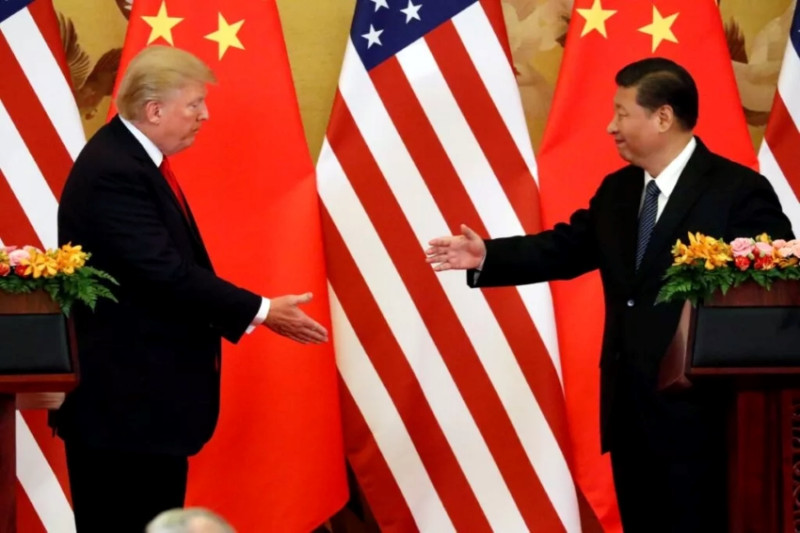
U.S. President Donald Trump has confirmed he will meet Chinese President Xi Jinping in South Korea within the next fortnight, despite rising trade tensions and the imposition of sweeping new tariffs on Chinese goods.
Speaking to Fox Business Network in an interview broadcast on Friday, Trump acknowledged that his proposed 100% tariff on Chinese imports was economically unsustainable but insisted it had been provoked by Beijing’s decision to tighten controls on rare earth exports.
"It's not sustainable, but that's what the number is," he said. "They forced me to do that."
Trump last week announced a new wave of 100% levies on China’s US-bound exports, as well as restrictions on the export of “any and all critical software” starting 1 November. The move was triggered by China’s abrupt expansion of export controls on rare earth elements – materials critical to global technology manufacturing and of which China holds a dominant share.
Despite the escalating dispute, Trump struck a more conciliatory tone ahead of the planned meeting with Xi, stating: “I think we’re going to be fine with China, but we have to have a fair deal. It’s got to be fair.”
As markets digested the latest developments, Wall Street appeared to regain some composure, with major US stock indexes rising in afternoon trading following several days of volatility sparked by renewed tariff threats and financial sector concerns.
Trump, speaking separately as he prepared to meet Ukrainian President Volodymyr Zelenskiy at the White House, added: “China wants to talk, and we like talking to China.”
US Treasury Secretary Scott Bessent confirmed he would speak with Chinese Vice Premier He Lifeng later on Friday to continue trade negotiations. “I think that things have de-escalated,” Bessent said.
“We hope that China will show the respect that we have shown them, and I am confident that President Trump, because of his relationship with President Xi, will be able to get things back on a good course.”
However, the World Trade Organization has raised the alarm over the growing rift between the world’s two largest economies. WTO Director-General Ngozi Okonjo-Iweala warned that a sustained US-China decoupling could slash global economic output by 7% in the long term.
Speaking to Reuters, she said: “We are extremely concerned about the latest spike in US-China trade tensions and have been in contact with officials on both sides to urge more dialogue.”
Nevertheless, tensions remained palpable ahead of the Trump-Xi summit.
Bessent, addressing the IMF’s steering committee on Friday, criticised China’s state-led economic model, calling on the IMF and World Bank to challenge China's internal and external imbalances and industrial policies. US officials argue that Beijing’s approach has led to global overcapacity and artificially cheap exports.
China’s Commerce Ministry responded sharply, accusing the US of undermining the rules-based global trading system since Trump returned to office in 2025. It vowed to ramp up dispute settlement measures at the WTO and urged Washington to reverse measures it says breach international non-discrimination rules.
“The United States must align its industrial and security policies with WTO obligations,” a ministry statement said on Friday.
Earlier in the week, Bessent had publicly accused one of Vice Premier He’s senior aides of behaving in an “unhinged” manner during trade discussions – a comment that Beijing said “seriously distorts the facts.”
With both leaders preparing to meet under a cloud of mutual recrimination, the stakes for the global economy remain high. The South Korea summit could prove pivotal in shaping whether the world’s most consequential bilateral relationship continues down the path of confrontation – or finds a fragile new equilibrium. - October 18, 2025