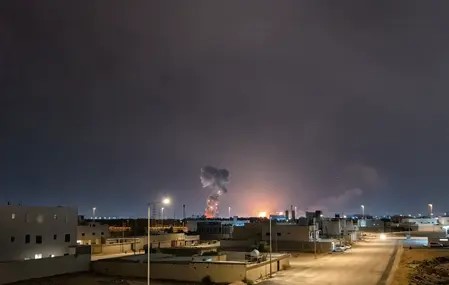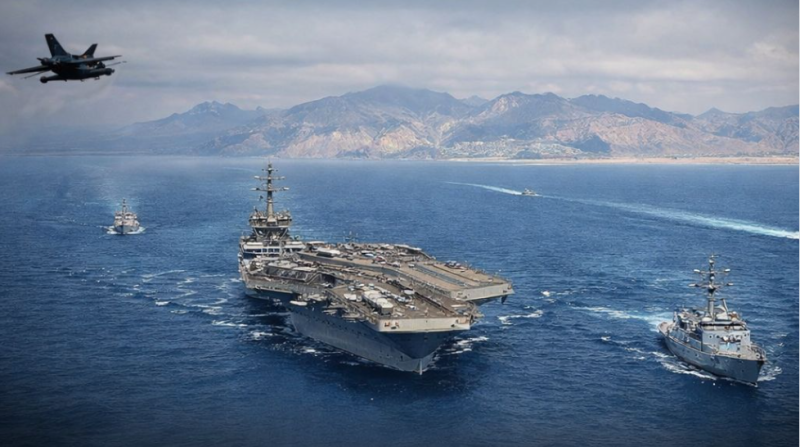
THE United States has announced a drastic escalation in its ongoing standoff with Iran, with US President Donald Trump declaring that the U.S. Navy will begin blockading the Strait of Hormuz on Monday.
This decision follows failed marathon talks aimed at reaching a deal to end the war and a fragile ceasefire, which lasted only two weeks.
Reuters, on Monday, cited that the blockade, set to begin at 10 a.m. ET (1400 GMT), will target all maritime traffic entering or leaving Iranian ports, further intensifying tensions in a region critical to global energy supplies.
In a statement released by U.S. Central Command (CENTCOM), the blockade will apply to vessels of all nations operating in Iranian waters, including ports along the Arabian Gulf and Gulf of Oman.
However, ships transiting the Strait to and from non-Iranian ports will not be impeded.
The U.S. also pledged to provide formal notices to commercial mariners in advance of the blockade’s enforcement.
Trump's remarks on social media added further fuel to the fire, warning that any vessel paying tolls to Iran in international waters would face U.S. retaliation, including the destruction of mines laid by Iran in the Strait.
The President's words were unequivocal: "No one who pays an illegal toll will have safe passage on the high seas," he wrote, adding ominously, "Any Iranian who fires at us, or at peaceful vessels, will be BLOWN TO HELL!"
In a swift response, Iran's Revolutionary Guard issued a stern warning, declaring that any military vessel approaching the Strait would be seen as a violation of the ceasefire agreement and dealt with decisively.
The escalation raised fears of further conflict in a region already on the edge of war.
Iran’s Parliamentary Speaker, Mohammad Baqer Qalibaf, dismissed Trump's threats, stating that they would have no impact on Iran's stance.
"If you fight, we will fight; if you come forward with logic, we will deal with logic," Qalibaf said, indicating that Iran would not back down.
His comments came as the two sides failed to secure an agreement during high-level talks in Islamabad, the first direct U.S.-Iranian discussions in over a decade.
The collapse of negotiations, which had come close to an "Islamabad MoU" (memorandum of understanding), was attributed by Iran to what it called U.S. "maximalism, shifting goalposts, and blockade."
Iranian Foreign Minister Abbas Araqchi lamented the missed opportunity, while Vice President JD Vance, head of the U.S. delegation, called the breakdown of talks "bad news for Iran much more than for the United States."
The ongoing conflict has already taken a heavy toll, with over six weeks of fighting leading to thousands of casualties, disrupting global oil markets and pushing prices above US$100 per barrel.
Trump has acknowledged that oil prices may remain high through the November midterm elections, a rare admission of the political implications of the war.
In a pointed response, Qalibaf mocked U.S. gasoline prices, posting a map of Washington-area pump prices and suggesting that Americans would soon "nostalgic for US$4-US$5 gas."
Despite the breakdown in talks, there are indications that negotiations may continue.
Trump told Fox News that he believes Iran will return to the negotiating table, calling the discussions "very friendly."
He also suggested that NATO allies, whom he had criticised for their lack of support in the conflict, may now assist in the operation in the Strait.
However, the collapse of talks left significant unresolved issues, including U.S. demands for Iran to halt uranium enrichment, dismantle its enrichment facilities, and cease funding groups like Hamas, Hezbollah, and the Houthis.
These issues, alongside the future of the Strait of Hormuz, remain major sticking points.
Iran, on its part, expressed frustration over what it called excessive U.S. demands, claiming that despite some agreement on other matters, the nuclear program and control of the Strait had hindered any deal.
Iranian President Masoud Pezeshkian reiterated Tehran’s call for a "balanced and fair agreement," emphasizing that a resolution was possible if the U.S. returned to the framework of international law.
In the midst of these developments, three supertankers loaded with oil successfully passed through the Strait of Hormuz on Saturday, marking the first vessels to exit the Gulf since the ceasefire.
Despite the ongoing deadlock, the movement of these vessels underscores the fragile nature of maritime safety in this crucial waterway.
As the situation unfolds, the U.S. blockade and the threat of military escalation continue to threaten the region’s stability, with global oil markets and political leaders bracing for the impact. - April 13, 2026