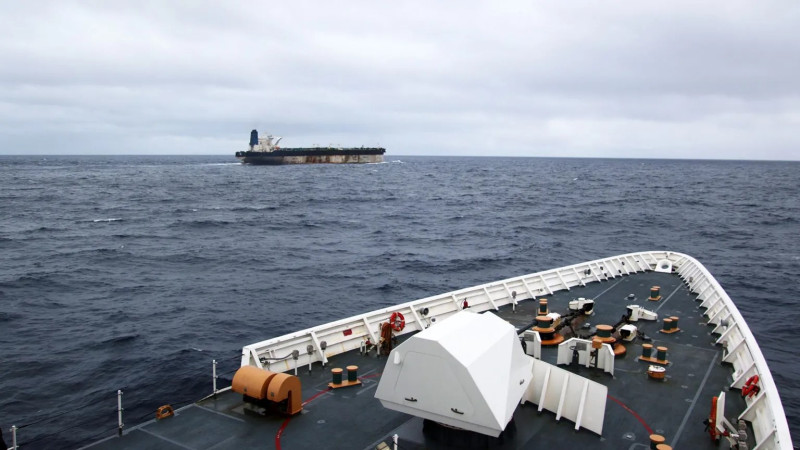
ELITE British forces have carried out a high-stakes maritime interception in the English Channel, marking the first time the United Kingdom has boarded a sanctioned vessel from Moscow’s clandestine energy network.
In an operation lasting six hours, Royal Marine Commandos and specially trained law enforcement officers from the National Crime Agency intercepted the vessel and, for the first time, boarded it, supported by the Royal Air Force.
The targeted tanker, named Smyrtos, was tracked carrying sanctioned Russian oil through international shipping lanes before armed units descended on the ship in the early hours of Sunday morning, according to the BBC.
The bold sea raid represents a major escalation in the Western economic blockade against the Kremlin, aimed at disrupting the illicit maritime supply lines that finance the conflict in Ukraine.
The impounded vessel is currently being held under armed guard off the south coast of England, where federal investigators are examining its cargo and registration history.
Sir Keir Starmer said: "This successful operation delivers yet another blow to Russia and reminds those fuelling Putin's war in Ukraine that we will not let them hide."
Despite the tactical success on the water, the raid unfolds against a backdrop of severe political turmoil within the British government regarding the adequacy of its own military resources.
The interception follows a week of damaging resignations from the Ministry of Defence, where top officials stepped down in protest over the Prime Minister's delayed Defence Investment Plan (DIP), claiming the proposed budget leaves the nation vulnerable to modern geopolitical threats.
John Healey resigned as defence secretary, warning on Thursday that the level of military spending proposed by Sir Keir "falls well short" of what is needed to protect the UK.
This was swiftly followed by the departure of Al Carns, the armed forces minister, who told the prime minister that the DIP was "neither transformative enough nor sufficiently funded".
The vessel at the center of the geopolitical clash had previously altered its identity and flag multiple times to evade international detection.
Maritime data indicates the tanker departed Russia’s Ust-Luga oil terminal near St. Petersburg on June 5, flying a Cameroon flag, before entering the English Channel on Saturday.
The British Ministry of Defence confirmed that this shadow fleet, consisting of over 700 ships, is responsible for transporting three-quarters of Russia’s sanctioned oil exports.
Al Carns told the BBC the operation would have involved armed forces personnel "flying low level over the sea, rearing up before the ship, fast roping onto the ship, securing it and then taking it into our territorial waters".
He told Sunday with Laura Kuenssberg that now the UK had performed its first boarding of a Russian shadow fleet vehicle, "we're probably going to see more, should the opportunities present themselves".
Cabinet ministers have defended the administration's strategic position, insisting that internal financial recalibrations are underway to ensure the military is adequately equipped for hostile encounters.
Culture Secretary Lisa Nandy told the BBC the prime minister "had been clear" with his cabinet that they "had to find more money for defence", adding that discussions on the Defence Investment Plan were ongoing.
She added the government had to "transform the way we do defence spending, so that what we're spending is fit for the threats we face now and in the future".
Legal authorities have backed the enforcement action, declaring that the maritime seizure aligns with broad statutory powers introduced earlier this year allowing the inspection of blacklisted vessels traversing British waters.
Responding to the interception, Attorney General Richard Hermer said: "This government made clear that we would pursue Russia's shadow fleet under the full force of international law."
The mission was executed in tight synchronization with French naval forces, utilizing a formidable array of British military assets including an RAF P-8 maritime patrol aircraft, HMS Sutherland, and HMS Ledbury, signalling a unified European front against illicit Russian maritime commerce. - June 14, 2026