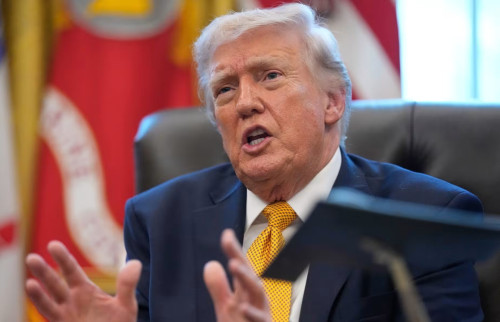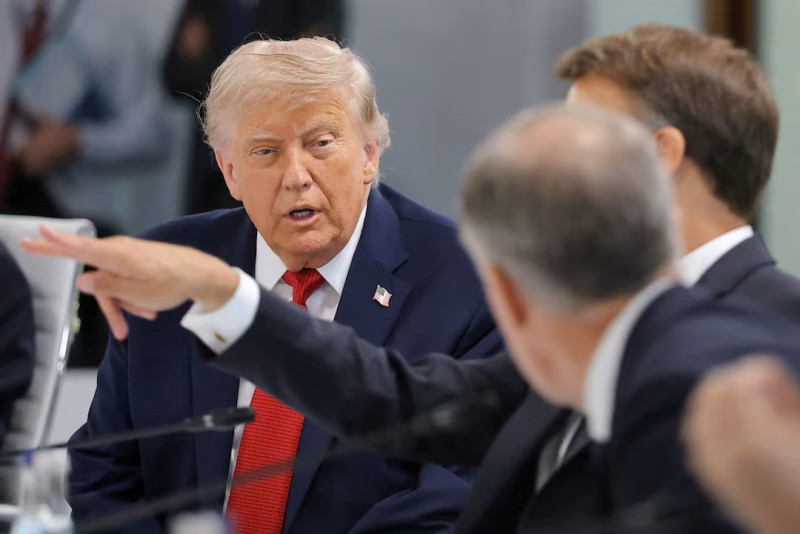
UNITED States President Donald Trump and Iranian President Masoud Pezeshkian have formally signed a landmark peace agreement in Versailles, France aimed at ending the Middle East war, marking the most significant diplomatic breakthrough since hostilities erupted earlier this year.
The memorandum of understanding was signed during a candlelit dinner at the Palace of Versailles following the G7 summit, with French President Emmanuel Macron and world leaders applauding as the agreement was concluded.
"Just signed it," AFP reported Trump telling reporters after emerging from the palace.
Iranian Foreign Ministry spokesman Esmaeil Baqaei confirmed the agreement had been finalised.
"The document was finalised with the signatures of the presidents," he told state news agency IRNA.
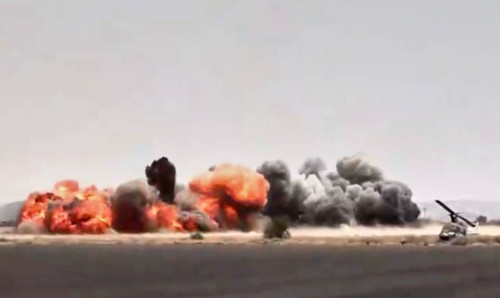
Brokered by Pakistan, the agreement takes immediate effect and is designed to halt the conflict that erupted on February 28, when the United States and Israel launched military operations against Iran, prompting Tehran to retaliate with waves of missile and drone attacks across the region.
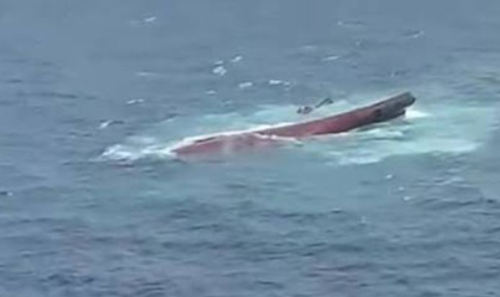
The conflict triggered the closure of the Strait of Hormuz, one of the world's most strategically important shipping routes, while the United States imposed a naval blockade on Iranian ports, sending shockwaves through global energy markets.
Pakistan Prime Minister Shehbaz Sharif announced that the accord would immediately restore maritime traffic.
"As a first step, Islamic Republic of Iran will instantly reopen the Strait of Hormuz and the United States of America will immediately lift the naval blockade," Sharif wrote on X.
Under the agreement, Washington will also immediately waive oil sanctions that have severely constrained Iran's economy.
The accord further commits the United States to facilitating a US$300 billion (RM1.2 trillion) reconstruction fund, backed by regional nations, once a comprehensive settlement is reached over Iran's nuclear programme.
Although an earlier signing ceremony involving Iranian Parliament Speaker Mohammad Bagher Ghalibaf and US Vice-President JD Vance was cancelled, Sharif said an official ceremony would still take place in Switzerland tomorrow, with technical negotiations commencing immediately afterwards.
The agreement initiates a two-month negotiating period focused on resolving the far more complex issue of Iran's long-term nuclear activities.
According to the text released by US officials, Tehran will dilute its enriched uranium stockpile, potentially through "down-blending on site under the supervision of the IAEA", the United Nations nuclear watchdog.
Washington said the move would unlock broader economic assistance for Iran, although US officials stressed that the United States would not be required to provide direct financial contributions.
Despite the diplomatic breakthrough, the agreement has exposed divisions within the United States.
Trump warned that military action remained an option should Tehran breach the deal.
"I was prepared to 'bomb the hell' out of Iran if they violated the agreement," he said earlier.
Republican Senator Bill Cassidy strongly criticised the accord.
"Iran's nuclear ambitions were not curbed, and they have learned that threatening the Strait of Hormuz works," Cassidy said.
"Sanctions will be lifted, and the bombing has stopped. This is the worst foreign policy blunder in decades."
Iran, meanwhile, portrayed the agreement as evidence that Washington had failed to achieve its military objectives.
"People will see it and judge," Ghalibaf said during a state television interview after the text was released.
China also welcomed the development, saying its senior diplomat had urged Tehran that it was "key" for all parties to "genuinely implement" their commitments.
The agreement was hailed by Hezbollah leader Naim Qassem as a "great victory" for Iran.
He also thanked Tehran for ensuring that the ceasefire extended to Lebanon, where Hezbollah had entered the conflict after launching rockets at Israel in support of Iran on March 2.
Although the accord has significantly reduced regional tensions, violence has not completely subsided.
Lebanese state media reported that Israeli air strikes in southern Lebanon had killed at least five people since the announcement, while the Israeli military said five of its soldiers were wounded after an explosive drone struck southern Lebanon, marking the first such incident reported since the US-Iran agreement.
Israel also said its air force intercepted several rockets launched towards troops operating in southern Lebanon, although no casualties were reported.
Financial markets reacted cautiously to the historic agreement.
Oil prices initially surged by about five per cent amid uncertainty over the signing before stabilising later in the day, reflecting investor hopes that the reopening of the Strait of Hormuz could restore stability to global energy supplies. - June 18, 2026