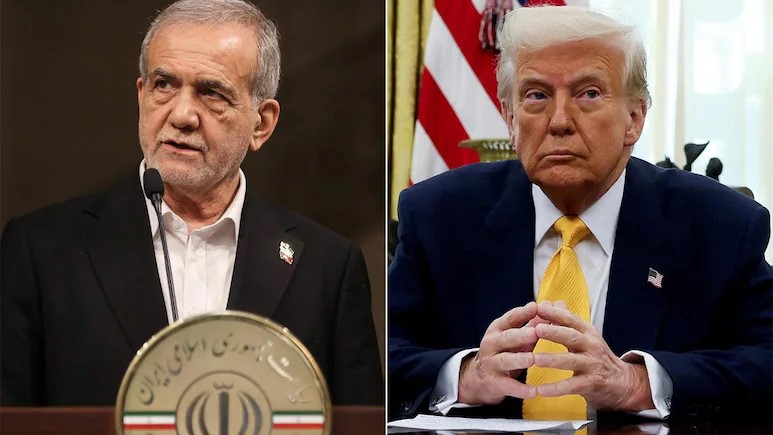
IRAN has firmly rejected any suggestion that its ballistic missile programme forms part of its recent agreement with the United States, with President Masoud Pezeshkian insisting the country's defence capabilities remain beyond the scope of negotiations.
Speaking during a news conference in Islamabad on Tuesday, Pezeshkian said the newly released memorandum of understanding (MoU) between Tehran and Washington contains no provisions requiring Iran to curb its missile arsenal.
"The discussion over our missiles does not exist in the MoU, and it never will," CNN quoted Pezeshkian saying.
He defended the missile programme as an indispensable component of Iran's national security, arguing it has acted as a deterrent against external military threats.
"If we did not have the missiles we use for our defense, Israel and the United States would have devastated Iran," he said.
Pezeshkian made the remarks while on an official visit to Pakistan, where he met senior leaders to discuss bilateral relations and wider regional developments.
His comments came days after Washington published the full text of the 14-point memorandum agreed with Tehran.
Read aloud by a senior US administration official, the document outlines measures including the reopening of the Strait of Hormuz, the easing of selected financial restrictions on Iran, and a framework for future technical discussions over Tehran's nuclear programme.
Notably, the agreement contains no reference to limiting Iran's conventional missile capabilities or broader military posture. The only explicit weapons-related commitment requires Iran not to "procure or develop nuclear weapons."
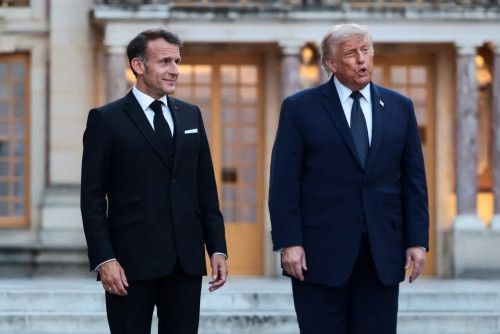
The omission reflects a notable shift from President Donald Trump's earlier position, when restricting Iran's missile programme featured prominently among the justifications for US military action. During last week's G7 summit, however, Trump suggested the issue had become less central, stating that "missiles aren't the problem."
Trump also dismissed Iranian assertions that no visit had been scheduled for inspectors from the International Atomic Energy Agency (IAEA), maintaining that Tehran had already agreed to such arrangements.
"They're wrong, they're wrong, they know they're wrong," Trump told reporters.
The contrasting public statements emerged as US Secretary of State Marco Rubio toured the Persian Gulf to consult regional allies while negotiations with Iran continue.
Rubio sought to separate the ongoing US-mediated talks between Israel and Lebanon from the broader US-Iran diplomatic process, despite repeated Iranian claims that the issues are interconnected.
"It's separate because Lebanon is a sovereign country," Rubio said upon arriving in the United Arab Emirates.
Meanwhile, the Lebanese Presidency disclosed that the Trump administration is examining the creation of a joint mechanism involving the United States, Lebanon and Iran to reinforce the ceasefire in southern Lebanon and oversee related security measures.
At the same time, Israeli Ambassador to the United States Yechiel Leiter warned that Israel and Lebanon were "heading toward a train wreck" as the fifth round of bilateral talks opened in Washington. Lebanese President Joseph Aoun has maintained that Beirut will "accept nothing less than the end of the Israeli occupation" in southern Lebanon.
Separately, Hezbollah accused Israel of committing a "blatant violation" of the US-Iran ceasefire framework after Lebanon's Health Ministry reported that two people were killed in Israeli strikes on Tuesday.
In a further sign of easing regional tensions, the International Maritime Organization (IMO) said the US-Iran agreement had enabled the evacuation of more than 11,000 stranded seafarers from the Persian Gulf following the relaxation of restrictions on the Strait of Hormuz.
Shipping traffic through the strategically vital waterway remained stable on Tuesday afternoon, according to MarineTraffic data. - June 24, 2026
.JPG)