NEPAL is pushing for a stronger cross-border early-warning system with China after a devastating Himalayan flood exposed critical gaps in the sharing of information on glaciers, river levels and extreme weather.
The disaster struck just three months after Nepalese and Chinese officials met in Kathmandu to discuss closer cooperation on monitoring floods, severe weather and glacier-related risks.
At the May 27 meeting, 10 Nepalese officials and about 12 Chinese officials, including representatives from Tibet, discussed joint measures to reduce disaster risks, including mapping glacial lakes and identifying vulnerable areas. The agenda was prepared by Nepal and seen by Reuters.
However, two Nepalese officials told Reuters that they did not receive sufficient information from China on glacier risks and water levels following the meeting, raising concerns that a lack of data could hamper Nepal’s ability to detect threats and prepare for major disasters.
"What we actually want from them, and still want, is that if there is early movement of glaciers or movement in that area, we want to know about it earlier," Reuters quoted Sauhardra Joshi, a hydrologist with Nepal’s Flood Forecasting Division who attended the May meeting saying.
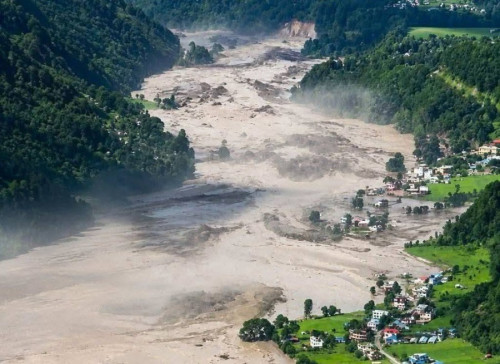
The latest disaster killed nearly 800 people in Nepal and China and left more than 3,000 missing, according to the latest figures cited in the report. A section of glacier collapsed, triggering a massive flow of water and mud through communities downstream.
Nepalese officials stressed that the shortcomings in cooperation were not the main cause of the disaster, but said their priority now was to strengthen coordination with China.
China’s Foreign Ministry did not respond to Reuters’ requests for comment on the May meeting or Nepal’s request for greater information-sharing.
A Chinese embassy statement on X said Beijing and Kathmandu remained in close contact and had made "significant progress" at the May meeting in improving cross-border disaster information-sharing.
The embassy also rejected claims circulating on Nepalese social media that China had failed to provide adequate warning, saying Chinese and international experts faced major challenges monitoring the remote Himalayan terrain and that Chinese experts had shared key information with Nepal "in a timely manner".
China had provided Nepal with warnings of heavy monsoon rainfall. Twelve days before the disaster, China’s World Meteorological Centre emailed Nepalese officials warning that heavy monsoon rain was expected between Aug 14 and 19.
"Rainfall is expected to increase across most parts of Nepal and we would like to draw your attention to the possibility of subsequent and cascading hazards, including but not limited to landslides and flash floods," the warning said.
But Nepalese officials said China’s information-sharing did not extend sufficiently to other threats such as sudden changes in water levels, landslides and extreme events.
"However, not for avalanches, water levels, landslides and extreme weather events," said Nepalese hydrologist Binod Parajuli, referring to the limitations of the information provided.
Parajuli said the speed at which the flood travelled into Nepal demonstrated the importance of having a robust early-warning system.
At about 8.32am Nepal time on Wednesday, a powerful surge of water struck a border crossing in Tibet as people attempted to escape. About 26 minutes later, Parajuli received a call from the head of Nepal’s National Disaster Risk Reduction and Management Authority about flooding on the Trishuli River.
Several monitoring stations subsequently stopped transmitting data. At least four stations were destroyed as the flood travelled 168km from the Nepal-China border.
The flood carried an estimated 57.4 million cubic metres of water and swept away boulders and buildings, destroying 19 bridges and about 40km of highway. More than 10 per cent of Nepal’s power-generation capacity was also knocked out, according to the Stimson Center.
"It was not water. It was a huge mudflow coming straight towards us. I tried to hold my wife’s hand, but she was swept away by the mud," said Keshav Prasad Baral of Tupche village, about 25km from the border.
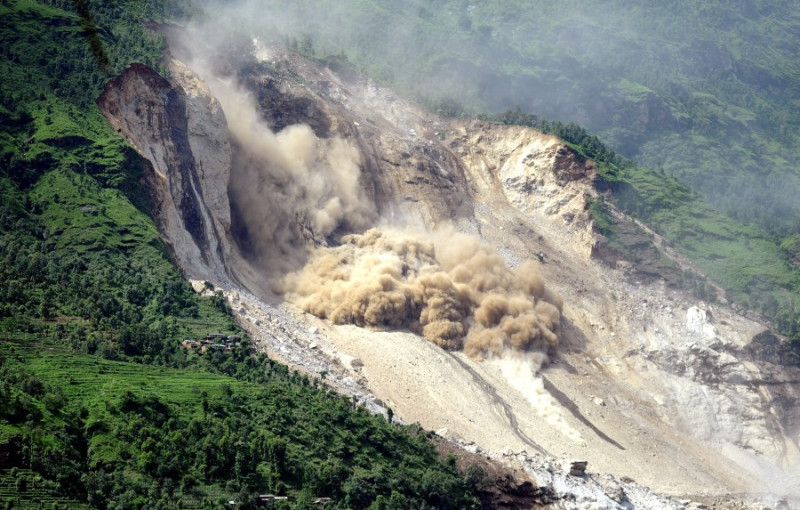
An initial assessment by Nepalese authorities found that part of a glacier had collapsed into a valley hundreds of metres below, triggering an extremely fast-moving flash flood.
The disaster has renewed concerns over the growing risks facing the Hindu Kush Himalaya, which contains more than 63,700 glaciers covering nearly 56,000 square kilometres.
A 2023 study by the International Centre for Integrated Mountain Development found that glacier melt was accelerating because of climate change, with declining snow cover and increasingly erratic snowfall expected to increase the risks of floods, landslides, erosion and sedimentation.
Environmental anthropologist and Stimson Center senior fellow Austin Lord said the latest disaster was caused by a glacier collapse in an area that was poorly monitored.
"This does not mean we can ignore the fact that a truly coordinated system still does not exist.
"Information exchange between Nepal and China is also very limited," said Lord, who has worked with the Nepalese government on disaster risk management and climate change.
Nepal now plans to work with China on studies and systems to monitor avalanches and glacial lake outflows, which Parajuli described as two major threats to mountain communities.
Nepal’s department also plans to propose a formal data-sharing agreement similar to the arrangement it has with India, seeking more frequent information on rainfall and river levels rather than warnings limited to heavy rainfall forecasts.
"Nepal will request data every 10 minutes so that we can warn people and save them.
"Our main goal is to ensure that no future disasters slip past our attention," Parajuli said.
This version puts the accountability/early-warning gap at the centre while making clear that Nepalese officials did not blame China for causing the disaster. - August 31, 2026