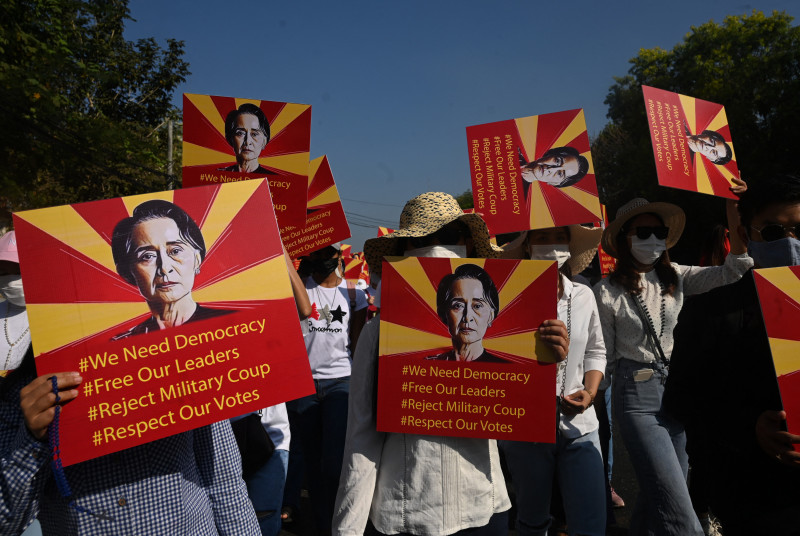
YANGON – Myanmar’s new military regime today warned the public not to harbour fugitive political activists, after issuing arrest warrants for veteran democracy campaigners supporting massive nationwide anti-coup protests.
Much of the country has been in uproar since last week, when soldiers detained Aung San Suu Kyi and ousted her government, ending a decade-old fledgling democracy after generations of junta rule.
Security forces have stepped up the arrest of doctors and others joining a civil disobedience movement that has seen huge crowds thronging the streets across big urban centres and isolated villages in mountainous frontier communities.
Police are hunting seven people who have lent vocal support to the protests, including some of the country’s most famous democracy activists.
“If you find any fugitives mentioned above, or if you have information about them, report to the nearest police station,” said a notice in state media today.
“Those who receive them will (face) action in accordance with the law.”
Among the list of fugitives is Min Ko Naing, who spent more than a decade in prison for helping lead protests against a dictatorship in 1988 while he was a university student.
“They are arresting the people at night, and we have to be careful,” he said in a video published yesterday on Facebook, skirting a junta ban on the platform, hours before his warrant was issued.
“They could crack down forcefully, and we will have to be prepared.”
The 1988 protests vaulted Suu Kyi to the forefront of Myanmar’s democracy movement, and the Nobel laureate spent years under house arrest as the generals’ prisoner.
She has not been seen in public since she was detained on February 1 alongside key aides.
Nearly 400 others have been arrested in the days since, including many of Suu Kyi’s top political allies, according to the Assistance Association for Political Prisoners monitoring group.
Military leader Min Aung Hlaing suspended requiring warrants for home searches and limiting detentions without court orders to 24 hours as part of several legal manoeuvres issued yesterday.
People in some urban residential areas have begun forming neighbourhood watch brigades to monitor their communities overnight – defying a junta curfew – and prevent the arrest of residents participating in the civil disobedience movement.
Crowds returned to the streets here today, with hundreds massing at an intersection near the commercial capital’s famed Shwedagon pagoda.
A day earlier, Buddhist monks gathered outside the city’s United States embassy and chanted the Metta Sutta, a prayer that urges protection from harm.
‘Media ethics’
Myanmar’s new military leadership has so far been unmoved by a torrent of international condemnation.
An emergency session of the United Nations Human Rights Council on Friday called for the regime to release all “arbitrarily detained” people, and for the military to hand power back to Suu Kyi’s administration.
Solidarity rallies have been staged in neighbouring Thailand, home to a large community of Myanmar migrant workers, as well as the US, Japan and Australia.
But, traditional allies of the country’s armed forces, including Russia and China, have dissociated themselves from what they have described as interference in Myanmar’s “internal affairs”.
The junta insists that it took power lawfully, and has instructed journalists in the country not to refer to itself as a government that took power in a coup.
“We inform... journalists and news media organisations not to write to cause public unrest,” said a notice sent by the Information Ministry to the foreign correspondents’ club yesterday.
It also instructed reporters to follow “news media ethics” when covering events in the country. – AFP, February 14, 2021