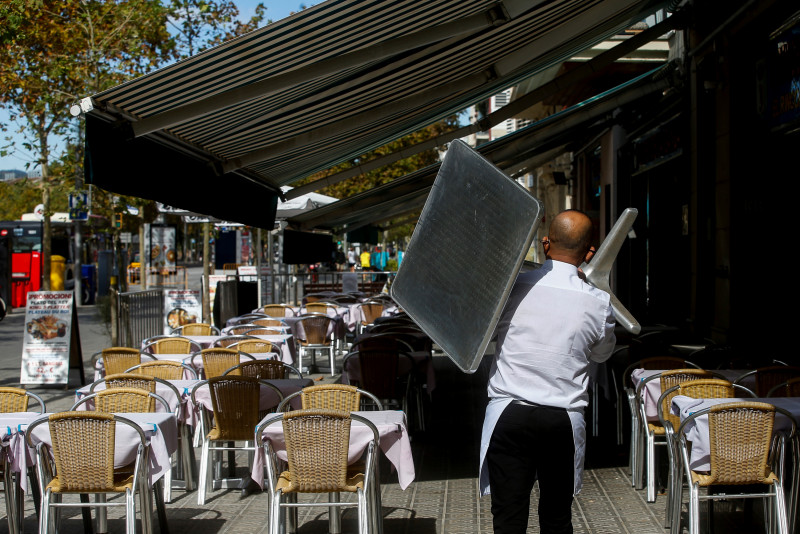
MADRID – Spain has lifted a state of emergency in place since last October to fight the Covid-19 pandemic, allowing locals to travel between regions for the first time in months.
“I was fed up with not being able to get out of Madrid,” jewellery designer Blaca Valls told AFP yesterday, echoing the relief of many in the country over the easing of restrictions.
“I felt frustrated, locked down, with no freedom,” said the 46-year-old, who plans to go to Galicia in northwest Spain next weekend to celebrate a birthday.
Argentina Enriquez, a 37-year-old Mexican student, said she is impatiently waiting to head to the countryside to enjoy barbecues with friends, play the guitar and go for walks.
“Just being together... a lot of emotions.”
Although the emergency measure, which expired at midnight (2200 GMT yesterday) will lead to more freedoms, it is a headache for the country’s 17 regional governments responsible for healthcare.
The state of emergency provided them with a legal framework to impose measures, such as night-time curfews or a ban on non-essential travel between regions, that limited freedoms.
Except for a few days over Christmas when the restrictions were lifted, people have not been able to travel to other regions, go on holiday or see family.
Discouraged by the surge in infections after Christmas, authorities did not loosen internal travel curbs during Easter week, normally a peak travel period in Spain.
But what really angered Spaniards was the fact that foreign tourists were able to pour into the country on holiday, while they were banned from travelling to the beach or visiting loved ones.
While intra-regional travel bans have ended and curfews have been lifted, not all of the restrictions are being relaxed in Spain, one of Europe’s hardest-hit nations with nearly 79,000 deaths and 3.5 million infections.
Differing legal views
Regions can still restrict opening hours and impose capacity limits for bars and restaurants.
They can also seek court approval for stricter measures, such as reimposing curfews, capping the number allowed at home gatherings or extending a ban on internal travel.
But, the courts have offered different rulings, leading to a patchwork of measures across the country.
A court in the eastern Valencia region approved a curfew from 12am to 6am, while the top court in the northern Basque Country said the area could not keep its night-time curfew.
To avoid this scenario, several regions have lobbied Prime Minister Pedro Sanchez’s government to extend the emergency.
However, his administration has refused, saying the measures cannot remain in place indefinitely, pointing out that the infection rate is stable and that Spain’s vaccination programme is progressing rapidly.
Even so, it passed a decree allowing regions the right to appeal to the Supreme Court if a local court strikes down a proposed measure.
At the head of a minority government, Sanchez had faced an uphill struggle to cobble together enough support to approve an extension of the state of emergency.
Train ticket sales up
State-owned rail operator Renfe says ticket sales for next week are up 13% over the last seven days.
But after more than a year of restrictions, and with the weather turning hot and sunny, authorities have warned people against letting their guard down.
Spaniards must be careful “not to get the wrong impression about what ending the state of emergency means... it doesn’t mean an end to the restrictions”, said the Health Ministry’s emergencies coordinator, Fernando Simon, on Thursday.
Everyone must continue to behave responsibly, he said.
“Nothing can be ruled out in terms of the evolution of the pandemic.” – AFP, May 9, 2021