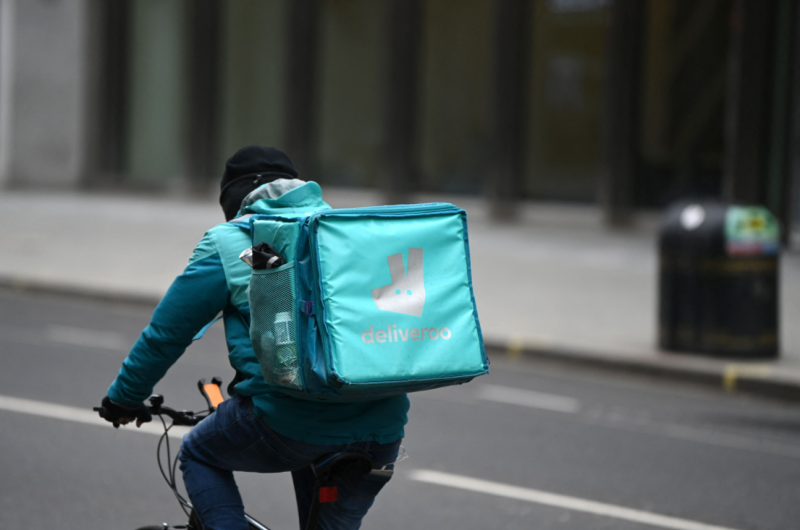
PARIS – A growing number of countries are taking on gig economy giants like Uber, Bolt and Deliveroo by giving their workers – who are routinely treated as freelancers – full employment rights.
With the European Union executive tabling new proposals today to clear up the grey area, here is a snapshot of recent decisions shaking up the sector.
Spain leads way
Spain was the first European Union country to give delivery workers full rights in August, recognising them as salaried staff with all relevant rights and protections, including sick leave and paid holidays.
The country’s left-wing government acted after the supreme court ruled on the issue.
The British takeaway food delivery app Deliveroo pulled out of Spain in November, but other platforms have decided to adapt, or tried to get around the law.
Italy strikes deal
Italy struck a deal this month to improve conditions for riders for food delivery platforms.
Prosecutors in Milan initially began looking at working conditions for delivery riders following a spate of road accidents, and the probe was eventually extended throughout the country.
In February, prosecutors told Foodinho-Glovo, Uber Eats Italy, Just Eat Italy and Deliveroo Italy that their riders cannot be considered as freelancers but as employees who receive wages.
Under the deal reached with the delivery platforms – which makes no mention of riders’ legal status – they will have to spend millions improving conditions for their 20,000 riders.
Unions, however, are taking cases through the courts.
Netherlands: court ruling
A Dutch court ruled in September that Uber drivers in the Netherlands are effectively under an employment contract. Uber has appealed the ruling.
Belgium: spoke in Uber’s wheels
Deliveroo claimed victory yesterday after a Brussels labour court ruled that its riders are not employees.
But at the end of November, an appeal court in the capital said a 2015 ban on private individuals offering taxi services also applies to apps like Uber.
Uber’s UK U-turn
In March, following a ruling by Britain’s High Court, Uber agreed to give its UK drivers workers’ entitlements including holiday pay and a pension.
Its 70,000 drivers there will now earn at least the minimum wage when driving for the taxi app.
US: Biden overturns Trump gig
The Biden administration in May blocked a rule handed down under former US president Donald Trump that would have prevented gig workers from demanding a minimum wage or overtime.
The state of California voted in 2019 to recognise gig economy workers as employees but digital giants including Uber and Lyft refused to comply with the law.
Instead, they bankrolled a referendum that effectively overturned it. Under it, drivers and delivery riders remain independent contractors but are to be paid minimum wages and a contribution to healthcare and insurance.
France: Uber, Deliveroo under cosh
France’s appeal court ruled in March 2020 the contract between Uber and its 28,000 drivers in France is an employment contract.
Deliveroo and three former directors will appear in a Paris court next March charged with “not declaring a large number of jobs”.
Argentina, Brazil among nations in Latin America considering regulatory measures
Several parliaments in Latin America are weighing legislation to regulate the activities of the platforms, notably Argentina, Brazil, Chile and Colombia. However, nothing concrete has so far emerged.
China: Didi under pressure
In early December, the Chinese transport ministry called on China’s version of Uber, Didi, and other platforms to improve drivers’ wages, breaks and working conditions. – AFP, December 9, 2021