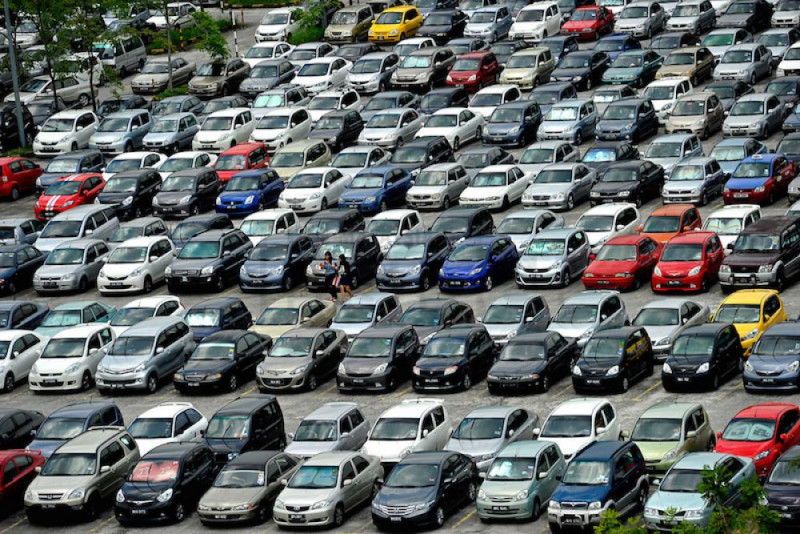
MALAYSIA must increase the export of car parts if it wants to become an Asean automotive hub, said the Malaysia Automotive, Robotics and IoT Institute (MARii).
MARii’s CEO Azrul Reza Aziz said Malaysian automobile companies must significantly increase the export of cars to achieve economies of scale and enable auto parts to be sold at more competitive prices.
He said increased sales volume could reduce production costs and component prices to increase competitiveness against regional and neighbouring countries where auto parts are cheaper due to high sales volumes.
Car manufacturers, auto industry researchers, and economists believe that these efforts are crucial to establishing Malaysia as a regional automotive hub for Asean and taking advantage of the region’s nearly 700 million consumer base.
“We urge original equipment manufacturers (OEMs) to not only export cars but also parts and components, thereby enhancing the overall competitiveness of the Malaysian automotive industry,” Azrul was quoted as saying by Bernama.
He was responding to reports that Malaysia’s supply chain costs are 30% higher than China’s and 10% costlier than Thailand’s.
Azrul said it was essential to recognise that these costs varied significantly depending on each company’s cost structure, car model, and supply chain ecosystem.
He added that companies may have different levels of maturity in their supply chains, which would impact their overall cost efficiency.
Malaysia has a lot of catching up to do, as despite marking significant growth, its record high total production volume (TPV) is only 775,000 vehicles, compared to China’s TPV of 30 million vehicles and Thailand’s 1.8 million.
Reza said Malaysian companies must transform by embracing digital advancements, leveraging Industry 4.0 technologies to address challenges.
This is crucial as the country aims to achieve carbon neutrality by 2050 and focus on the development of electric vehicle components, autonomous vehicles, and Internet of Things components, he said.
“Given the constraints on purchasing raw materials in bulk due to cost implications and the added expenses of stock handling and maintenance, digital solutions offer respite in terms of immediate insights and resolutions.
“Furthermore, digital solutions enhance efficiency and effective improvements in research and development, notably through the utilisation of computer-aided engineering and additive manufacturing technologies,” he said.
Meanwhile, Malaysian Automotive Association president Shamsor Zain said China and Thailand’s populations and vehicle markets are considerably larger than Malaysia’s.
Their reduced reliance on exports means that their vendors are less vulnerable to fluctuating exchange rates.
Similarly, such costs are largely driven by the push and pull of demand and supply, he said.
“Although Malaysia has a relatively mature automotive supply chain, dating back more than 50 years, the cost of setting up or refreshing component manufacturing with new technology is very high.
“The most effective way to justify these investments is for Malaysia to position itself as an export hub,” he said.
Shamsor said the local automotive industry needs to expand export volume and ramp up the capacity of OEMs.
He added that manufacturers often have different perspectives on how their business models are structured, with cost being only one consideration among many. – July 15, 2024.










.jpg)