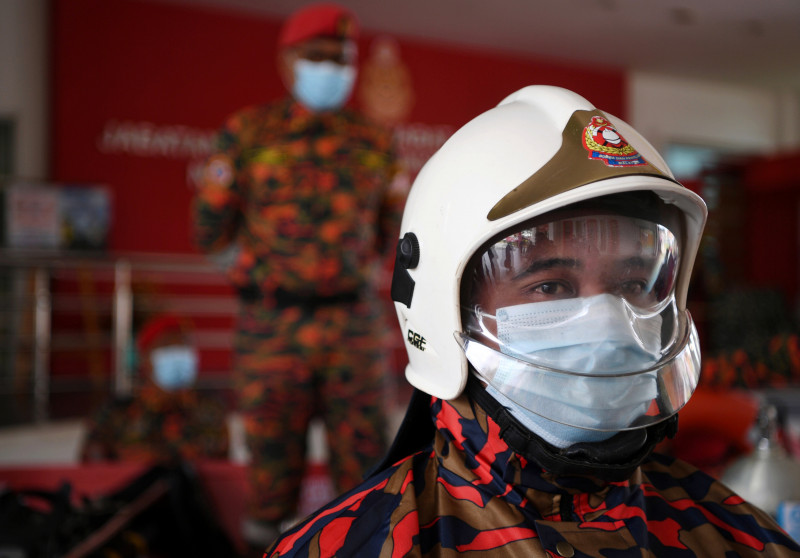
THE role of the Malaysian Fire and Rescue Department (JBPM) goes well beyond extinguishing fires. Its mission today spans the protection of lives, the safeguarding of property, and the deployment of elite units trained to respond to some of the nation’s most extreme emergencies.
“The core duty of JBPM is not only to save lives but also to protect public property in every form of rescue operation,” Harian Metro cited Azhar Yusof, Operations Officer and Senior Fire Officer II at the Jalan Hang Tuah Fire and Rescue Station saying. “Above all, every operation we carry out prioritises the preservation of life.”
BBP Jalan Hang Tuah, one of Kuala Lumpur’s most historically significant fire stations, first opened in 1953. It now operates from a modern facility built in 2012, playing a central role in the capital’s emergency response. The station currently houses 108 officers and personnel, with capacity for up to 130.
Among its frontline assets are two Fire Rescue Tender (FRT) trucks, an Aerial Ladder Platform (ALP) for high-rise rescues, two water tankers (10,000 and 20,000 litres), and a dedicated Water Rescue Unit (PPDA).
“Fires are the most frequent type of incident we respond to,” said Azhar, “but we also assist other stations across the city in structural fires and emergencies.”
While firefighting remains the department’s most visible function, JBPM is also home to highly trained specialist teams. These include the Hazardous Materials (Hazmat) Unit, High Rise Rescue Team (HRRT), Tunnel Rescue Unit, K9 Detection Unit, and JBPM’s own Air Unit.
Of these, only the Water Rescue Unit is permanently stationed at Jalan Hang Tuah, covering the wider Kuala Lumpur area.
Md Rosmezi Md Zain, 56, a veteran diver with the PPDA and Senior Fire Officer II, has served with the unit since 2000. He describes water-based rescues as some of the most demanding operations in the field.
“The water is pitch-black, filled with mud and weeds. In these black water conditions, you see absolutely nothing,” he said.
Among his most memorable missions were the recovery of five foreign nationals who drowned in a Selayang mining pool and a prolonged search during a sinkhole incident near Masjid India. “It takes extreme discipline, full teamwork, and physical endurance,” he said.
Another elite unit, the Rapid Intervention Motorcycle (RIM) team, plays a crucial role in urban emergencies — particularly in heavy traffic. Their mandate: arrive first, stabilise the situation, and prepare for the arrival of larger fire appliances.
Zuhairi Mat Sari, 47, who has served in the RIM unit since 2006, said the biggest challenge is navigating a 300kg motorcycle quickly and safely through congested city streets.
“RIM is a vital asset. Every second counts when saving lives, and this unit buys critical time while the trucks make their way through traffic,” he said. “Initially, I joined because of family encouragement, but every life we help save brings a satisfaction beyond words.”
At the heart of every successful operation is the often-overlooked Pasukan Pengendali Jentera (PPJ) — the engine operators tasked with safely transporting fire trucks and equipment to incident sites.
“Being in the PPJ is not just about driving,” said Azhari Azhiz, 48, Senior Fire Officer II and PPJ crew member. “We must ensure all equipment functions properly, and our driving must be flawless. A mistake could risk the lives of other team members.”
The PPJ requires rigorous training due to the size and complexity of the vehicles involved. “We’re under pressure to arrive quickly, but our control must be absolute. That’s the greatest challenge,” he said.
As JBPM continues to evolve in the face of increasingly complex urban risks, its commitment remains constant: to serve with precision, professionalism and unwavering courage — both above ground and below, on land and in water, often in the most unforgiving of conditions. - October 6, 2025





.jpeg)