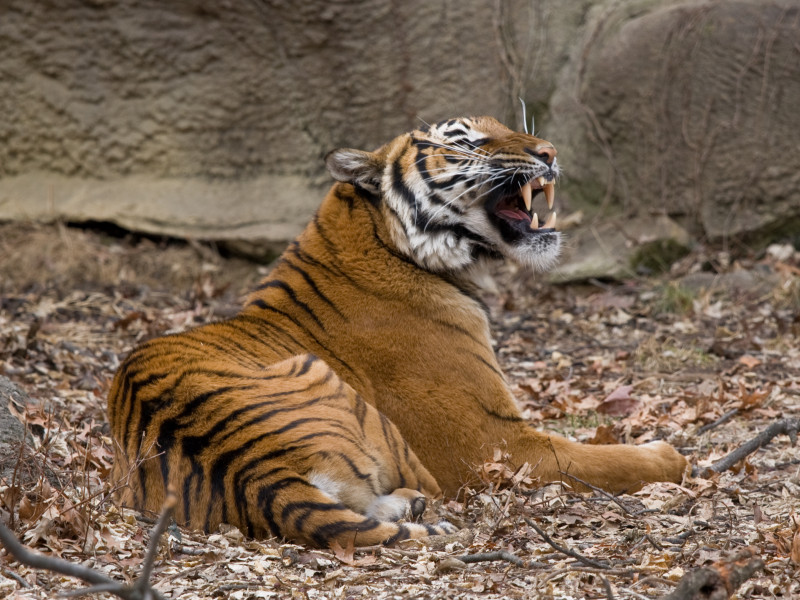
RESEARCH into the behaviour and breeding of Malayan Tigers (Panthera tigris jacksoni) in captivity is not only aimed at increasing the species’ numbers but also at ensuring the preservation of Malaysia’s natural ecosystems.
Associate Professor Dr Choong Siew Shean, Deputy Dean (Academic) of the Faculty of Veterinary Medicine at Universiti Malaysia Kelantan (UMK), said the study, conducted alongside final-year students, focuses on two main tiger groups: those bred entirely in captivity and those recently captured from the wild due to human-wildlife conflict.
“We observed behavioural differences between these two groups. Tigers born in captivity are calmer and easier to approach, whereas newly captured tigers remain wild and become stressed when encountering humans,” he told Bernama.
Dr Choong explained that the study also monitors biological cycles and natural behaviours during mating periods to improve breeding naturally, avoiding assisted reproductive technologies such as artificial insemination.
“Natural breeding is better as it allows tigers to display their instincts and natural behaviours. Tigers are solitary animals, so if kept together for too long, they may form bonds and lose interest in mating. We only bring them together at the appropriate time,” he said.
One of the main conservation challenges is habitat loss caused by logging, agriculture, and infrastructure development such as highways, which fragment tiger territories. “Male tigers have larger territories that overlap with several females. But as forests shrink, the chances of encountering a mate diminish, not to mention illegal hunting and wire traps still occurring,” Dr Choong added.
He noted that genetic studies have confirmed the Malayan Tiger as a unique subspecies, distinct from the Indochinese Tiger, making it critically endangered and a target for poachers. “Every part of the Malayan Tiger has high value, such as the head, teeth, and skin, when sold on the black market,” he said.
UMK is also expanding conservation efforts through a Sambar deer breeding project to provide natural prey for tigers in the wild. “We recently received a grant from the Ministry of Natural Resources and Environment and are collaborating with the Department of Wildlife and National Parks (Perhilitan) to breed Sambar deer. Previously, we kept East Asian deer, but they are non-native and have limited conservation value. Sambar deer are essential as one of the main food sources for tigers. If deer populations decline, the food chain is affected,” he explained.
Dr Choong highlighted that African swine fever affecting wild boar populations also impacts the ecosystem, as these animals are prey for large predators. “When the lower levels of the food chain, such as deer or wild boar, decline, the effect rises to the top. Tigers, as apex predators, depend on the balance below them,” he said.
The Sambar deer project at UMK Bachok started with ten deer in its first phase, focusing on conservation rather than profit. “This project is primarily educational. Caring for deer is costly, so we do not view it commercially. Once the population is sufficient, Perhilitan will plan for their release to balance the ecosystem,” he added.
Regarding potential human-tiger conflicts, Dr Choong said tigers naturally avoid humans and attack only if threatened or facing extreme food scarcity.
“If a tiger attacks a human, it knows the consequences are severe. Usually, tigers avoid humans unless threatened or an opportunity arises. Cases we hear about are rare; sometimes the animals strike, but they do not eat humans,” he said.
He stressed that protecting the Malayan Tiger must go hand in hand with fostering public awareness and appreciation for natural resources.
“Starting with small actions like avoiding food waste and valuing water can cultivate a love for nature. If we teach children to appreciate nature at home, they will eventually care for forests and wildlife. All of this is interconnected,” he said.
Dr Choong added that even urban communities indirectly benefit from forests through clean air and water.
“Sometimes we feel life is easy and leave food uneaten, but all of that comes from nature. Learning to respect nature from a young age also helps us value life, including tigers we may never see,” he concluded. - November 8, 2025