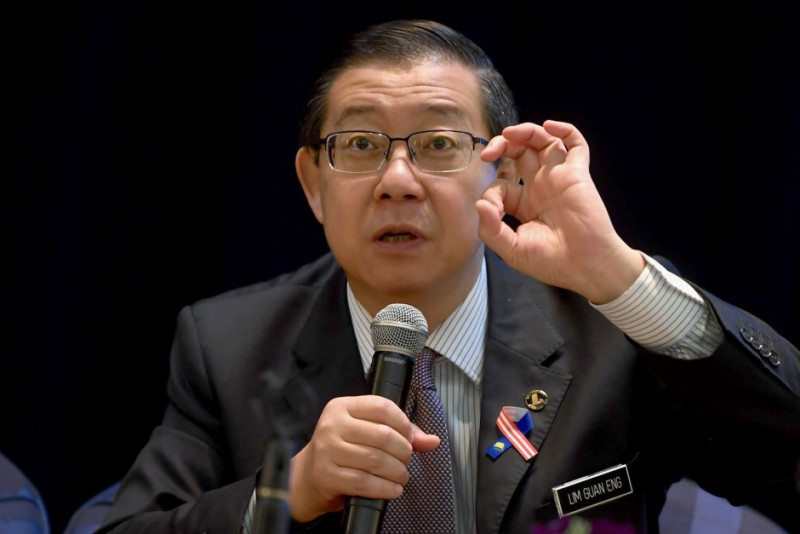

FORMER finance minister Lim Guan Eng has urged the government to reverse its controversial increase in Bumiputera equity ownership requirements for high-value asset disposals, arguing that the move could weaken Malaysia’s competitiveness and discourage investment.
Lim called on the Finance Ministry to reinstate the previous 30 per cent Bumiputera equity threshold for acquisitions involving properties worth more than RM20 million sold by government-linked companies (GLCs) and government-linked investment companies (GLICs), instead of the current 50 per cent requirement.
According to Lim, restoring the earlier threshold would strengthen market confidence and attract greater investor participation.
“The Finance Ministry needs to consider reversing the increase in bumi equity ownership to 50 percent by reverting to the previous 30 percent threshold for disposals of properties valued above RM20 million by the government-linked companies (GLC) or government-linked investment companies (GLICs),” Lim said in a statement.
The DAP chairman cited the recent RM2 billion acquisition involving Eco World Development Group Bhd as an example of how major corporate transactions could proceed smoothly without provoking racial tensions.
“No non-bumi had opposed the RM2 billion acquisition of a substantial stake in Eco World Development Group Bhd and its sister company by the bumi entrepreneur Tan Sri Syed Mokhtar Albukhary.
“The shares in EcoWorld, equivalent to 30.1 percent, were sold by former deputy chairman Datuk Leong Kok Wah resulting in Syed Mokhtar as the dominant shareholder in EcoWorld,” he said.
Lim argued that Malaysians broadly accepted the transaction because it was viewed as a commercial decision rather than an ethnic issue.
“All Malaysians accepted this transaction because they see this not through a racial lens but as a market-based commercial decision by private parties,” he said.
“The problem is that there are still extremists in Malaysia who continue to look at the racial angle in every commercial decision.”
Lim stressed that Pakatan Harapan’s longstanding position had been to maintain the status quo of a 30 per cent bumiputera quota in public policy and government-linked economic frameworks while ensuring equal opportunities for all Malaysians.
“Fostering national unity, stability and harmony is the understanding for Pakatan Harapan (PH) in maintaining the status quo of 30 percent ethnic quotas in government and public policy.
“Within this framework, PH seeks to provide equal opportunities for all Malaysians,” he said.
He criticised the revised framework under the Ministry of Economy’s Property Acquisition Guidelines (PAG), which came into effect on November 18, 2025, describing it as inconsistent with Pakatan Harapan’s original approach.
Under the updated guidelines, companies acquiring properties valued above RM20 million from GLCs and GLICs are now required to have at least 50 per cent Bumiputera equity ownership, an increase from the previous 30 per cent threshold.
Lim highlighted the Employees Provident Fund (EPF) as one of the key institutions affected by the policy, noting that it represented the retirement savings of Malaysians from all communities.
“Amongst the most important GLICs is the Employees Provident Fund (EPF), the premier statutory retirement fund of all Malaysians, from both bumi and non-bumi,” he said.
While acknowledging that the policy framework had existed under previous administrations, Lim noted that the current government had chosen to strengthen the requirement rather than maintain existing arrangements.
“The increase in bumi equity ownership from 30 percent to 50 percent by the current government has not only caused disillusionment amongst the PH base supporters but also raises concerns that this government may do the same for other policy instruments and administrative arrangements,” he said.
Lim ultimately called on Prime Minister Datuk Seri Anwar Ibrahim to intervene directly and restore the earlier threshold.
“Prime Minister Datuk Seri Anwar Ibrahim should reverse the increase in bumi equity ownership by reverting to the previous 30 percent for disposals of properties valued above RM20 million by GLCs and GLICs,” he added. - May 24, 2026