POLITICAL corruption investigations tend to come with their own theatre.
At the centre of that theatre is what many now call the “orange parade” — the ritual of public detentions, orange lock-up uniforms, and photo ops designed to show that justice is being done.
It happened in 2017.
Warisan president Datuk Seri Mohd Shafie Apdal was detained by the MACC in the run-up to the 14th General Election, accused of misappropriating rural development funds.
He was held for eight days. He and his party allies were paraded in orange lock-up attire, their images broadcast across national media.
The charges never came. But the damage — or the intention — was done.
Now, in 2025, Sabah is once again caught in the swirl of a corruption scandal just as elections approach.
The MACC has confirmed that two state assemblymen and a civilian will be charged for allegedly receiving money in exchange for mining licenses.
So the question is - will the orange parade return?
So far, it hasn’t. At least not yet.
Despite the MACC confirming impending charges, there has been no public display, no orange shirts, no front-page photos of handcuffed lawmakers.
Back then, the Warisan leaders were the opposition.
Now, the individuals under investigation are sitting assemblymen — and by all accounts, supportive of the current state administration.
In Sabah, perception is everything. And the silence, the absence of spectacle, is beginning to look like a double standard.
Compounding the scrutiny is the fact that this time, unlike in 2017, the evidence was not behind closed doors.
Videos and audio recordings gone viral — showing individuals apparently discussing receiving payments and what not in return for lucrative mining concessions.
The public has seen it, shared it, and formed their own conclusions.
What once required an official investigation to bring to light is now unfolding in real time on social media. The allegations are not hidden — they are visual, visceral, and undeniable.
And yet, for all the viral evidence and serious allegations, the treatment remains subdued or so it seems.
Will there be any orange jumpsuits? Public humiliation or parade?
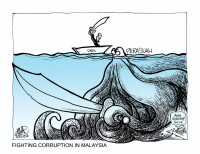
It raises the uncomfortable possibility that anti-corruption action in Sabah is still a matter of political convenience — harsh when the target is the opposition, but muted when the accused are closer to power.
Back in 2018, Warisan did not win the state election outright. It only formed a government after defections — first from UPKO, then from several Umno assemblymen who abandoned the BN bloc they had just helped win.
The irony isn’t lost on Sabahans: turncoats brought Warisan to power. Turncoats later brought it down.
The same dynamics of power and betrayal play may be playing out once more — with corruption allegations lingering overhead.
But no matter what is being played out by the political elites in this drama, the ones really affected is still the people.
Sabah remains one of the poorest states in Malaysia. Basic infrastructure is still lacking in large parts of the interior. Roads are impassable, clinics under-equipped, schools without electricity.
Every mining license that was allegedly sold for political gain is not just a legal violation — it’s a moral betrayal of Sabahans who were promised better.
And while politicians jockey for control, stage press conferences, and prepare for the polls, the people continue to wait — not for an orange parade, but for clean water, functioning hospitals, and dignified lives.
This is not about spectacle. It is about equality before the law. If Shafie was paraded in full public view before any charges were filed — only to walk free — then those now accused, with more visible evidence at hand, must not be shielded by silence or political proximity.
If justice only parades some, and protects others, it is not justice at all. - June 19, 2025