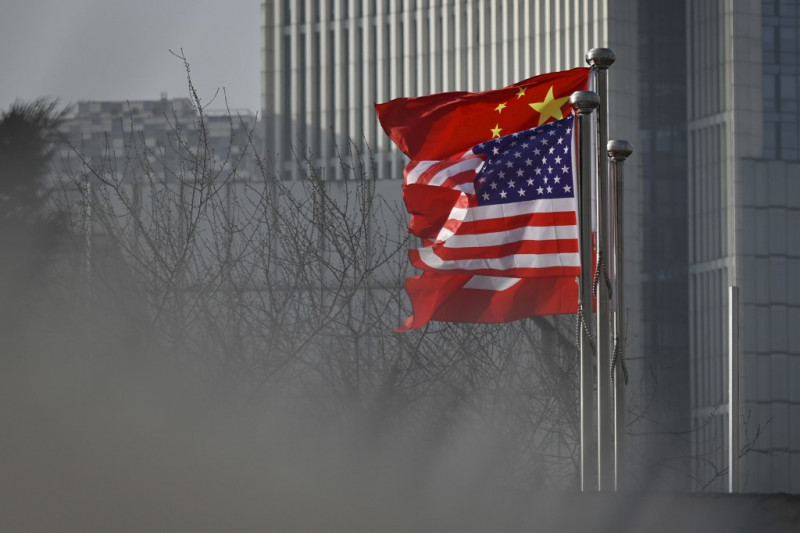
THE U.S. government has banned American government personnel in China, as well as family members and contractors with security clearances, from any romantic or sexual relationships with Chinese citizens, The Associated Press has learned.
Four people with direct knowledge of the matter told the AP about the policy, which was put into effect by departing U.S. Ambassador Nicholas Burns in January shortly before he left China. The people would speak only on condition of anonymity to discuss details of a confidential new directive.
Though some U.S. agencies already had strict rules on such relationships, a blanket “non-fraternization” policy, as it is known, has been unheard of publicly since the Cold War. It’s not uncommon for American diplomats in other countries to date locals and even marry them.
A more limited version of the policy was enacted last summer prohibiting U.S. personnel from “romantic and sexual relations” with Chinese citizens working as guards and other support staff at the U.S. Embassy and five consulates in China.
But Burns, the departing ambassador, broadened it to a blanket ban on such relations with any Chinese citizen in China in January, days before President Donald Trump took office.
The AP was unable to determine exactly how the policy defined the phrase “romantic or sexual relationship.”
Two of the people with knowledge of the ban told the AP the new policy was first discussed last summer after members of Congress contacted Burns to express concern that restrictions on such relationships were not stringent enough. The House Select Committee on the Chinese Communist Party did not respond to a request for comment.
The new policy covers U.S. missions in mainland China, including the embassy in Beijing and consulates in Guangzhou, Shanghai, Shenyang and Wuhan, as well as the American consulate in the semi-autonomous territory of Hong Kong. It does not apply to U.S. personnel stationed outside China.
The only exception to the policy is U.S. personnel with pre-existing relations with Chinese citizens; they can apply for exemptions. If the exemption is denied, they must end the relationship or leave their position, the people said. Anyone who violates the policy will be ordered to leave China immediately.
The policy was communicated verbally and electronically to American personnel in China in January, but has not been publicly announced.
The State Department said it does not comment on internal matters. The National Security Council referred questions to the State Department. Burns, the former ambassador, did not reply to an AP request sent to his email address at The Cohen Group, a consultancy that he rejoined as vice chair in February.
Intelligence services across the world have long used attractive men and women to obtain sensitive information, famously during the Cold War. The State Department and other agencies with offices in China have long had stringent reporting requirements on personal relationships for American personnel stationed there, as well as rivals considered high intelligence threats such as Russia or Cuba.
Declassified State Department documents show that in 1987, the U.S. government barred personnel stationed in the Soviet bloc and China from befriending, dating or having sex with locals after a U.S. Marine in Moscow was seduced by a Soviet spy. Such restrictions were relaxed after the collapse of the Soviet Union in 1991, according to news reports at the time.
In China, a blanket ban on such relations has not been in effect for many years. Until the new ban in January, U.S. personnel in China were required to report any intimate contact with Chinese citizens to their supervisors, but were not explicitly forbidden from sexual or romantic relationships.
U.S. diplomats and intelligence experts say that Beijing continues to aggressively use so-called honeypots to access American secrets. In presentations before being stationed in China, U.S. personnel are briefed on case studies where Chinese intelligence services sent attractive women to seduce American diplomats, and warned that dozens of Chinese state security agents can be assigned to monitor any individual diplomat of interest.
Little is known about the U.S. government’s non-fraternization policies elsewhere, as they are considered classified. It is unknown how restrictive such policies are in other countries.
Rising tensions, tighter controls
In recent years, tensions between Washington and Beijing have escalated over trade, technology and geopolitical competition.
Peter Mattis, a former CIA analyst and president of The Jamestown Foundation, a Washington-based think tank, said there were at least two publicised cases in which Chinese agents seduced American diplomats stationed in China, though he hasn’t heard of such a case in recent years.
Mattis added that another issue is that Chinese state security doesn’t gather intelligence just through spies, but also by pressing ordinary Chinese people for information, often through threats or intimidation. That, Mattis said, means any Chinese citizen who dates an American diplomat could be vulnerable to coercion.
The Chinese foreign ministry did not comment on the ban, saying in a faxed statement that it was “more appropriate to ask the U.S. about this question.”
China also has been tightening already strict controls on its personnel overseas, according to Chinese regulations, news reports and four people familiar with China’s bureaucracy who spoke on condition of anonymity so they could discuss a sensitive topic.
In recent years, Beijing began strictly enforcing regulations that bar promotions for Chinese civil servants with spouses who acquired foreign citizenship and restrict diplomats from spending an extended period of time in one country, forcing some to return to China. – April 3, 2025