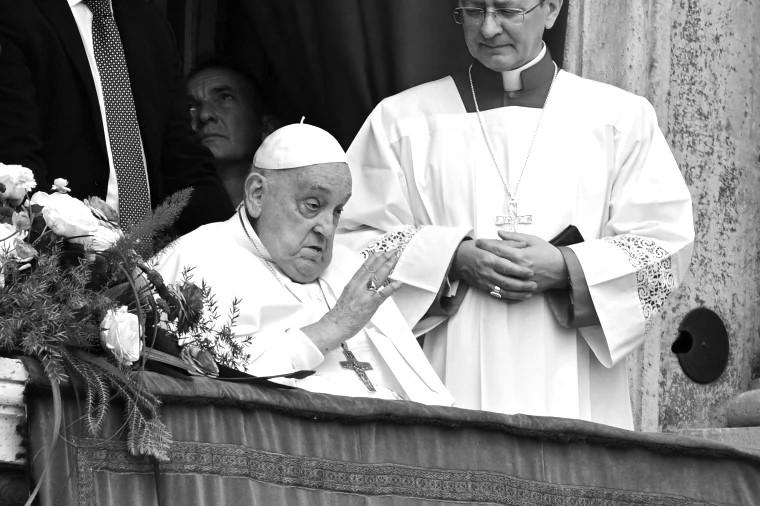
THE passing of a Pope sets in motion a series of carefully orchestrated rites and rituals well before the conclave to elect his successor begins. They involve the certification of death and public display of his body for the faithful to pay their respects, followed by the funeral and burial.
Pope Francis, who died on Monday, revised various rites last year, simplifying the funeral rituals to emphasise his role as a mere bishop and allowing for burial outside the Vatican in keeping with his wishes. But the core elements remain, including the three key moments that must be observed between the death of a pope and his burial, AP reported today.
The reforms are incorporated into the slim red volume “Ordo Exsequiarum Romani Pontificis,” Latin for “Rite of Burial for Roman Pontiffs.”
The changes became necessary after Francis expressed his own wishes, and after Emeritus Pope Benedict XVI died on Dec. 31, 2022. For Benedict, the Vatican had to work out the novelty of a funeral for the first retired pope in 600 years.
A few months later, Francis revealed he was working with the Vatican’s master of liturgical ceremonies, Archbishop Diego Ravelli, to overhaul the entire book of rites to simplify them.
In explaining the reforms, Ravelli said the changes aimed “to emphasize even more that the Roman Pontiff’s funeral is that of a pastor and disciple of Christ and not of a powerful man of this world.”
The declaration of death
The three main stations, or moments, occur first in his home, then in St. Peter’s Basilica, and then in the place of burial.
The reform allows for the formal confirmation of death to occur in Francis’ personal chapel rather than his bedroom. It is unclear why; the change may be more practical than anything since Francis chose to live in a small suite in the Vatican’s Santa Marta hotel rather than the Apostolic Palace. He has a personal chapel at Santa Marta.
Upon the pope’s death, the head of the Vatican health service examines the body, ascertains the cause of death and writes a report. The body is dressed in white.
The body rests in the pope’s personal chapel for the ritual pronouncement of death, presided over by the camerlengo, the Vatican official who runs the Holy See administration between the death or resignation of one pope and the election of another. The camerlengo is American Cardinal Kevin Farrell, one of Francis’ most trusted aides.
In a change from the past, the rite no longer requires the body to be placed in the traditional three coffins made of cypress, lead and oak. Now, the pope’s body is placed in a wooden coffin, with a zinc coffin inside. The pope is dressed in red liturgical vestments, his miter — the traditional headdress of bishops — and the pallium woolen stole, a kind of scarf. The Pasqual candle, a large, decorated candle used at Easter, is placed nearby.
The camerlengo drafts the formal declaration of death, attaching the certificate that had been prepared by the health service chief.
The master of liturgical celebrations, Ravelli, then decides when other faithful can pay their respects before the coffin is moved to St. Peter’s Basilica for public viewing.
Once in the basilica
When the body is brought into the basilica, the Litany of Saints chant is sung. The camerlengo leads the procession.
In another change, the pope’s body is no longer placed on an elevated bier. Rather, the simplified wooden coffin is placed facing the pews, with the Pasqual candle nearby.
The sealing of the coffin
The night before the funeral, the camerlengo presides over the closing and sealing of the coffin, in the presence of other senior cardinals. A white cloth is placed over the pope’s face.
A bag containing coins minted during his papacy is placed in the coffin along with a one-page written account of his papacy — known in Italian as a “rogito,” a word indicating an official deed. It is read aloud by the master of liturgical ceremonies and then rolled up and slipped inside a cylindrical tube that is placed inside the coffin. Another copy is kept in the Vatican archives. The covers of both the zinc coffin and the wooden one bear a cross and the papal coat of arms.
Francis’ coat of arms, which he kept from when he was bishop, features a shield and the monogram of his Jesuit order, with the words “Miserando atque eligendo,” Latin for “Having had mercy, he called him.” It comes from an episode in the Gospel where Christ picks a seemingly unworthy person to follow him.
The funeral is presided over by the dean of the College of Cardinals or, if that is not possible, by the vice dean or another senior cardinal. The current dean is Italian Cardinal Giovanni Battista Re, 91. The vice dean is Argentine Cardinal Leonardo Sandri, 81. Francis earlier this year extended both of their five-year terms rather than appoint new ones.
Francis’ reform allows for burial outside the Vatican, with the camerlengo presiding. Various seals are impressed on the coffin, and it is placed inside the tomb.
Francis has said he wants to be buried not in St. Peter’s Basilica or its grottoes, where most popes are buried, but in the St. Mary Major Basilica across town. His choice reflects his veneration of an icon of the Virgin Mary that is located there, the Salus Populi Romani (Salvation of the people of Rome).
After every foreign trip, Francis would go to the basilica to pray before the Byzantine-style painting that features an image of Mary, draped in a blue robe, holding the infant Jesus who in turn holds a jeweled golden book.
“It’s my great devotion,” Francis told Mexico’s N+ in revealing his future burial plans. “The place is already prepared.”
With the burial, the Catholic Church begins nine days of official mourning, known as the “novemdiales” and the conclave begins. - April 21, 2025