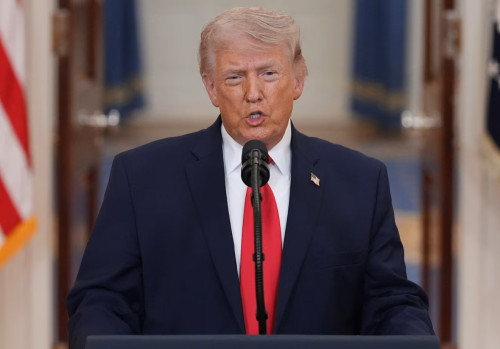
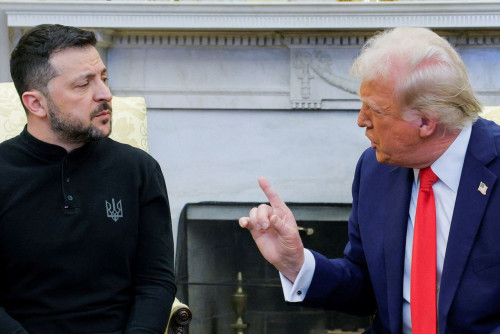
UNITED STATES President Donald Trump asserted in an interview published on Friday that tariff negotiations were underway with China, but Beijing denied any talks were taking place, the latest in a series of conflicting signals over what progress was being made to de-escalate a trade war threatening to sap global growth.
Reuters reported Trump telling TIME magazine that talks were taking place and that Chinese President Xi Jinping had called him, an assertion he repeated to reporters as he was leaving the White House on Friday morning for Rome to attend the funeral of Pope Francis.
"China and the U.S. are NOT having any consultation or negotiation on #tariffs," China shot back in a foreign ministry statement posted by the Chinese Embassy in the U.S. "The U.S. should stop creating confusion."
Trump, speaking to reporters aboard Air Force One later on Friday, said it would be a win if China would open up its markets for U.S. products and that tariffs could make that happen.
"Free up China. You know, let us go in and work China," he said. "That would be great. That would be a big win, but I'm not even sure I'm going to ask for it because they don't want it open."
The back-and-forth added to the substantial uncertainty surrounding the state of play over Trump's erratic tariff policy, not just around China, but also as it pertains to the dozens of countries scrambling to strike their own deals to ease the burden of the hefty import taxes he has unleashed since returning to the White House in January.
His team of negotiators was conducting what amounted to a lightning round of trade talks with foreign officials who had swarmed Washington this week for the spring meetings of the International Monetary Fund and World Bank Group.
The Wall Street Journal, citing unnamed people familiar with the matter, reported that the U.S. Trade Representative aims to streamline the process by laying out broad categories for negotiation: tariffs and quotas; non-tariff barriers to trade, such as regulations on U.S. goods; digital trade; rules of origin for products; and economic security and other commercial issues. It also plans to focus on a list of 18 countries that have submitted written proposals.
A USTR official told Reuters it was "working under an organized and rigorous framework and moving ahead quickly with willing trading partners." The official said the administration had made U.S. objectives clear to other countries and has a "very good sense of what they can each individually offer."
But while Trump officials, including Treasury Secretary Scott Bessent, touted indications of swift progress, many of their counterparts were more circumspect, and finance chiefs at the IMF were heading home with renewed urgency to diminish the risks presented by the tariffs.
"I'm walking away from these meetings with a clear sense of everything that is at stake and the risks that are there for jobs, for growth, for living standards all over the world," Irish Finance Minister Paschal Donohoe told Reuters. "The meetings here ... reminded me of why we need to leave no stone unturned in the next few weeks and months to see how we can reduce that uncertainty."
While clarity on whether deals are actually being struck to avoid the imposition of even steeper tariffs come early July, there were signs of some de-escalation.
China exempted some U.S. imports from its steep tariffs as business groups said Beijing has allowed some U.S.-made pharmaceuticals to enter the country without paying the 125% duties that Beijing imposed earlier this month in response to Trump's 145% tariffs on Chinese imports.
Also, a list of 131 product categories said to be under consideration for exemptions was circulating among some businesses and trade groups. Reuters could not verify the list, which includes vaccines, chemicals and jet engines, and China has not yet communicated publicly on the issue.
Trump's administration has also in recent days signaled it is looking to defuse the tension with China, with Bessent saying both sides see the current state of play as untenable.
Meanwhile, Trump told reporters at the White House that he was very close to a deal with Japan. That is seen by analysts as a ‘test case’ for other bilateral trade agreements, though talks could be difficult. Some expect Prime Minister Shigeru Ishiba and Trump to announce a pact when they meet at the G7 summit in Canada in June.
Trump also told TIME he had made "200 deals" that would be completed within three to four weeks, though he declined to provide specifics. He said he would consider it a "total victory" if tariffs were still 20% to 50% a year from now.
Trump has argued that his thicket of trade barriers will revive U.S. manufacturing industries that have been hollowed out by global competition.
Economists, however, broadly warn that they would lead to higher prices for U.S. consumers and increase the risk of recession.
U.S. stocks closed higher on Friday, though they are down roughly 10% since Trump returned to office in January, lagging indexes in other countries, while the dollar has fallen at an unprecedented rate.
Trump's tariffs dominated discussions at the IMF meetings this week, where finance ministers angled for one-on-one meetings with the U.S. treasury secretary.
Bessent characterized initial talks with South Korea as "very successful" on Thursday, which Seoul called a "good start." Further discussions are scheduled for next week.
Switzerland also said it was satisfied with its initial meeting with Bessent. The U.S. trade office said it is "constantly engaged" with Japan and other countries, but said Trump would ultimately decide whether they would proceed.
There was little sign of tangible progress with other countries, despite the urging of IMF head Kristalina Georgieva, who warned earlier this week they could cause a severe slowdown in global growth. - April 26, 2025