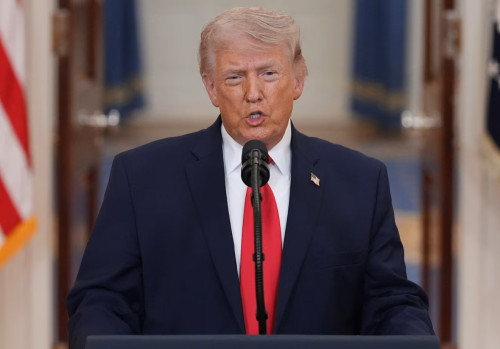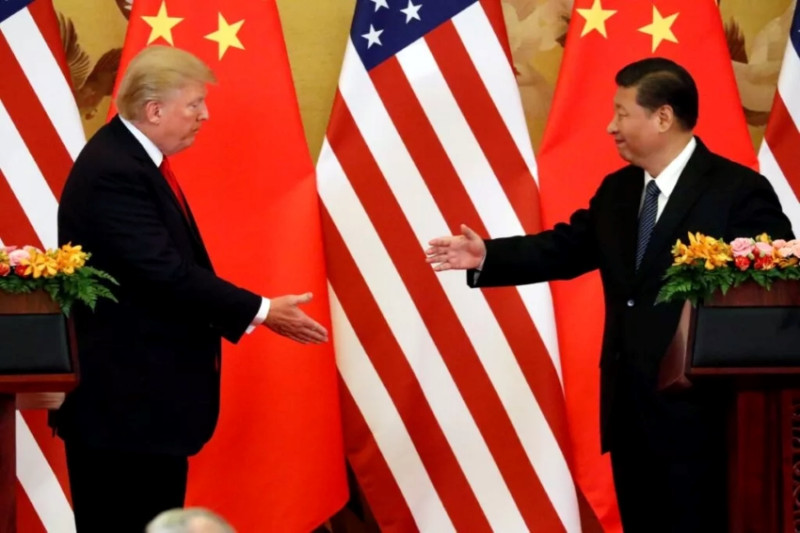
A DEAL getting the fragile truce in the U.S.-China trade war back on track is done, U.S. President Donald Trump said on Wednesday, after negotiators from Washington and Beijing agreed on a framework covering tariff rates.
The deal also removes Chinese export restrictions on rare earths minerals and allows Chinese students access to U.S. universities.
Reuters reported today that Trump took to his social media platform to offer some of the first details to emerge from two days of marathon talks held in London that had, in the words of U.S. Commerce Secretary Howard Lutnick, put "meat on the bones" of an agreement reached last month in Geneva to ease bilateral retaliatory tariffs that had reached crushing triple-digit levels.
"Our deal with China is done, subject to final approval with President Xi and me," Trump said on the Truth Social platform. "Full magnets, and any necessary rare earths, will be supplied, up front, by China. Likewise, we will provide to China what was agreed to, including Chinese students using our colleges and universities (which has always been good with me!). We are getting a total of 55% tariffs, China is getting 10%."
A White House official said the 55% represents the sum of a baseline 10% "reciprocal" tariff Trump has imposed on goods imported from nearly all U.S. trading partners; 20% on all Chinese imports because of punitive measures Trump has imposed on China, Mexico and Canada associated with his accusation that the three facilitate the flow of the opioid fentanyl into the U.S.; and finally pre-existing 25% levies on imports from China that were put in place during Trump's first term in the White House.
Lutnick said the 55% rate for Chinese imports is now fixed and unalterable. Asked on Wednesday on CNBC if the tariff levels on China would not change, he said: "You can definitely say that."
Still, many specifics of the deal and details for how it would be implemented remain unclear.
U.S. Treasury Secretary Scott Bessent told U.S. senators that the deal would not reduce U.S. export restrictions on high-end artificial intelligence chips in return for access to Chinese rare earths.
"There is no quid pro quo in terms of chips for rare earths," Bessent told a Senate Appropriations subcommittee hearing.
China's commerce ministry did not immediately reply to a request for comment and more information.
Framework For A Deal
Officials from the two superpowers had gathered at a rushed meeting in London starting on Monday following a call last week between Trump and Chinese leader Xi Jinping that broke a standoff that had developed just weeks after the preliminary deal reached in Geneva that had defused their trade war.
The Geneva deal had faltered over China's continued curbs on critical minerals exports, prompting the Trump administration to respond with export controls preventing shipments of semiconductor design software, jet engines for Chinese-made planes and other goods to China.
Lutnick said the agreement reached in London would remove restrictions on Chinese exports of rare earths minerals and magnets and some of the recent U.S. export restrictions "in a balanced way," but did not provide details after the talks concluded around midnight London time (7 p.m. EDT).
"We have reached a framework to implement the Geneva consensus and the call between the two presidents," Lutnick said, adding that both sides will now return to present the framework to their respective presidents for approvals.
"And if that is approved, we will then implement the framework," he said.
In a separate briefing, China's Vice Commerce Minister Li Chenggang also said a trade framework had been reached in principle that would be taken back to U.S. and Chinese leaders.
Chart shows China's share in the global rare earths reserves and mining and refining production.
Chart shows China's share in the global rare earths reserves and mining and refining production.
Back To Square One
Trump's shifting tariff policies have roiled global markets, sparked congestion and confusion in major ports, and cost companies tens of billions of dollars in lost sales and higher costs.
U.S. stocks drifted lower on Wednesday but have recouped most of the losses suffered earlier in the spring during Trump's wave of tariff announcements.
"It's a done deal, according to President Trump, but we haven't seen any details, which is why I think the market is not reacting to it yet. As with just about everything, the devil is in the details," said Oliver Pursche, senior vice president and adviser at Wealthspire Advisors in Westport, Connecticut.
The World Bank on Tuesday slashed its global growth forecast for 2025 by four-tenths of a percentage point to 2.3%, saying higher tariffs and heightened uncertainty posed a "significant headwind" for nearly all economies.
The U.S.-China deal may keep the Geneva agreement from unravelling over duelling export controls, but does little to resolve deep differences over Trump's unilateral tariffs and longstanding U.S. complaints about China's state-led, export-driven economic model.
"If China will course correct by upholding its end of the initial trade agreement we outlined in Geneva - and I believe after our talks in London, they will - then the rebalancing of the world's...two largest economies is possible," Bessent told a separate House of Representatives hearing hours after returning from the London talks.
The two sides left Geneva with fundamentally different views of the terms of that agreement and needed to be more specific on required actions, said Josh Lipsky, senior director of the Atlantic Council's GeoEconomics Center in Washington.
"They are back to square one, but that's much better than square zero," Lipsky added.
It was not immediately clear from Trump's comments where things stood regarding the timeline for a more comprehensive deal that had been reached last month in Geneva, a deadline set at that time for August 10. - June 12, 2025