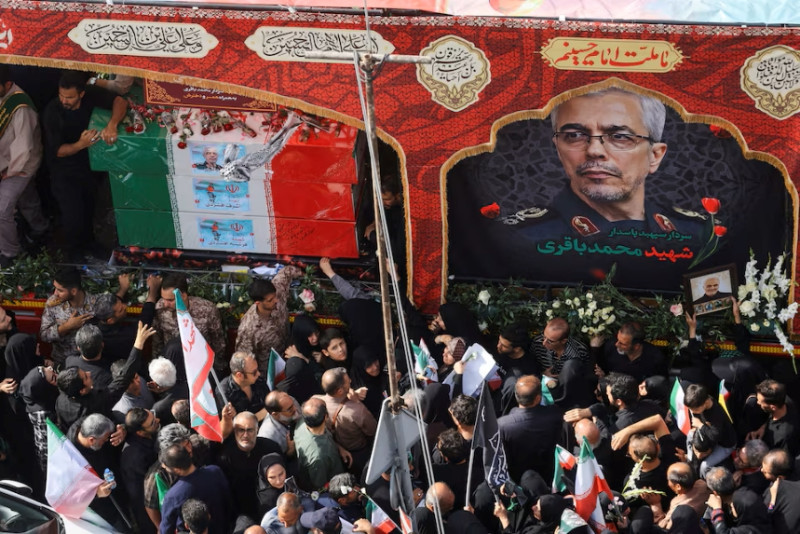
MOURNERS dressed in black lined streets in Iran's capital Tehran at a funeral on Saturday for top military commanders, nuclear scientists and some of the civilians killed during this month's war with Israel.
At least 16 scientists and 10 senior commanders were among those mourned at the funeral, according to state media, including armed forces chief Major General Mohammad Bagheri, Revolutionary Guards commander General Hossein Salami, and Guards Aerospace Force chief General Amir Ali Hajizadeh.
Their coffins were driven into Tehran's Azadi Square adorned with their pictures as well as rose petals and flowers, as crowds waved Iranian flags. State-run Press TV showed an image of ballistic missiles on display.
State TV said the funeral, dubbed the "funeral procession of the Martyrs of Power", was held for a total of 60 people killed in the war, including four women and four children.
Attending the funeral were President Masoud Pezeshkian and other senior figures including Ali Shamkhani, who was seriously wounded during the conflict and is an adviser to Iran's Supreme Leader Ayatollah Ali Khamenei.
Bagheri, Salami and Hajizadeh were killed on June 13, the first day of the war.
Israel, the only Middle Eastern country widely believed to have nuclear weapons, said its war against regional rival Iran aimed to prevent Tehran from developing its own nuclear weapons.
Iran denies having a nuclear weapons program. The U.N. nuclear watchdog, which carries out inspections in Iran, has said it has "no credible indication" of an active, coordinated weapons programme in Iran.
A senior Israeli military official said on Friday that Israel had killed more than 30 senior security officials and 11 senior nuclear scientists during the war.
According to Iranian health ministry figures, 610 people were killed on the Iranian side in the 12-day war, 13 of them children and 49 women, before a ceasefire went into effect on Tuesday. More than 4,700 were injured.
Activist news agency HRANA put the number of killed at 974, including 387 civilians while Israel's health ministry said 28 were killed in Israel and 3,238 injured. - June 28, 2025