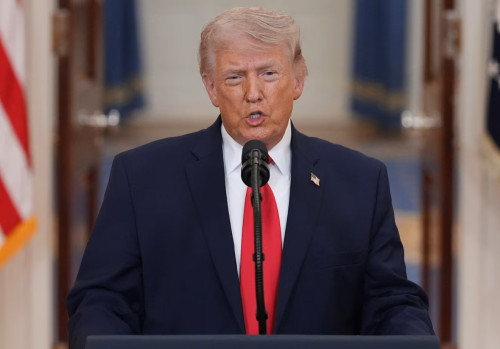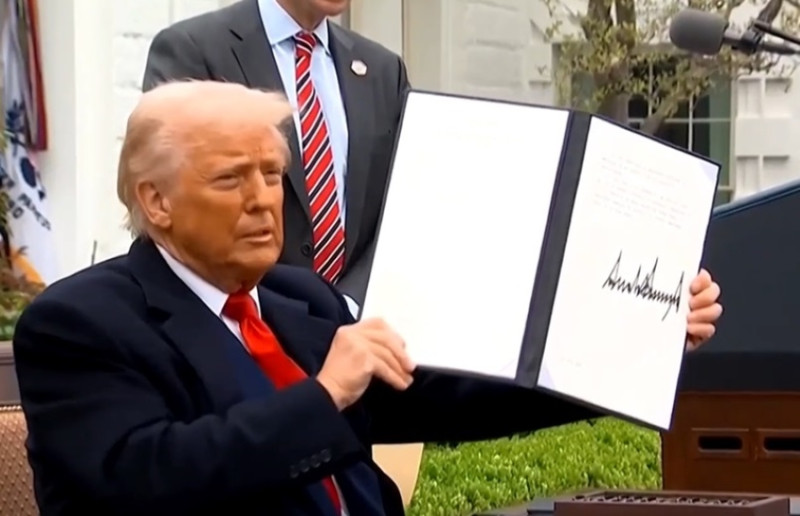
A DIVIDED U.S. appeals court ruled on Friday that most of Donald Trump's tariffs are illegal, undercutting the Republican president's use of the levies as a key international economic policy tool.
Reuters reported today that the court allowed the tariffs to remain in place through October 14 to give the Trump administration a chance to file an appeal with the U.S. Supreme Court.
Jumpstart your morning with the latest legal news delivered straight to your inbox from The Daily Docket newsletter. Sign up here.
The decision comes as a legal fight over the independence of the Federal Reserve also seems bound for the Supreme Court, setting up an unprecedented legal showdown this year over Trump's entire economic policy.
Trump has made tariffs a pillar of U.S. foreign policy in his second term, using them to exert political pressure and renegotiate trade deals with countries that export goods to the United States.
The tariffs have given the Trump administration leverage to extract economic concessions from trading partners but have also increased volatility in financial markets.
Trump lamented the decision by what he called a "highly partisan" court, posting on Truth Social: "If these Tariffs ever went away, it would be a total disaster for the Country."
He nonetheless predicted a reversal, saying he expected tariffs to benefit the country "with the help of the Supreme Court."
The 7-4 decision from the U.S. Court of Appeals for the Federal Circuit in Washington, D.C., addressed the legality of what Trump calls "reciprocal" tariffs imposed as part of his trade war in April, as well as a separate set of tariffs imposed in February against China, Canada and Mexico.
Democratic presidents appointed six judges in the majority and two judges who dissented, while Republican presidents appointed one judge in the majority and two dissenters.
The court's decision does not impact tariffs issued under other legal authority, such as Trump's tariffs on steel and aluminium imports.
Unusual And Extraordinary
Trump justified both sets of tariffs - as well as more recent levies - under the International Emergency Economic Powers Act. IEEPA gives the president the power to address "unusual and extraordinary" threats during national emergencies.
"The statute bestows significant authority on the President to undertake a number of actions in response to a declared national emergency, but none of these actions explicitly include the power to impose tariffs, duties, or the like, or the power to tax," the court said.
"It seems unlikely that Congress intended, in enacting IEEPA, to depart from its past practice and grant the President unlimited authority to impose tariffs."
The 1977 law had historically been used for imposing sanctions on enemies or freezing their assets. Trump, the first president to use IEEPA to impose tariffs, says the measures were justified given trade imbalances, declining U.S. manufacturing power and the cross-border flow of drugs.
Trump's Department of Justice has argued that the law allows tariffs under emergency provisions that authorize a president to "regulate" imports or block them completely.
Trump declared a national emergency in April over the fact that the U.S. imports more than it exports, as the nation has done for decades. Trump said the persistent trade deficit was undermining U.S. manufacturing capability and military readiness.
Trump said the February tariffs against China, Canada and Mexico were appropriate because those countries were not doing enough to stop illegal fentanyl from crossing U.S. borders, an assertion the countries have denied.
More Uncertainty
William Reinsch, a former senior Commerce Department official now with the Center on Strategic and International Studies, said the Trump administration had been bracing for this ruling. "It's common knowledge the administration has been anticipating this outcome and is preparing a Plan B, presumably to keep the tariffs in place via other statutes."
There was little reaction to the ruling in after-hours stock trading.
"The last thing the market or corporate America needs is more uncertainty on trade," said Art Hogan, chief market strategist at B. Riley Wealth.
Trump is also locked in a legal battle to remove Federal Reserve Governor Lisa Cook, potentially ending the central bank's independence.
"I think it puts Trump's entire economic agenda on a potential collision course with the Supreme Court. It's unlike anything we've seen ever," said Josh Lipsky, chair of international economics at the Atlantic Council.
The 6-3 conservative majority Supreme Court has issued a series of rulings favoring Trump's second term agenda but has also in recent years been hostile to expansive interpretations of old statutes to provide presidents newly-found powers.
The appeals court ruling stems from two cases, one brought by five small U.S. businesses and the other by 12 Democratic-led U.S. states, which argued that IEEPA does not authorize tariffs.
The Constitution grants Congress, not the president, the authority to issue taxes and tariffs, and any delegation of that authority must be both explicit and limited, according to the lawsuits.
The New York-based U.S. Court of International Trade ruled against Trump's tariff policies on May 28, saying the president had exceeded his authority when he imposed both sets of challenged tariffs. The three-judge panel included a judge who was appointed by Trump in his first term.
Another court in Washington ruled that IEEPA does not authorize Trump's tariffs, and the government has appealed that decision as well. At least eight lawsuits have challenged Trump's tariff policies, including one filed by the state of California. - August 30, 2025